
Brawby Storm Spill Reduction (2026)
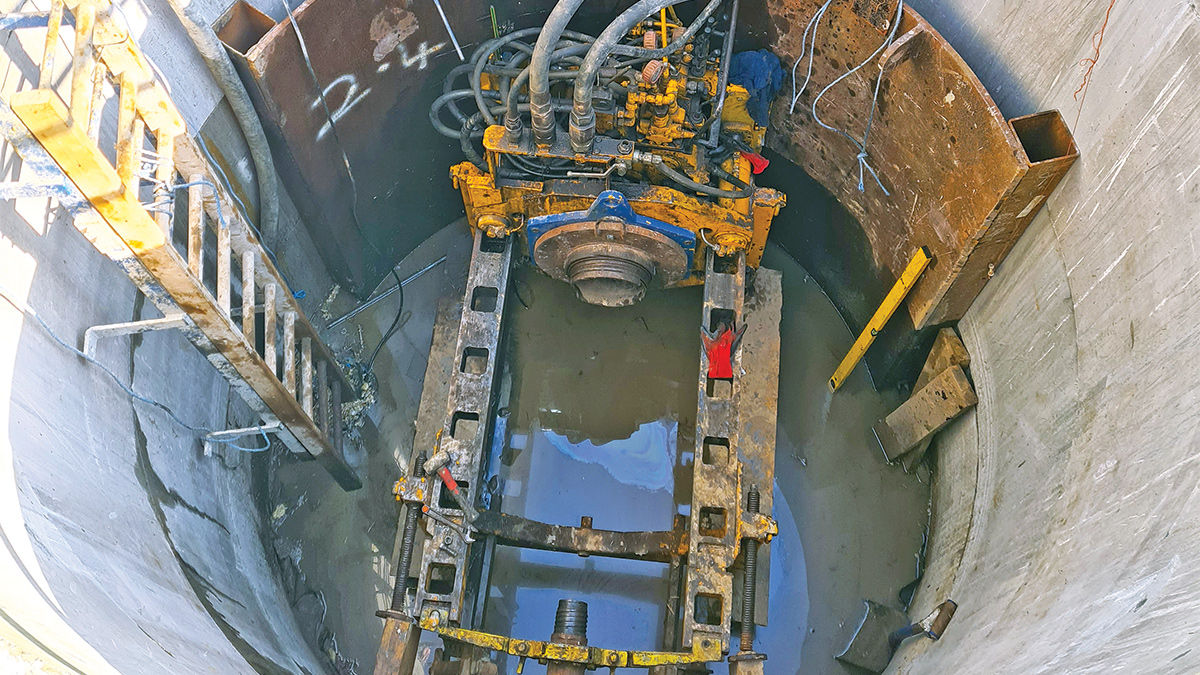
Auger boring from one manhole to another - Courtesy of Mott MacDonald Bentley
Brawby is a village in North Yorkshire that has historically experienced fluvial flooding, and more recently surface water flooding due to increased population and housing growth. The village is located on flat ground adjacent to the River Seven and is protected by a flood bund constructed in the 1940s. Historically, all highway drainage discharged into a combined sewer system leading to a small sewage treatment works, which was frequently overwhelmed and resulted in the discharge of untreated sewage to the environment. As part of Yorkshire Water’s Storm Spill Reduction Programme, Mott MacDonald Bentley (MMB) has designed and constructed a new surface water sewer and pumping station. Delivered predominantly using tunnelling techniques, the scheme diverts surface water flows directly to the river, bypassing the sewage treatment works.
Background and planning
Brawby STW was identified by Yorkshire Water as a frequent source of sewage spills. Investigations by MMB determined that the primary cause was an increase in surface water flows overwhelming the treatment capacity of the works, resulting in discharges via the storm system.
The issue was exacerbated by the receiving watercourse, a poorly maintained ditch connected to the River Seven via a flap valve. During periods of high river levels, the ditch was unable to drain, causing the STW outfall to become surcharged. In extreme events, this resulted in sewage backing up into the village streets.
To address this, MMB proposed the construction of a new surface water sewer to separate surface water from foul flows and discharge it directly to the river.
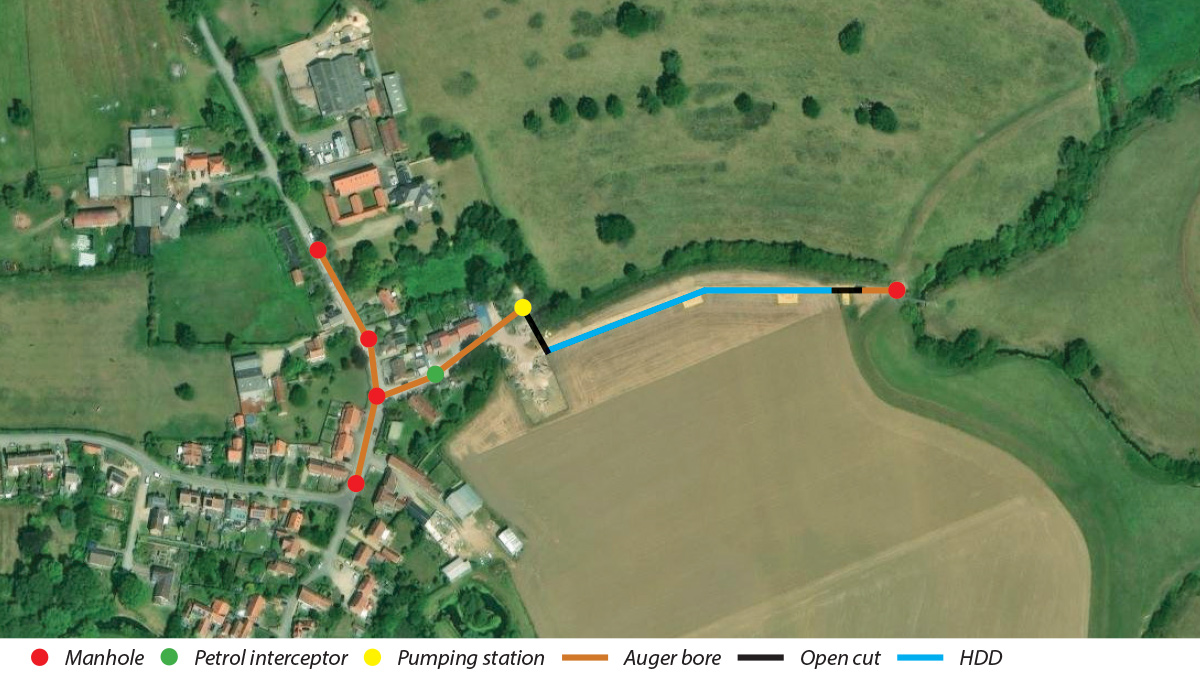
Overview of the project – Courtesy of MMB
Due to the very flat topography of Brawby, typical of the Vale of Pickering, a pumping station was required to convey flows to the discharge point.
The pumping station would be located within the STW boundary and designed as a caisson shaft to minimise the working footprint on the constrained site. Sections of the new sewer would be constructed using auger boring, with the rising main installed via horizontal directional drilling (HDD), reducing disruption to local residents.
Design & construction
Design commenced in October 2024, with beneficial completion required by March 2025 to meet Ofwat AMP7 requirements. To achieve the accelerated programme, the design was developed and delivered in stages in close collaboration with Yorkshire Water. The civil design was submitted eight weeks after project initiation, with the MEICA design submitted a further two months later; both were accepted first time.
MMB worked closely with the Environment Agency (EA) to secure the Flood Risk Activity Permit (FRAP) required to construct the discharge chamber through the flood bund. While FRAP approvals can typically be a lengthy process, the project aligned directly with the EA’s objectives for waste and water quality, providing confidence that consent could be achieved within the programme constraints.
Specialist tunnelling contractor, HB Tunnelling Ltd, was engaged early to support delivery of the caisson shaft, auger bores and the horizontal directional drilling works. This early collaboration delivered immediate benefits, including a proposal to enlarge one shaft so it could also be used as the auger boring launch point, eliminating the need for a temporary launch pit.
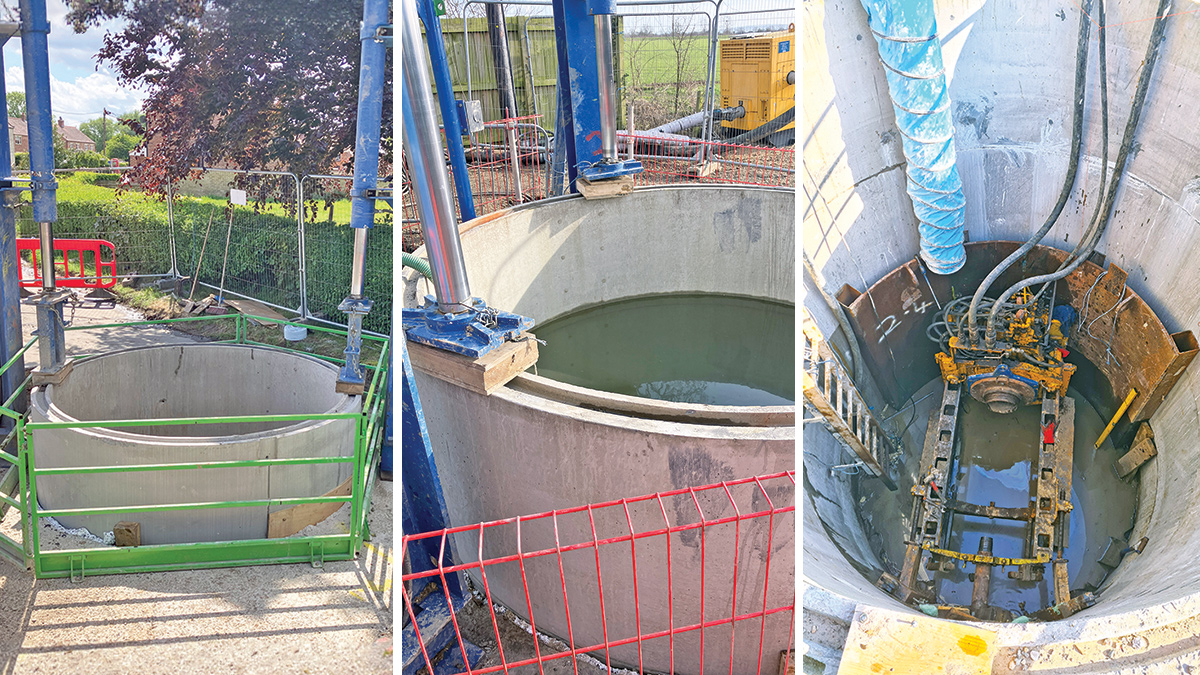
(left) Sinking a manhole as a caisson shaft, (middle) groundwater rising above ground level, and (right) auger boring from one manhole to another – Courtesy of Mott MacDonald Bentley
During construction, groundwater levels were encountered significantly higher than indicated by the ground investigation. Following a review of the borehole logs, the design team concluded that an artesian aquifer is present beneath Brawby, exposed during excavation for a manhole. As conventional construction methods became unworkable, MMB and HB Tunnelling Ltd jointly developed an alternative approach: installing all manholes as caisson shafts and auger boring the sewer between them. As a result, the scope increased from two caisson shafts to six, and from 75m of auger bored sewer to 225m.
As constructed, the system operates as follows:
- Surface water is collected via highway gullies and conveyed into the new sewer network.
- Flows combine into a single pipeline and pass through a petrol interceptor located beneath the road, removing hydrocarbons and silt from the flow.
- The stormwater then discharges into a 5 m deep pumping station within the STW.
- Twin pumps transfer the flow through a rising main to a discharge chamber constructed within the existing flood bund.
- From here, the water gravitates through a flap valve into the River Seven.
Typically, in auger boring, thin steel casings are advanced through the ground behind the cutting head to form a temporary tunnel. Clay jacking pipes are then installed within the casing, which is removed at the reception shaft, leaving a spigot-and-socket pipeline in place. However, as auger bored systems do not incorporate conventional pipe bedding, the presence of loose sand introduced a risk of leakage due to ground movement.
To mitigate this, the steel casings were welded together in the launch pit to form a continuous pipe and were left in situ as the permanent sewer. Corrosion specialists from Mott MacDonald were engaged to verify that the steel pipeline would achieve the required 100-year design life for sewer infrastructure.
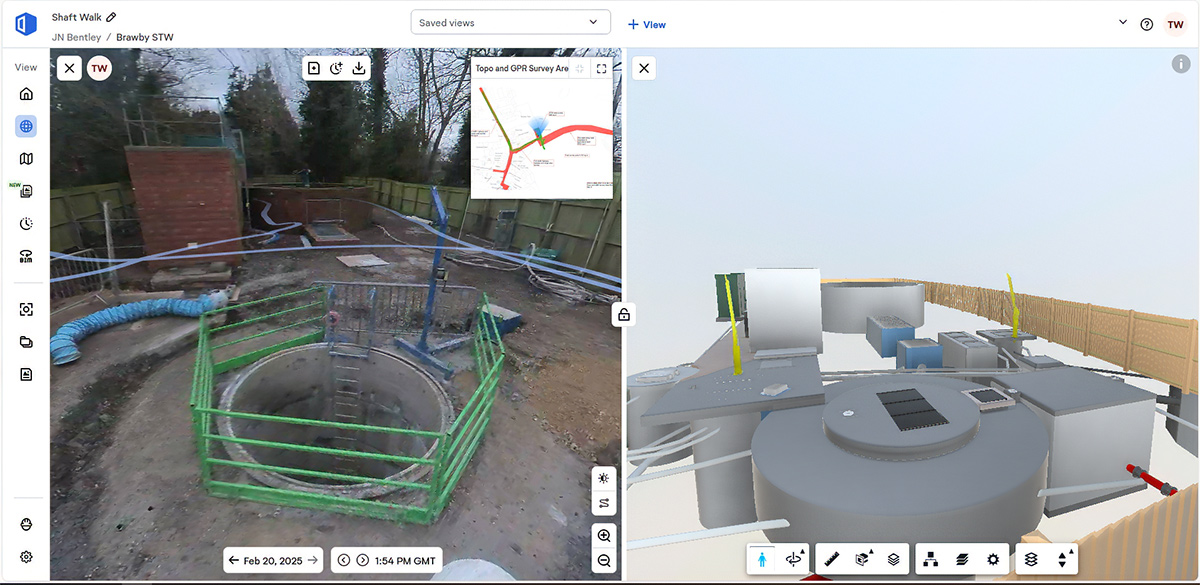
Comparison of construction progress against the design model – Courtesy of Mott MacDonald Bentley
Brawby Storm Spill Reduction: Supply chain – key participants
- Client: Yorkshire Water
- Principal designer: Mott MacDonald Bentley
- Principal contractor: JN Bentley
- Pipe corrosion advisor: Mott MacDonald
- Design/installation of caisson shafts, auger boring & horizontal directional drilling: HB Tunnelling Ltd
- Electrical installation: Circle Control & Design Systems
- Supply of petrol interceptor: Hydro International Ltd
- Submersible pumps: Xylem Water Solutions
- Valves: AVK UK Ltd
- MCC: CEMA Ltd
- Road surfacing: Calder C.A.D. Ltd
Community engagement
During construction, updates to the design and methodology created a perception among local residents that the project had stalled. To address this, Mott MacDonald Bentley (MMB) held a community drop-in session at the village hall, building on engagement undertaken at the start of construction. This provided an opportunity to answer questions, explain the evolving works, and maintain transparency with the local community.
Residents and local councillors were supportive of the scheme, despite the disruption caused by roadworks, recognising the long-term benefits it would deliver to the village. The positive relationship between the project team and the community was reflected in the rapport developed on site, with operatives receiving regular cake deliveries from residents!
Towards the end of the construction programme, MMB collaborated with the local highways authority to coordinate road reinstatement works. As the village roads were already scheduled for resurfacing, MMB reinstated the areas affected by construction up to an agreed extent, avoiding duplication of works and saving the local authority approximately 280m of road resurfacing work.
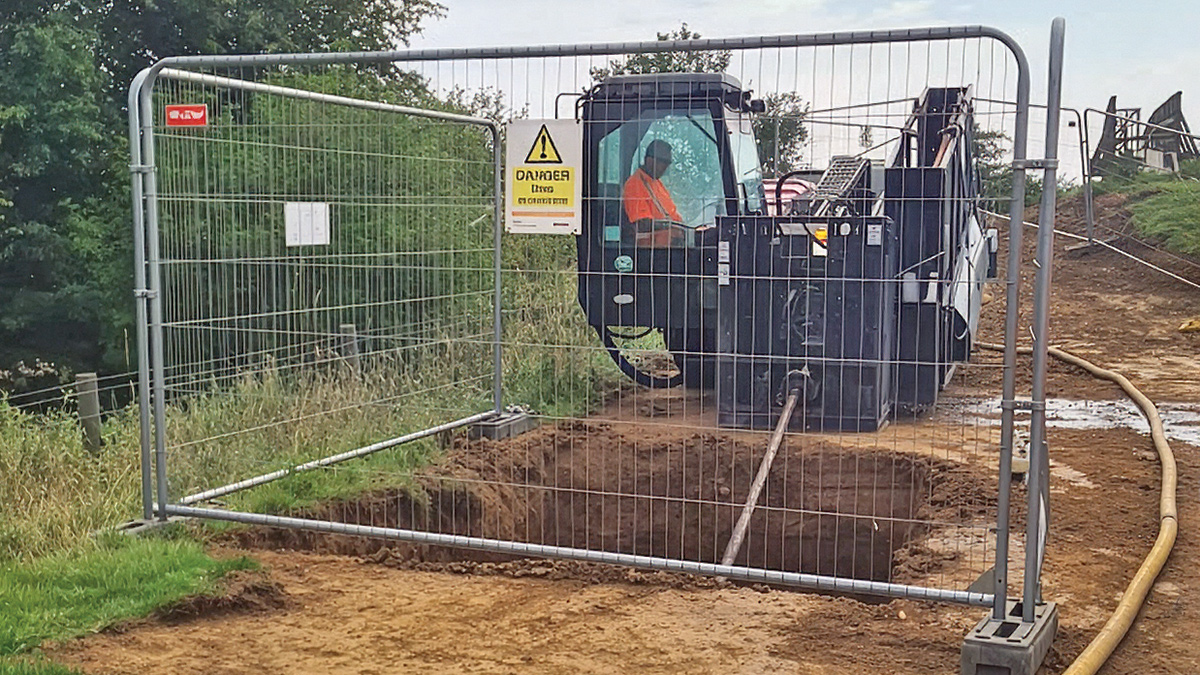
Horizontal directional drilling minimised disruption – Courtesy of Mott MacDonald Bentley
Conclusion
Construction was completed over a period of approximately one year, concluding in November 2025, and achieved a 100% record of ‘Perfect Days’. This reflects an exemplary safety performance, with no injuries, lost time incidents, environmental harm, dangerous occurrences, near misses, or utility strikes recorded throughout the project.
The site manager was supported by the Safety, Health, Environment and Quality (SHEQ) team, who conducted fortnightly site visits to inspect works and provide guidance. A strong safety culture was embedded across the entire project team, from office-based staff to site operatives, encouraging proactive reporting and continuous improvement by recognising both good practice and opportunities for enhancement.
From the outset of design, hazard and operability (HAZOP) studies, along with access, lifting and maintenance reviews, were undertaken collaboratively with Yorkshire Water. This ensured that risks to operators were eliminated or mitigated at the design stage, demonstrating a cradle-to-grave approach to safety.
Due to seasonal variations in rainfall, it is too early to quantify the full spill reduction performance of the system. However, early feedback from local residents indicates a significant reduction in flooding, suggesting that surface water flows which previously overwhelmed the treatment works and caused sewage spills are now being effectively intercepted and safely discharged to the river.
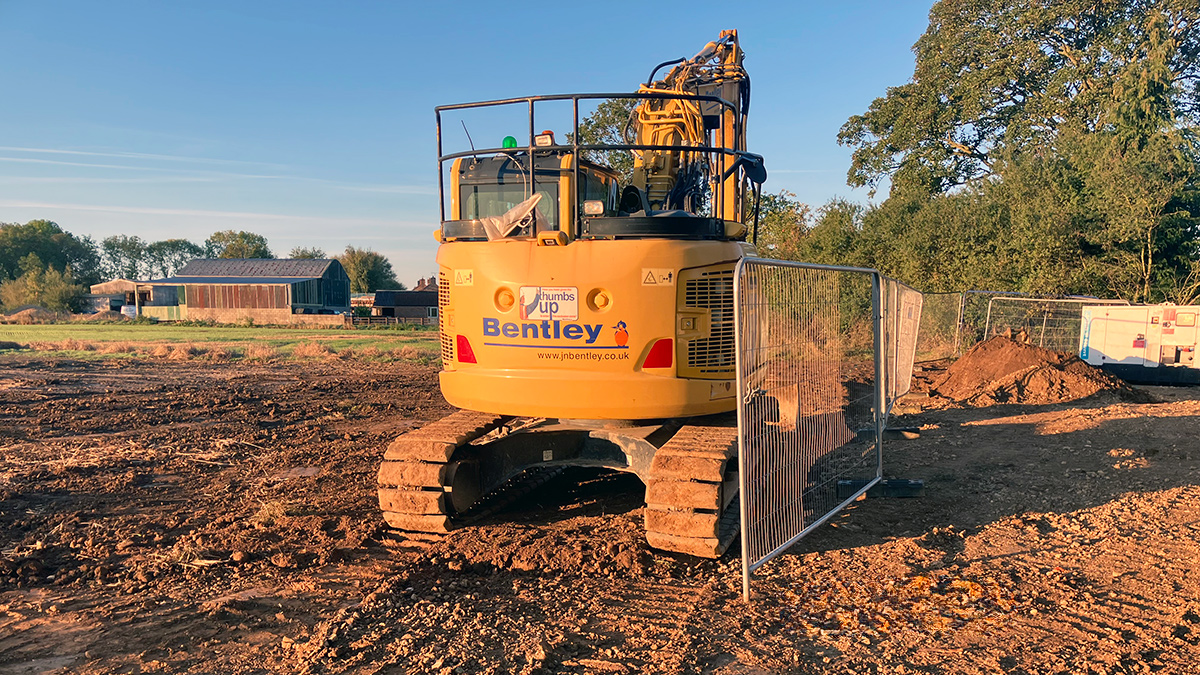
JN Bentley excavator reinstating the compound - Courtesy of Mott MacDonald Bentley