
Dundee Emergency Drought Mitigation Programme (2026)
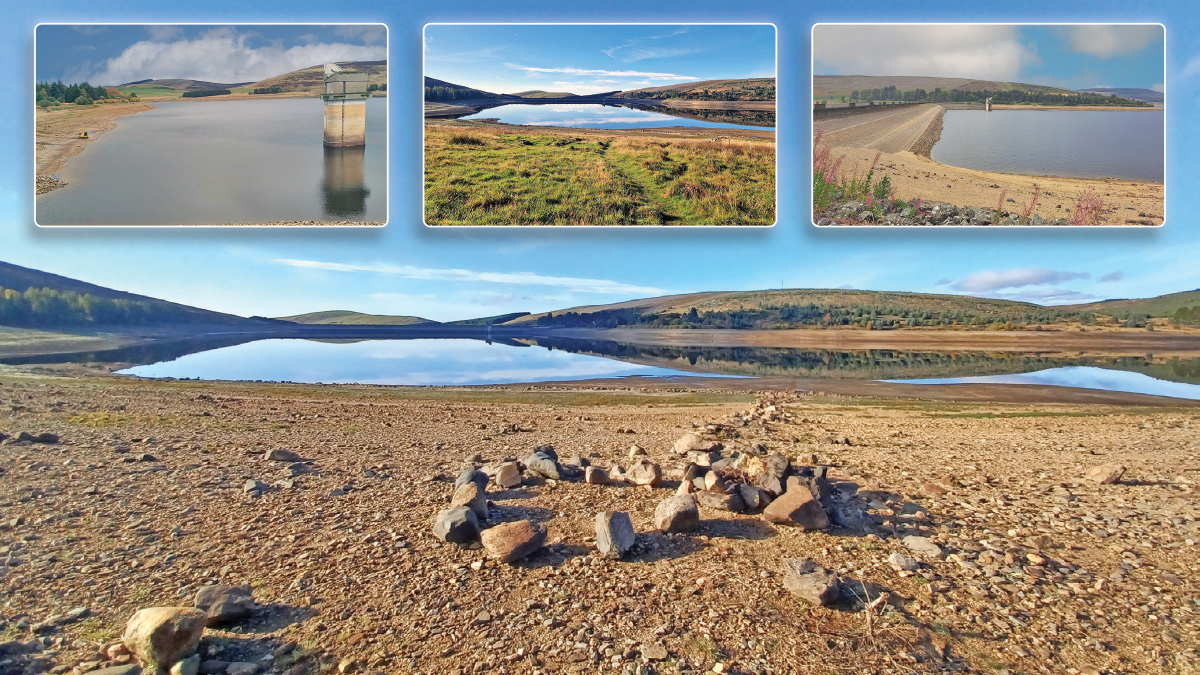
Examples of reservoir low water levels (October 2025) - Courtesy of Scottish Water
The Backwater and Lintrathen Water Resource Zone is currently in yield deficit, meaning that without investment, raw water stocks will be insufficient to meet demand in a severe drought event comparable to that of the worst historic drought. The reservoir system is susceptible to multi-season drought events, where reservoir levels are not guaranteed to recover during the winter recharge period. Recognising this vulnerability, Scottish Water initiated a programme of drought resilience measures designed to preserve reservoir storage, develop alternative sources of supply and improve operational flexibility across the network. The resulting Dundee Emergency Drought Mitigation Programme brought together a portfolio of projects aimed at reducing drought risk and protecting future supplies for 300,000 customers.
Background & recent history
A prolonged rainfall deficit during 2024 and 2025 significantly reduced inflows to the Backwater and Lintrathen reservoir system, with limited winter recharge to restore levels. The situation worsened during summer 2025 when an unprecedented algal bloom at Lintrathen Reservoir rendered the source unavailable for supply, increasing reliance on Backwater Reservoir. By October 2025, Backwater Reservoir had reached its lowest recorded level, creating a credible risk to the water supply if dry conditions were to persist through a second winter.
The position changed dramatically in January 2026 when rainfall reached 248% of the long-term average, resulting in the largest increase in reservoir storage since records began and significantly exceeding modelling projections.
While reservoir levels recovered, the events highlighted the vulnerability of the Backwater and Lintrathen Water Resource Zone to both prolonged drought and raw-water quality issues. In response, Scottish Water continued to develop a range of mitigation measures aimed at increasing system flexibility, preserving strategic storage and improving long-term resilience.
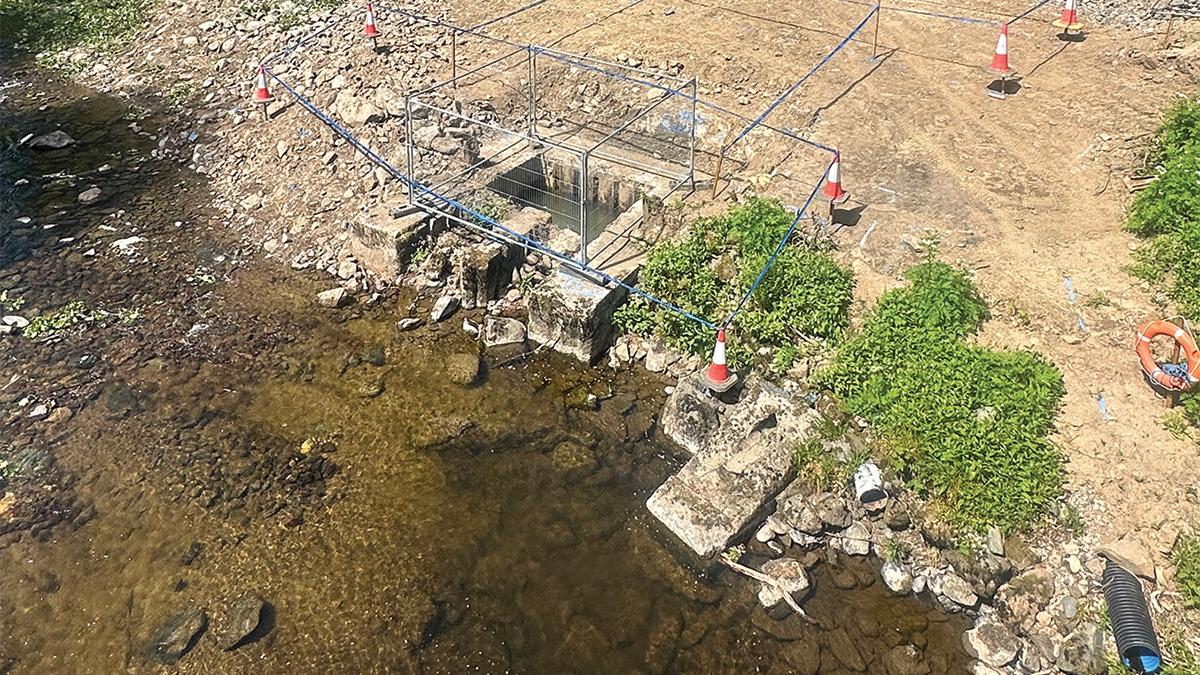
Existing abstraction structure from previous pumped line to Lintrathen WTW – Courtesy of Scottish Water
Methodology
Scottish Water’s normal approach to major capital investment is through a structured programme of planning, design and delivery. However, the escalating risk to water supplies during the 2025 drought required a more agile and accelerated approach. To enable rapid development and assessment of potential interventions, Scottish Water established a highly collaborative delivery model involving client, contractor, consultant and operational teams working in close partnership.
This approach allowed project scopes, costs, programme requirements and overall feasibility to be developed and reviewed at pace, enabling informed decisions to be made within compressed timescales. The programme was characterised by streamlined governance, integrated decision making and a shared focus on protecting supplies to customers. Key features of the delivery model included
- Updated emergency processes to allow ‘quick hit’ projects (less bureaucracy).
- More collaboration between operational, engineering and delivery teams which are normally remote.
- Co-location of Scottish Water and the contractor to support efficient communication and decision making.
- Dedicated technical, environmental, land and planning resources to accelerate project development
- Early and ongoing engagement with regulators and key stakeholders.
- Collaborative commercial arrangements that aligned objectives and supported programme flexibility.
By combining expertise from across multiple disciplines and organisations, the programme was able to investigate and, where appropriate, progress a range of drought mitigation measures at a pace not achievable through traditional capital delivery processes.
Drought interventions: Removing the potential for shortages
Between April and December 2025, Scottish Water evaluated five potential schemes aimed at strengthening future water resource resilience and reducing the risk of drought-related supply challenges. This case study examines the investigations, engineering works and feasibility assessments required for each option, and the technical, environmental, operational and economic considerations that informed decision making. It explores the outcomes of these assessments and explains how they ultimately determined whether each scheme was considered viable for progression to the next stage of development and if so, in what form.
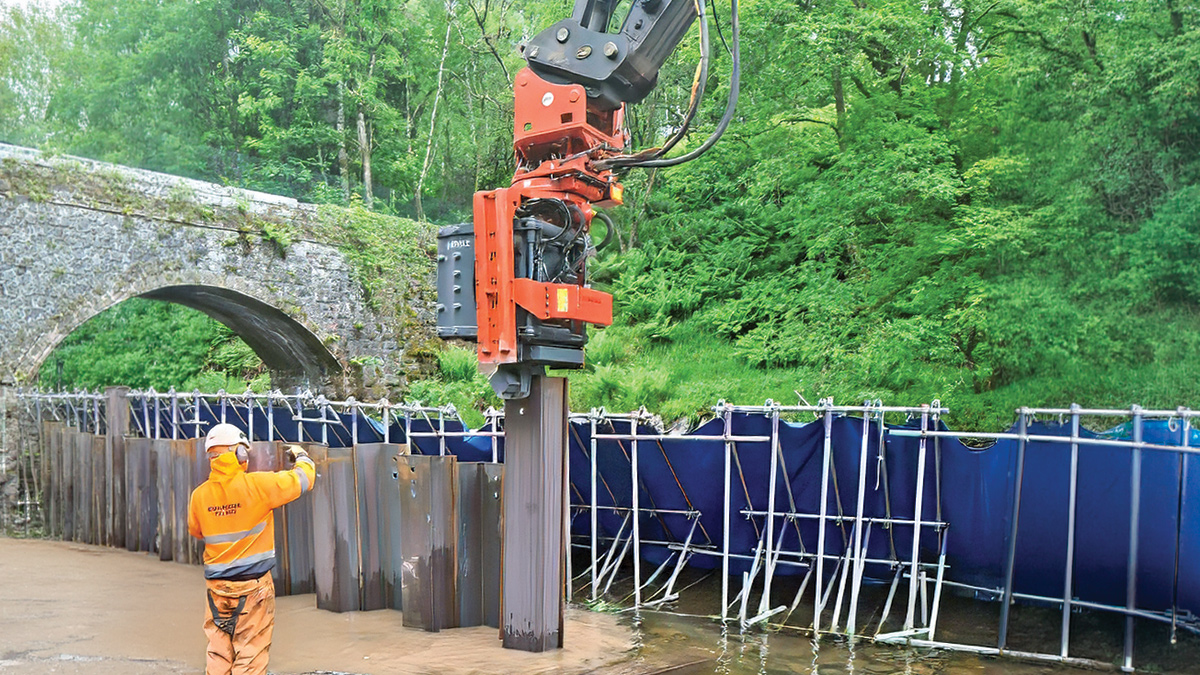
Sheet piling for cofferdam – Courtesy of Scottish Water
River Isla Abstraction: Compensation flow
This was the first project to start on site under a ‘blue light’ status in July 2025. The scheme was developed to preserve strategic storage within the Backwater and Lintrathen reservoir system by replacing compensation water releases from Lintrathen Reservoir with water abstracted from the nearby River Isla.
The proposal enables up to 18 MLD to be abstracted from the river and transferred to the Melgam Water upstream of the existing compensation weir. By maintaining the required compensation flow using river water, releases from Lintrathen Reservoir can be reduced or stopped, retaining valuable storage within the reservoir system during periods of drought. Operation of the scheme requires a temporary variation to the Environmental Authorisations (Scotland) Regulations (EASR) permit and approval from the Scottish Environment Protection Agency (SEPA).
The detailed scope was developed collaboratively between Scottish Water, Morrison Construction and AtkinsRéalis as the project progressed on site. Initially the main challenge of construction, both in terms of time and difficulty, was considered to be the installation of the 1.8km transfer pipeline running around the reservoir perimeter and as a result, early efforts focused on progressing this element of the works to reduce construction risk and maintain programme certainty.
River Isla Abstraction: Supply chain
- Main contractor: Morrison Construction
- Main designer: AtkinsRéalis
- Structural/civils design: AECOM
- Temporary works design: Groundforce
- Temporary works installation: Burnside Piling
- Temporary dam installation: Flexi Dam
- MEICA design: FerrierPumps
- Pumping solutions: Selwood
- Vegetation removal: Trees4Scotland
- Small plant hire: GAP Group
- Excavator hire: Blackwood Plant Hire
- Cabins: Wernick Hire
- ATVs: Rattery
- Tracked dumpers & forklift: Jarvie Plant
- ATV concrete mixer: Altrad Belle
As the design evolved, however, it became clear that the river intake, outfall arrangements and associated hydraulic infrastructure would present challenges of a similar scale. The abstraction infrastructure required extensive engagement with environmental stakeholders to secure approvals for both design and construction methodologies. Additional environmental constraints emerged following detailed site investigations, while the confined working areas created difficulties for access, material handling and construction activities. Uncertain ground conditions and the need for extensive temporary works within a flashy river environment further increased project complexity.
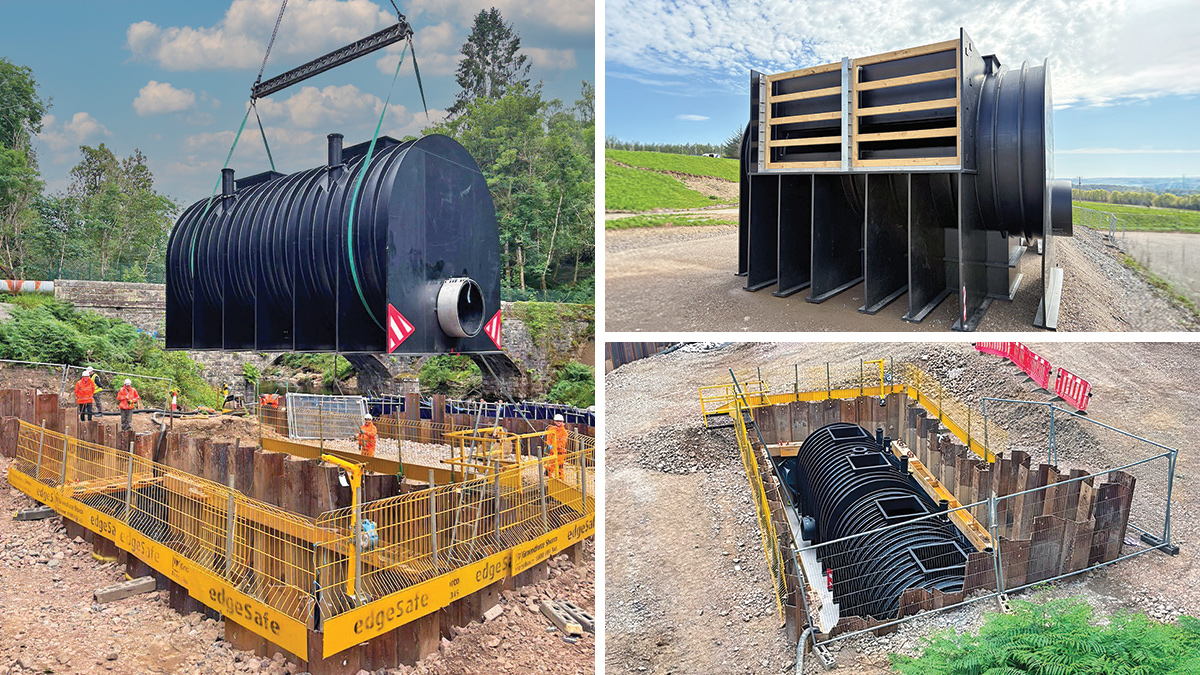
River Isla Abstraction: Installation of the wet well tanks – Courtesy of Scottish Water
River Isla Abstraction project scope:
- 1.8km of 400mm OD SDR 17 PE100 pipeline between the River Isla abstraction point and Lintrathen Loch compensation flow weir, including air valve and scours.
- Abstraction structures including:
- Intake chamber.
- Pumping well.
- Above-ground slab for temporary/permanent pumps.
- Manifold pipework.
- Break pressure chamber.
- Outfall structure.
- A two-way valve arrangement on the 1.8km 400mm OD SDR 17 PE100 transfer main, allowing for future adaptation of the River Isla Abstraction Scheme to enable direct transfer of water to Lintrathen Reservoir rather than solely providing compensation flows.
As of July 2026, construction remains ongoing, with commissioning scheduled for October 2026. Subject to SEPA authorisation, the scheme will provide a strategically important drought mitigation asset, capable of preserving reservoir storage during periods of peak summer demand when water resources are typically under greatest pressure.
Borrowfield Borehole: Supplement of supply
One of the indirect drought mitigation measures identified within Scottish Water’s Drought Plan was the reactivation of the former Borrowfield Borehole to support supplies within the Montrose SZ. By providing an alternative treated water source, the scheme would reduce dependency on water supplied from Lintrathen WTW, preserving resources within the Backwater-Lintrathen system during periods of drought.
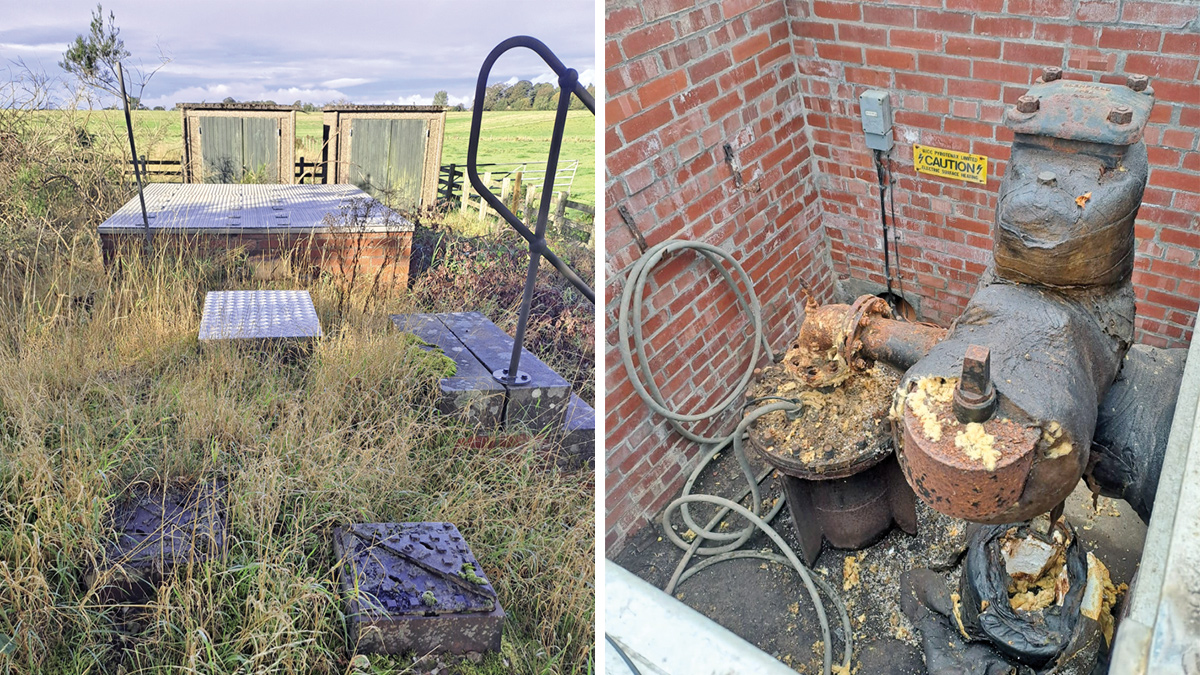
(left) The existing (out of service) Borrowfield borehole site and (right) the out of service Borrowfield borehole pumps – Courtesy of Scottish Water
The borehole had been out of service for approximately 20 years and therefore the initial phase of the project focused on determining whether the source could be safely and reliably returned to operation. Scottish Water’s DV2 framework contractor, RSE, engaged DrillCorp to undertake a series of investigations, supported by Scottish Water’s in-house hydrogeological specialists. The assessment programme comprised:
- Removal of existing borehole pumping infrastructure.
- CCTV inspection to confirm borehole depth and assess the condition of the lining.
- Test pumping and geophysical logging.
- Air-lift cleaning to remove accumulated sand and debris.
- Installation of a dedicated sampling point.
- Raw water quality sampling and analysis.
- Development of a 1.7km transfer main connecting the borehole to Hillhead DSR.
While investigation works were progressing, RSE simultaneously developed a conceptual design for a compact WTW capable of bringing the source into service. However, as water quality data became available and treatment requirements were refined, it became apparent that substantial infrastructure would be required to achieve compliance with current Drinking Water Quality Regulator for Scotland (DWQR) standards, which included sodium hypochlorite and orthophosphate dosing, a chlorine contact channel, a treated water distribution tank and pumping station, a break tank, and a new MCC kiosk
Although technical investigations demonstrated that the borehole could potentially be reinstated, the scale of treatment and network infrastructure required significantly increased project costs. When compared with the expected yield benefit and operational value delivered by the source, the business case could not be justified.
Consequently, the option was discounted from further development, demonstrating the importance of robust feasibility assessment in ensuring investment is directed towards drought mitigation measures capable of delivering the greatest resilience benefits.
Tay Bridge: Supplement of supply
Another option to improve network resilience was a strategic connection between Dundee and Fife via the Tay Road Bridge. The proposed link would enable treated water to be transferred between the Dundee and Fife Water Resource Zones, providing greater flexibility to balance supplies during periods of varying demand.
A similar connection had existed historically, prior to the amalgamation of the regional water councils into Scottish Water, with water exported from the former Tay regional council to Fife during peak demand periods. However, network improvements in Fife rendered the pipeline redundant and it was subsequently removed following modifications to the bridge infrastructure.

Duct beneath Tay road bridge – Courtesy of Scottish Water
The proposed works included installation of a new water main on the existing service channel of the bridge deck and connections to the existing networks on either side of the River Tay.
Productive discussions and site inspections were undertaken with the Tay Bridge management team to assess the feasibility of the crossing. However, constraints associated with ducting capacity, structural limitations and complex access requirements, together with the emergence of more cost-effective alternatives, resulted in the option not being progressed beyond the feasibility stage.
Lintrathen Direct Pumping: Adaptability of supply
A key limitation at Lintrathen WTW is the inability to utilise water from the adjacent Lintrathen Loch, despite its proximity and the existence of dedicated abstraction infrastructure. Although a pumping station was constructed in the 1980s for this purpose, it has remained out of service due to a long-standing operational preference for supplying the works from Backwater Reservoir.
Water from Lintrathen Loch has instead been directed to Clatto WTW, which has a larger filtration capacity so is better suited to managing the frequent algal blooms that occur within the loch.
To improve operational flexibility and provide an alternative raw water source, RSE was commissioned under an emergency project to assess the condition of the existing pumping infrastructure and develop a scheme to return it to service. The proposed works included refurbishment of the intake system, installation of replacement pumps capable of supplying up to 34 MLD, new pipework connections and a manifold arrangement linking into the existing network.
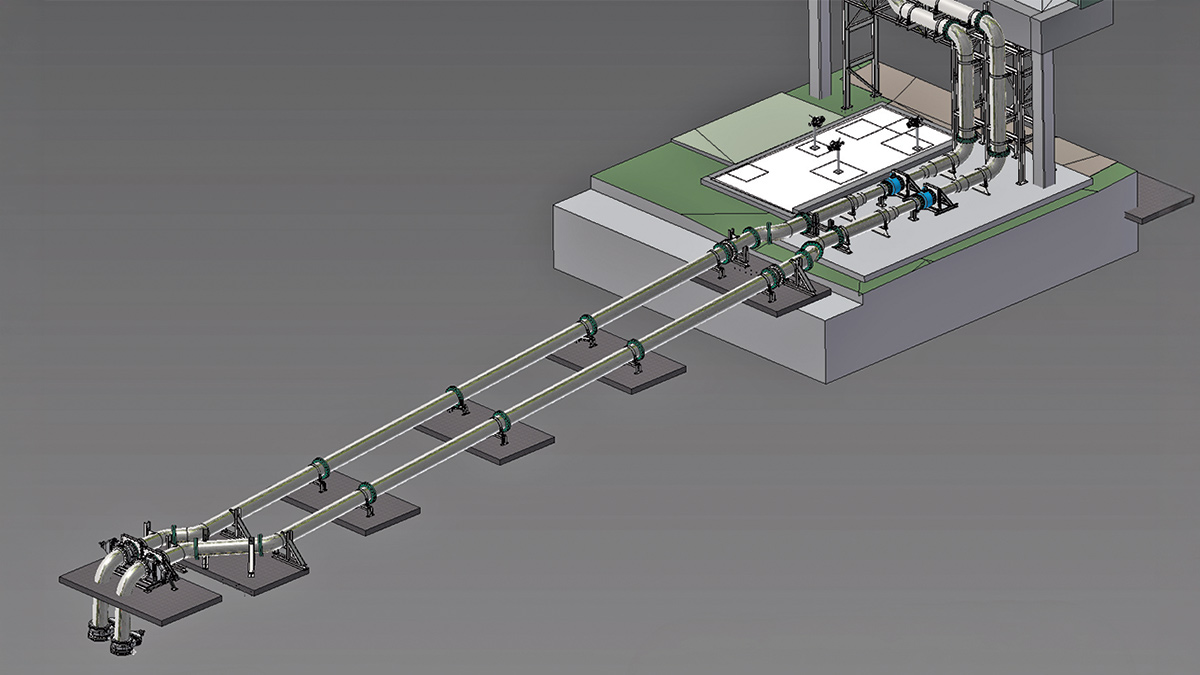
Lintrathen WTW pumping refurbishment: 3D model of the inlet to pumping station above-ground pipework – Courtesy of Scottish Water
While the project was targeted for delivery in early 2026, several technical challenges emerged during development including issues with the power supply, ageing infrastructure such as large valves and pipework, and supply lead times for new pumps and specialty above-ground pipework.
As of July 2026, the infrastructure is all now in place, however, commissioning is reliant on a full operational shutdown to provide the necessary backup power, and some minor repairs to the tunnel which supplies the pump well. These are both due to be completed by October.
Despite these challenges and the increased programme, the project is an important step towards increasing the adaptability and resilience of the raw water supply system. Fortunately, the level of emergency has reduced allowing for a more planned approach to completion.
Lintrathen Direct Pumping: Supply chain
- Main contractor: RSE
- Sheet piles & temporary works design: Groundforce
- Temporary over pumping system: Selwood
- Pipe cutting & hot tapping: Pipeline Services
- Supply of emergency pumps and VSDs: Xylem Water Solutions
- Control panels for emergency intake pumps: RSE Controls
- Craneage: Forsyth of Denny
Lintrathen Loch algae mitigation
During summer 2025, Lintrathen Loch experienced a significant algal bloom caused by a combination of high temperatures and low reservoir levels. The resulting deterioration in raw water quality restricted the use of the loch as a water source, with elevated algae concentrations creating treatment challenges at Clatto WTW and increasing pressure on regional water supplies.
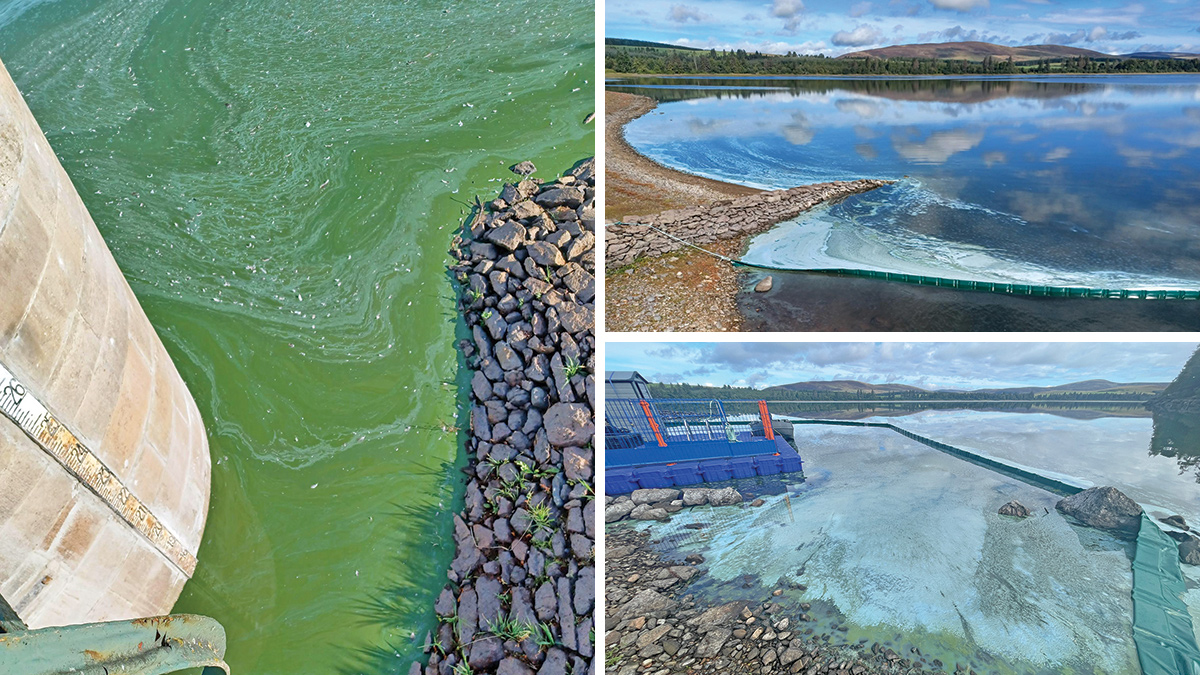
Algae in Lintrathen Loch (summer 2025) – Courtesy of Scottish Water
In response, Scottish Water commenced the development of a range of mitigation measures aimed at both controlling algal growth and reducing its impact on abstraction operations. Options under consideration include the deployment of floating straw bale arrays to naturally inhibit algae growth and a diffuser-based aeration system designed to increase dissolved oxygen levels, improve water circulation and discourage the formation of harmful blue-green algae blooms. The aeration system could also provide wider benefits, including improved water quality and reduced ice formation during winter months.
To protect treated water production, a separate option has been developed around the abstraction point. This involves installing a bubble curtain around the intake tower using existing compressed air infrastructure to create a physical barrier that limits algae entering the intake, while also promoting oxygen transfer and local mixing of reservoir water. Together, these measures aim to improve the resilience of the loch as a strategic water resource and reduce the operational risks associated with future algal bloom events.
Next steps
Next steps are to complete commissioning of the River Isla scheme, resolve outstanding technical constraints for Lintrathen direct pumping (including backup power and isolation), and confirm the preferred algae mitigation solution through design, licensing and trialling.
In parallel, the programme should capture lessons learned from ‘blue light’ delivery (governance, commercial approach and decision timelines) and translate these into a repeatable rapid-response framework. Maintaining momentum on these actions will improve drought resilience Scotland-wide, reduce the likelihood of demand restrictions, and provide a more robust long-term supply position for Dundee and surrounding communities.
Conclusion
The Dundee Emergency Drought Mitigation Programme highlights the scale and pace of intervention required to respond to a drought event that had the potential to exceed the worst on record. Success was achieved through rapid mobilisation, close collaboration between Scottish Water, delivery partners and operational teams, and early engagement with regulators and environmental stakeholders.
The programme encompasses a diverse portfolio of resilience measures, ranging from the major River Isla abstraction scheme, designed to preserve storage within the Dundee supply system (targeted for commissioning in October 2026), to investigations into alternative water sources such as the Borrowfield Borehole and Tay Bridge connection. Complementing these supply-focused projects are initiatives at Lintrathen aimed at improving operational flexibility and protecting raw water quality, including direct pumping proposals and algae mitigation measures.
Together, these interventions demonstrate how a combination of strategic planning, innovative engineering and collaborative delivery can strengthen the resilience of water infrastructure in the face of increasing drought risk and climate uncertainty, securing supply to Scottish Water’s customers.