
North Lodge Rising Main Relining Project (2026)
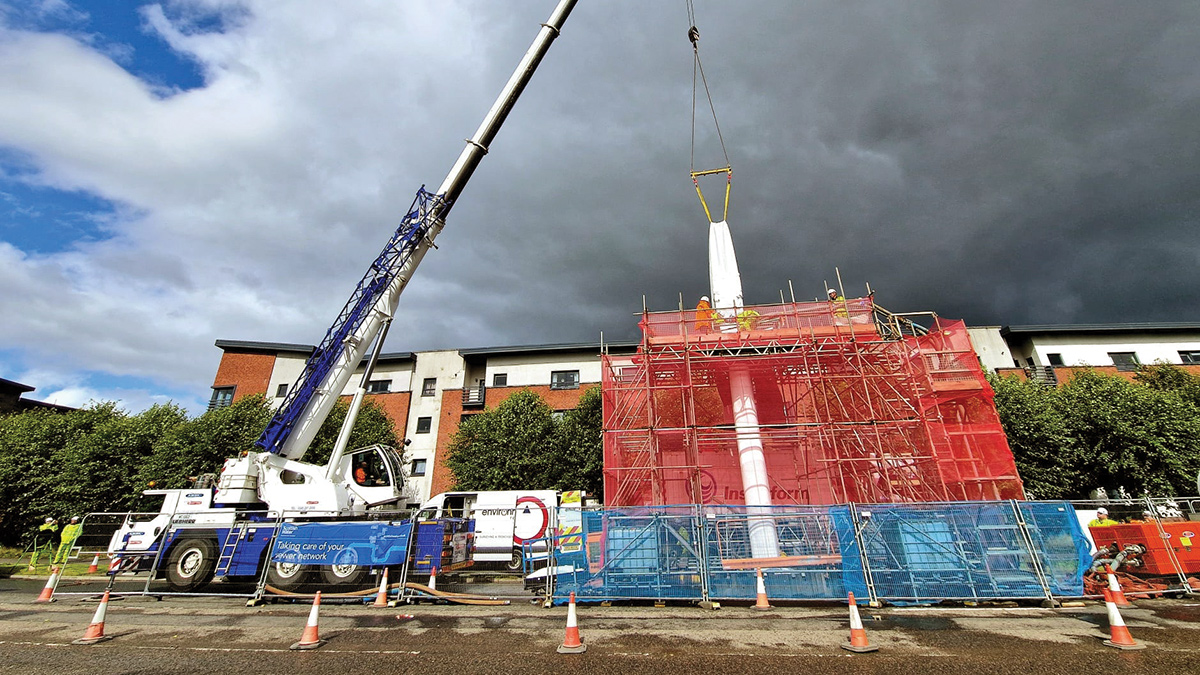
Phase 1 liner installation on Kings Inch Road - Courtesy of Environmental Techniques
The existing sewer along King’s Inch Road in Renfrew is a strategic sewer rising main 700mm taking all flows from North Lodge Pumping Station to Shieldhall Wastewater Treatment Works just to the east of Glasgow Airport. The existing trunk rising main had burst multiple times, creating a significant risk to the local community and environment. The sewer is a large pressurised rising main, meaning when failures occurred, the resulting flooding and pollution impacts could be substantial. Scottish Water took the decision to accelerate a £16m rehabilitation project to improve reliability in the sewer network, providing long-term resilience, reducing the risk of future bursts and lessening disruption for customers.
Planning & phasing
Scottish Water adopted a risk-based phasing strategy for the King’s Inch Road Rising Main Upgrade. Historical burst data and condition assessments were reviewed to identify areas of greatest structural deterioration. An 840m section, where the majority of failures had occurred, was selected as the first priority phase, along with two other phases totalling nearly 2km of pipework.
By targeting the highest-risk section first, Scottish Water was able to maximise the reduction in flooding and pollution risk while developing a longer-term programme to upgrade the remaining sections of the rising main.
Since the original installation of the rising main in the 1950s, new residential flats had been constructed parallel to the sewer rising main making the option to carry out a traditional open cut method more difficult.
Alliance Partner Caledonia Water, the client Scottish Water, and specialist supply chain partner Environmental Techniques Ltd reviewed how best to deliver the project. Rather than excavating the entire length of King’s Inch Road, the team chose a specialist trenchless relining solution instead of traditional open-cut replacement.
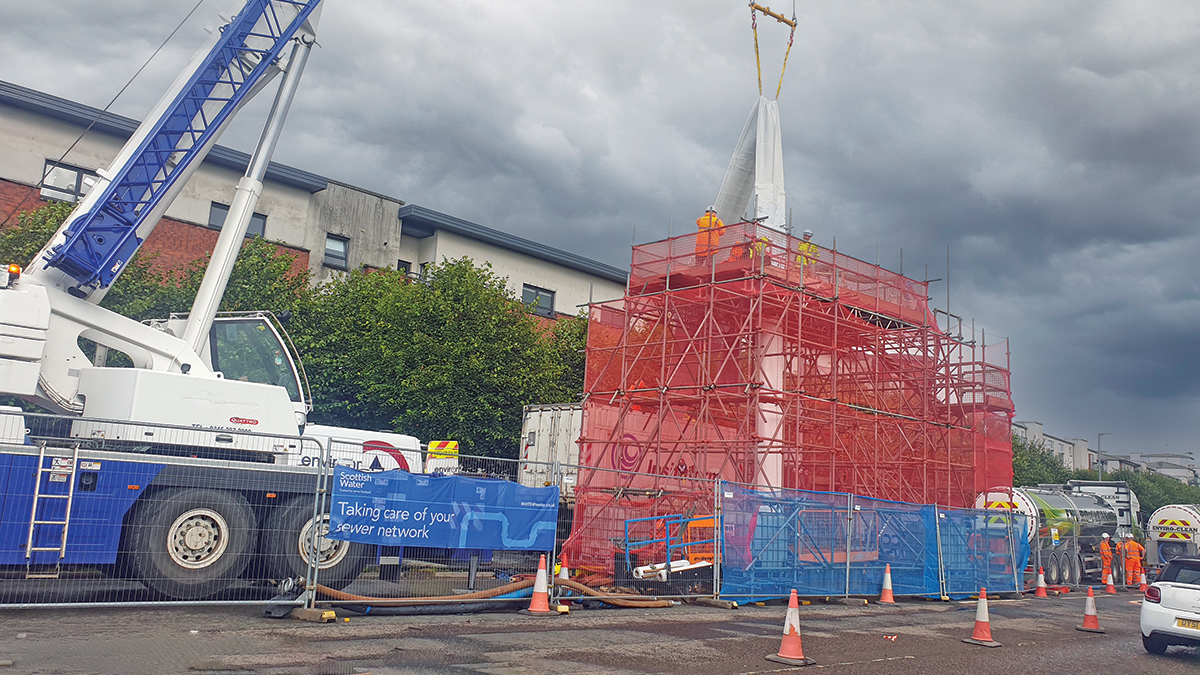
Phase 1 liner installation on Kings Inch Road – Courtesy of Caledonia Water Alliance
The technique would enable the existing pipe to be structurally renewed from a series of access pits, creating a new internal liner that would restore the pipe’s integrity and extend its service life.
Relining was chosen because it avoided excavating nearly 2km along King’s Inch Road, significantly reducing disruption to local residents, businesses, road users and underground utilities, while providing a long-term solution to repeated sewer bursts.
Project scope
- Lining of 1.71km of the existing 700mm diameter ductile iron rising main from North Lodge Pumping Station in three phases.
- Phase 1: 840m of cured-in-place-pipe (CIPP) lining by hot curing.
- Phase 2: 560m of CIPP lining.
- Phase 2a: 310m of UV lining.
- Excavation of 10 lining pits to enable lining in both directions.
- Three separate bypass installations for each of the three phases to enable overpumping of all flows during lining works.
- Planned shutdown to install valve arrangement for bypass installation for each phase.
- Installation of overland twin 450mm plastic pipe:
- Phase 1: 1,720m (2 x 860m lengths).
- Phase 2: 1,460m (2 x 730m lengths).
- Phase 2a: 640m (2 x 320m lengths)
Site investigation
Before the main construction works began, the team carried out investigations along King’s Inch Road to understand ground conditions, confirm the location of underground services, and plan the works safely.
This early phase included a small welfare setup, traffic management, Heras fencing, and controlled working areas to complete the investigation works safely alongside the live road and surrounding properties. The works included boreholes, trial pits, manhole and GPS surveys, and reinstatement of the areas disturbed during the investigations.
The trial pits helped the team confirm the location of existing services and assess where future lining pits and temporary bypass pipework would be required. The boreholes provided deeper ground information, helping the project team plan excavations, temporary works and construction methods before the main rehabilitation works began.
The information gathered during the site investigation stage reduced uncertainty before construction, enabling the project team to plan the lining works, temporary bypass arrangements, access routes, and reinstatement more safely and in a more coordinated manner.
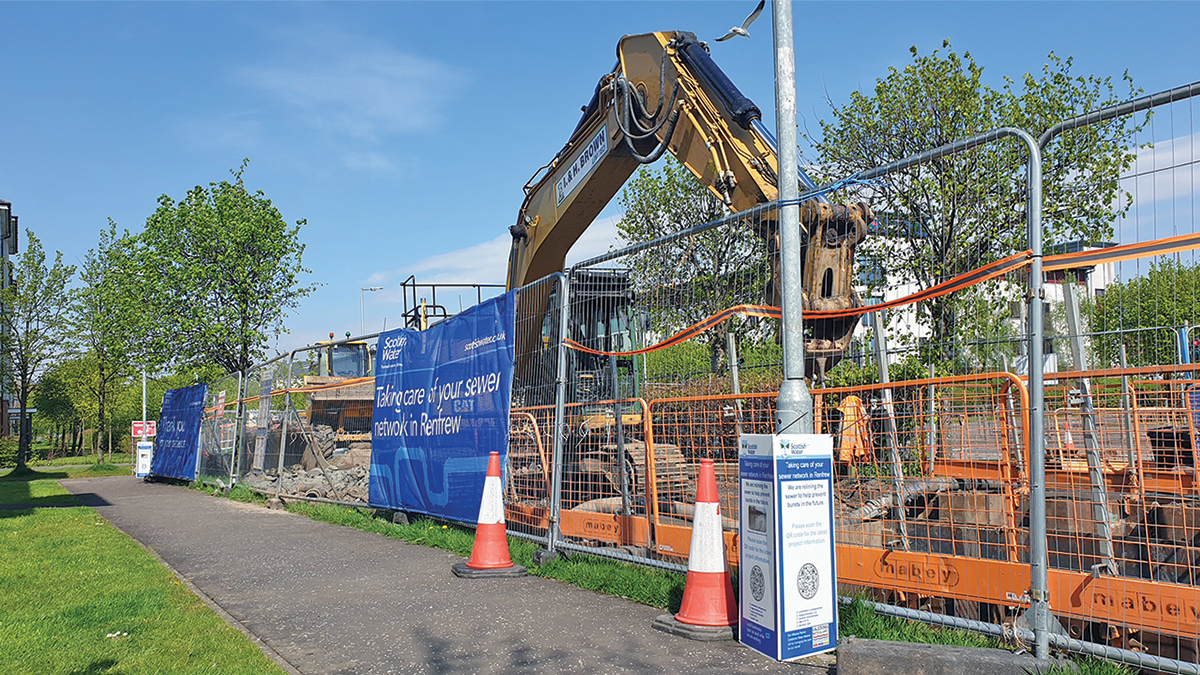
Relining pit on Kings Inch Road – Courtesy of Caledonia Water Alliance
Supply chain – key participants
- Project delivery: Caledonia Water Alliance
- AECOM
- M-Group Water
- Hot cure & UV relining main contractor: Environmental Techniques Ltd (ET)
- Hot cure relining: Insituform | RSM Lining Supplies
- UV relining: Reline UV Distribution
- Civils contractors: I&H Brown Ltd | Cleantech Civils Ltd
- Excavations & earthworks: Environmental Techniques Ltd
- Mechanical & electrical contractors: Electrical & Technical Services LTD (ETS)
- Tankering & drain-down: ET / Enviro-Clean (Scotland) Ltd
- Scaffolding: AHL Scaffolding Ltd | ET
- Temporary works/shoring: Mabey Hire Ltd | Groundforce | LB Foundations |
- Temporary pipe manufacturer: Saint Gobain PAM UK
- Valves: FPP Scotland Ltd
- Pipe cutting: ET | Swan Pipelines
- Plant hire: Bedrock Plant Hire Ltd
- Traffic management: Sunbelt Rentals
- Re-surfacing: Arbuckle McLean Ltd
- Vegetation management: Trees 4 Scotland
- Security: Prime Secure
- Fencing: Alter Supplies & Contracting | AIM Ltd
Overland temporary bypass pipe
One of the first major activities after establishing the site was installing the temporary bypass along King’s Inch Road. This bypass was designed to maintain all wastewater flows from North Lodge Wastewater Pumping Station while the existing rising main was taken out of service for relining.
The bypass comprised twin 450 mm-diameter HDPE pipes, delivered to site, positioned along the route, and butt-fusion welding in situ. This required careful planning and coordination because of the volume of pipework, the busy road environment, and the need to work at the bypass tie-in locations at each end of the section.
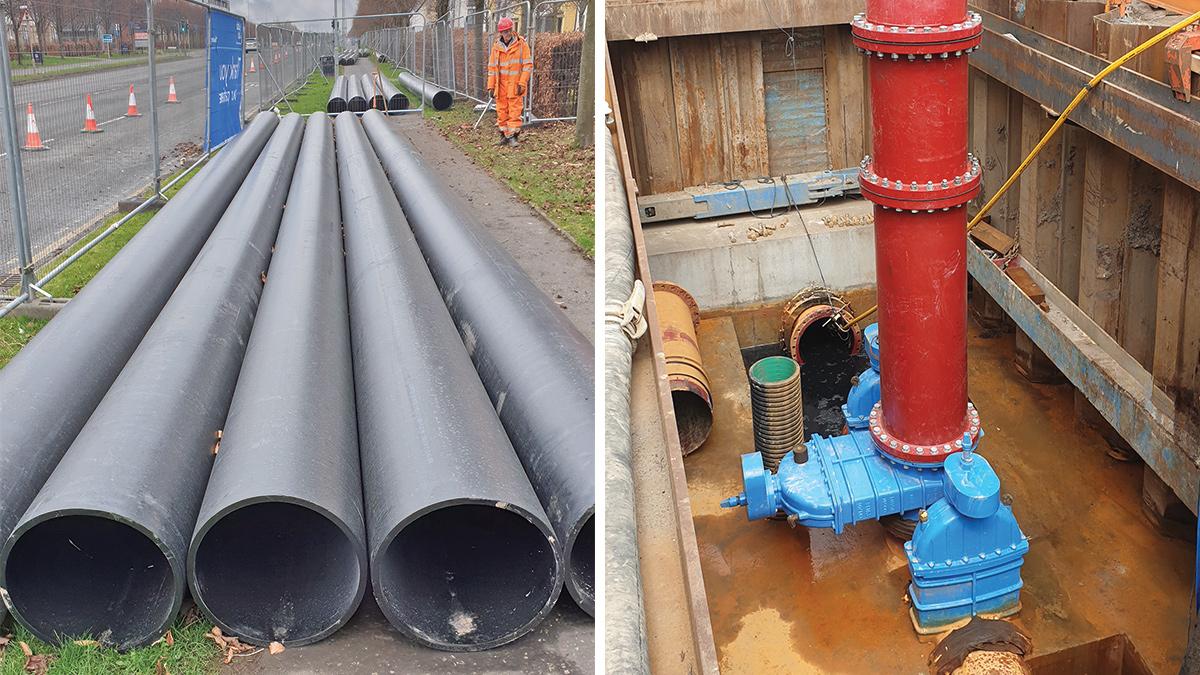
(left) Overland pipe laid out before being welded – Courtesy of Caledonia Water Alliance, and (right) tie in point for overland temporary bypass pipe – Courtesy of Environmental Techniques
To improve reliability and reduce the need for additional temporary pumping equipment, the project team excavated down to the existing rising main and tied the bypass into the live pumping station arrangement. This allowed the existing pumps at North Lodge Wastewater Pumping Station to continue operating during the works, rather than relying on temporary pumps. This approach reduced temporary plant requirements, fuel use and hire costs, with the resulting cost saving passed back to Scottish Water.
Once the bypass was installed, tested and operational, flows were safely diverted away from the section of rising main being relined. This protected the 840m section of main during the works and allowed the lining activities to be completed while maintaining wastewater service. Following successful testing of the upgraded main, flows were transferred back into the rehabilitated pipework, the temporary bypass was removed, and the affected road and community access arrangements were reinstated.
Hot-cure lining technique vs UV lining technique
Across the North Lodge Rising Main project, two pressure lining techniques were used: hot-cure lining and UV-cured lining. Both methods renew the pipe from the inside, creating a new fully structural liner within the existing rising main, and each technique is suited to different pipe and site conditions.
Hot-cure lining was used for the more challenging sections of the route. This method is particularly effective where the existing pipe has bends, ridges or minor changes in diameter. The liner is more forgiving during installation and can be designed to accommodate bends exceeding 45 degrees, making it well suited to older rising mains where the exact internal condition and alignment can vary.
A key achievement on the project was the installation of a 305m long, 700mm diameter hot-cure pressure liner. This was a significant installation and is understood to be among the longest large-diameter pressure liners of its type installed in the UK. The liner’s length and diameter required careful planning, specialist equipment, and close coordination among the design, site, and installation teams.
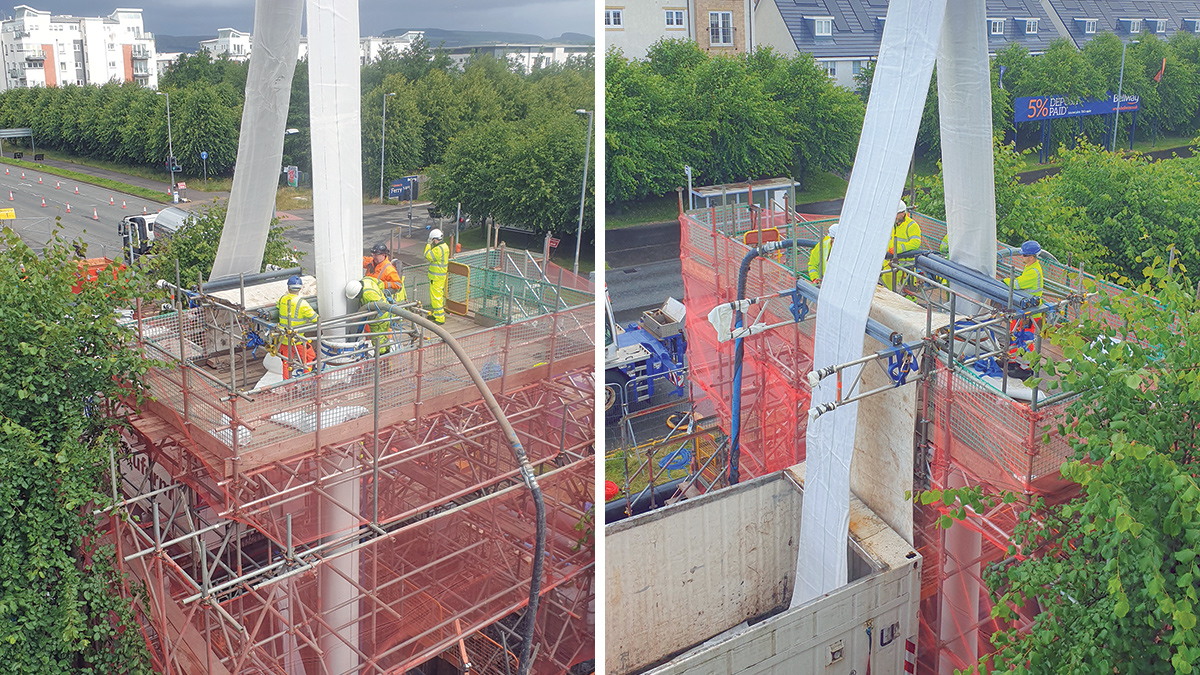
Phase 1 liner installation on Kings inch Road – Courtesy of Caledonia Water Alliance
For large-diameter pipes, hot-cure lining requires a more extensive setup than some other lining methods. A scaffold tower is used to generate the water pressure needed to invert the liner through the existing pipe. Once the liner is in position, a boiler unit heats the water to nearly 80°C, allowing the liner to cure in place. The curing process typically takes around eight hours, after which the pipe is left to cool naturally.
UV lining was used where the pipe alignment and internal conditions were better suited to this technique. UV liners are thinner than hot-cure liners and are highly effective on straight sections where the host pipe has no bends and the diameter remains consistent. Instead of being inverted with water pressure, the liner is winched into position, inflated with air, and cured using a UV light train pulled through the pipe by a specialist computer-controlled rig.
One advantage of UV lining is that it does not require a scaffold tower to generate installation pressure, as the liner is inflated with compressed air. This can reduce temporary works, plant requirements and working space where the pipe conditions are suitable. However, UV liners are less suited to significant bends or large changes in diameter, so they are not always the correct solution.
By using both techniques, the project team was able to select the most appropriate lining method for each phase of the works. Hot-cure lining provided flexibility and robustness for the more complex sections, while UV lining offered an efficient solution where the pipe alignment was straight and the diameter more consistent.
After completing both liner types, the ends were cut back, end seals were installed, and the newly lined sections were pressure-tested before the rising main was returned to service. This confirmed that each section had been correctly installed and could safely carry wastewater flows once back in operation.
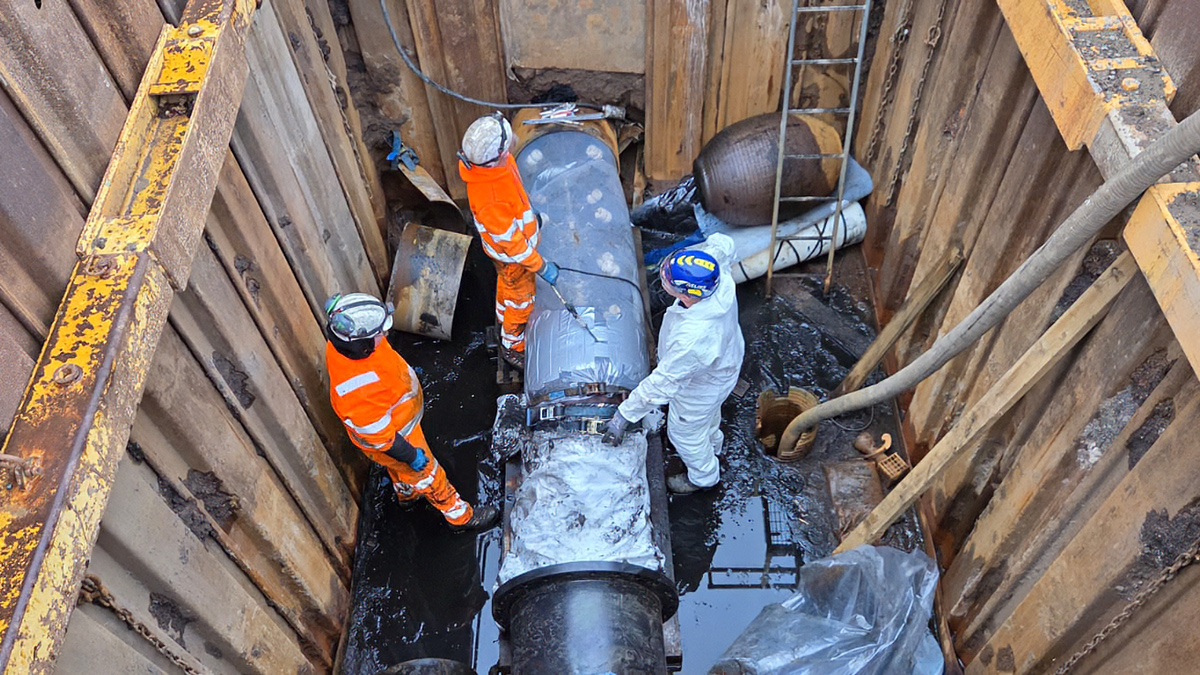
UV light train insertion – Courtesy of Environmental Techniques Ltd
Carbon reduction techniques/sustainable approach
The project delivered significant sustainability benefits by opting for trenchless relining rather than a full open-cut replacement. This enabled nearly 2km of 700mm rising main to be rehabilitated via a series of targeted access pits, thereby avoiding more than 1.6km of continuous excavation along King’s Inch Road.
A full replacement would have required larger road closures, significant quantities of new steel and HDPE pipework, disposal of excavated material, imported backfill and extensive reinstatement. By renewing the existing pipe from within, the project reduced material use, waste, vehicle movements, disruption and carbon emissions.
The temporary bypass was also planned to reduce reliance on diesel-powered temporary pumps. The team tied into the existing rising main and utilised the live North Lodge Pumping Station, enabling the mains-powered pumps to handle flows during the works. This reduced fuel use, emissions, hire costs and operational risk, with the savings passed back to Scottish Water.
The works were programmed so the phases ran back-to-back, allowing the same compound, welfare, fencing and core traffic management setup to be maintained rather than repeatedly established and removed. This reduced duplication, improved efficiency and created further savings through effective planning by the project management team.
Additional measures included connecting site cabins to the mains electricity supply to avoid using generators, using local suppliers where practical to reduce transport mileage, and purchasing temporary bypass pipework for reuse across phases.
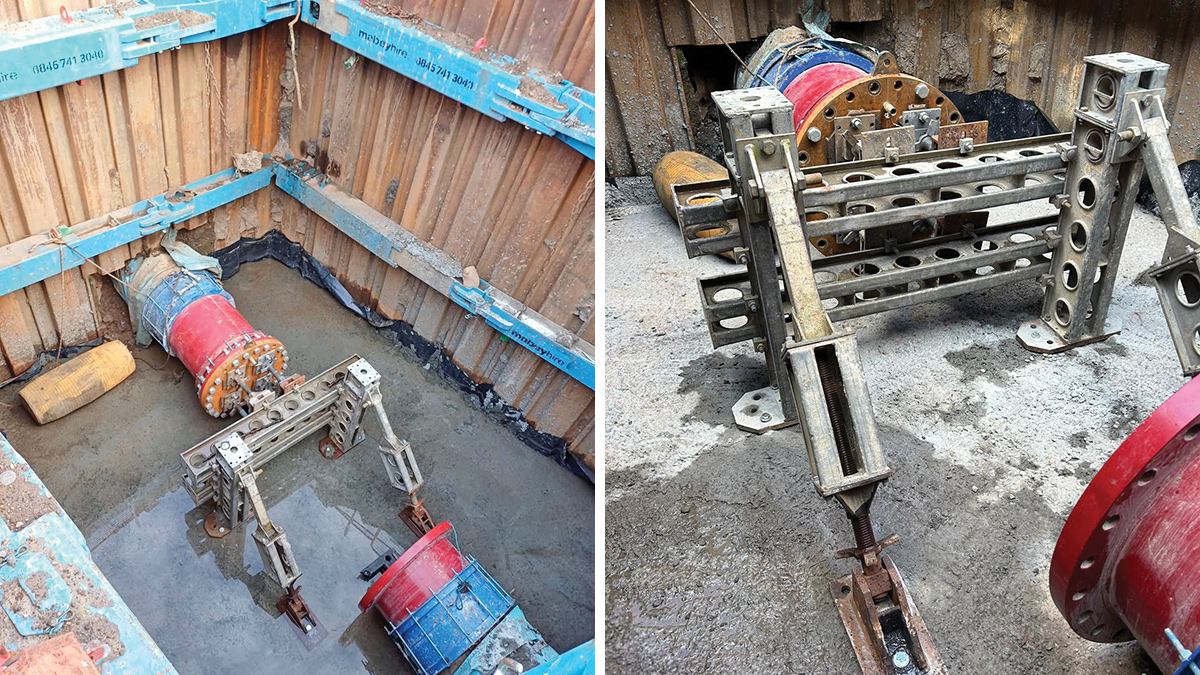
Pressure test bracing pit – Courtesy of Environmental Techniques Ltd
Reuse of the 450mm temporary bypass pipework
The overland twin 450mm bypass pipework was purchased for the project and, following completion of each phase, was dismantled, cut down and rewelded for reuse on subsequent phases. The pipework was successfully reused throughout all three phases of the Kings Inch Road project and was later deployed on a further project at Saltcoats. This reduced project costs while also lowering the overall carbon footprint.
Stakeholder engagement throughout planning & delivery
Due to the number of burst and pollution incidents in the past, there was significant concern in the community, so Scottish Water and Caledonia Water Alliance supported the affected customers and communities. A public information event was held at the Renfrew Town Hall before the work started, which was extremely well attended by residents, businesses and the local councillor, all of whom supported the work starting.
Conclusion/summary
- Project cost: £16m
- Start date – design: November 2023
- Start date – construction: January 2024
- Completion date: June 2026
The North Lodge Rising Main Relining Project has strengthened a critical section of Scottish Water’s wastewater network in Renfrew. By relining approximately 1.71km of the existing sewer rising main, the project has significantly reduced the risk of future bursts, flooding, and environmental pollution. Since completion, no bursts have occurred in the rehabilitated sections.
With a 50-year design life, the works will also reduce the likelihood of future emergency repairs, tanker responses, clean-up operations and unplanned road disruptions.
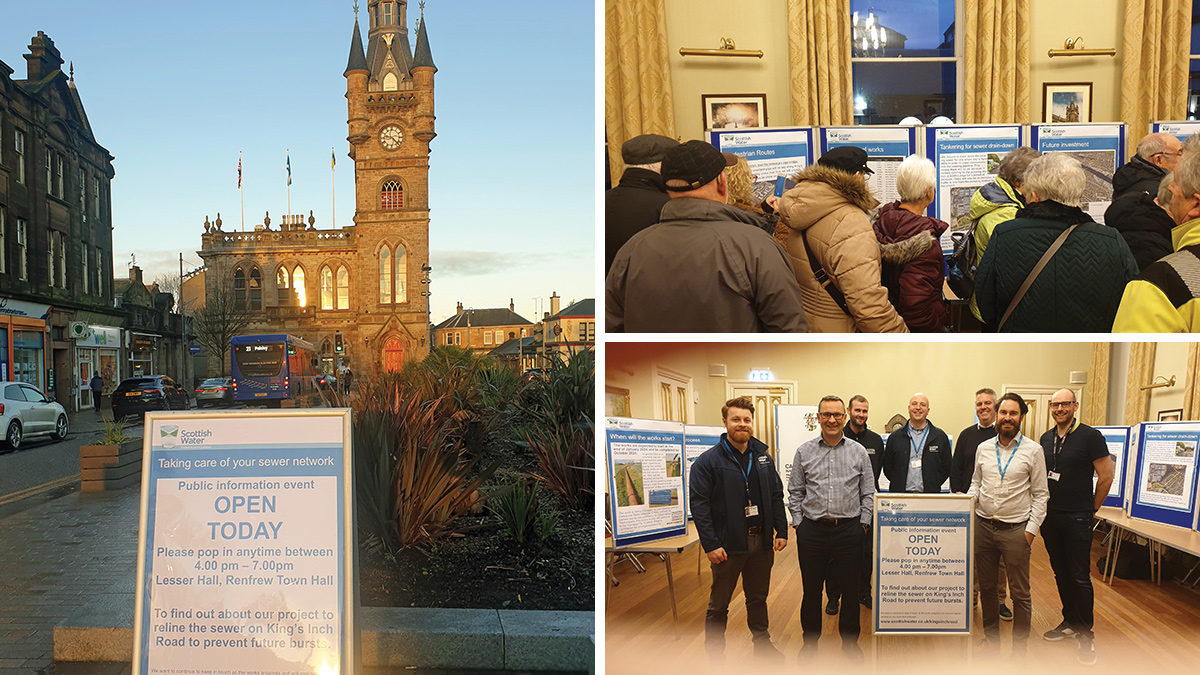
Community engagement – Couresy of Caledonia Water Alliance
Delivered using innovative trenchless technology, the project minimised disruption to local communities and road users, avoiding extensive excavation on King’s Inch Road.
Completed in June 2026, the £16m investment has enhanced the long-term resilience of a strategic sewer serving North Lodge Pumping Station. The upgraded asset provides greater structural integrity, improved environmental protection, and a reliable wastewater service for years to come, while demonstrating the value of collaboration among Scottish Water, Caledonia Water Alliance, and Environmental Techniques Ltd.