

Walton-on-the-Naze Storm Storage Enhancement (2026)

Breaking ground to start the underground storm tank works - Courtesy of @one Alliance
Walton-on-the-Naze is a coastal town in Essex where low-lying ground levels and a combined sewer network mean wastewater and storm flows are heavily influenced by rainfall. Walton Terminal Pumping Station plays a critical role in managing these flows, serving residential communities alongside seasonal increases in population driven by tourism. Flows collected within the network are ultimately conveyed towards the designated bathing waters at Walton and Frinton. These environmentally sensitive waters are subject to stringent bathing water regulations, meaning the performance of the wastewater network has a direct impact on water quality, public health and the reputation of the local coastline.
The issue
The existing wastewater system no longer provides sufficient storage capacity or operational flexibility to manage both current and future rainfall conditions. With limited storm storage, constrained pumping arrangements and increased pressure from more frequent and intense rainfall events, the system can become overwhelmed during periods of heavy rainfall. As a result, storm overflows currently operate more frequently than permitted under bathing water regulations.
Updated hydraulic modelling, incorporating future population growth, climate change allowances and long-term network changes, has demonstrated that without intervention the performance of the network would continue to deteriorate.
Any potential spill events have the potential to impact bathing water quality at Walton and Frinton, presenting environmental, operational and reputational challenges while increasing pressure on an already constrained wastewater network.
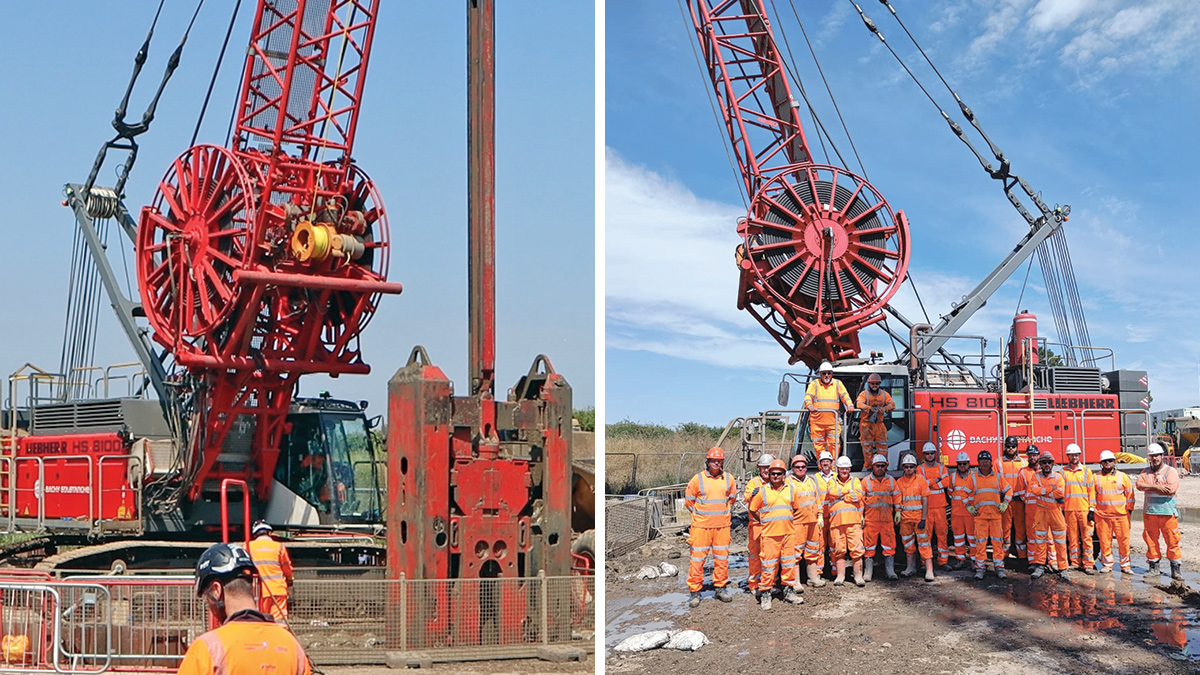
(left) Bachy Soletanche excavating the ground in preparation for the diaphragm walls to be placed and (right) Walton-on-the-Naze site team – Courtesy of @one Alliance
The project
Construction has commenced on the £18m Walton-on-the-Naze Storm Storage Enhancement Scheme to significantly increase storage capacity, improve operational control and strengthen the resilience of the wastewater network.
And as a key hydraulic control point within Anglian Water’s coastal wastewater network, Walton Terminal Pumping Station plays an important role in storing, managing and conveying storm flows during periods of heavy rainfall. Once complete, the scheme will provide a long-term solution that strengthens network resilience, supports environmental compliance and helps safe-guard one of the region’s most important coastal environments against future population growth and climate change.
This project represents a critical investment in protecting sensitive coastal waters while improving resilience across the wider catchment. Alongside the engineering challenge itself, the project must also be delivered while maintaining continuous operation of the existing terminal pumping station. Careful planning, innovative construction techniques and close collaboration between design, delivery and operational teams will ensure wastewater services continue uninterrupted throughout construction.
The solution
At the heart of the project is the construction of a new underground storm storage tank, located on land owned by Tendring District Council and currently used as overflow parking. The tank will measure approximately 38m long by 19m wide and 12m deep. At 4,805m3, it will provide a substantial increase in storage capacity while minimising the overall construction footprint.
The new storage tank will be hydraulically connected to the existing network via an 82m long, 1,200mm diameter gravity sewer, allowing excess storm flows to transfer into the new storage facility once existing capacity has been reached. Within the storm tank, a new bellmouth arrangement will improve hydraulic performance while retaining solids at source, reducing downstream sedimentation and supporting more efficient long-term maintenance. Storm flows will be returned to the wastewater network through a resilient duty/assist/standby pumping arrangement comprising three 9kW submersible pumps capable of returning flows of up to 110 litres per second.
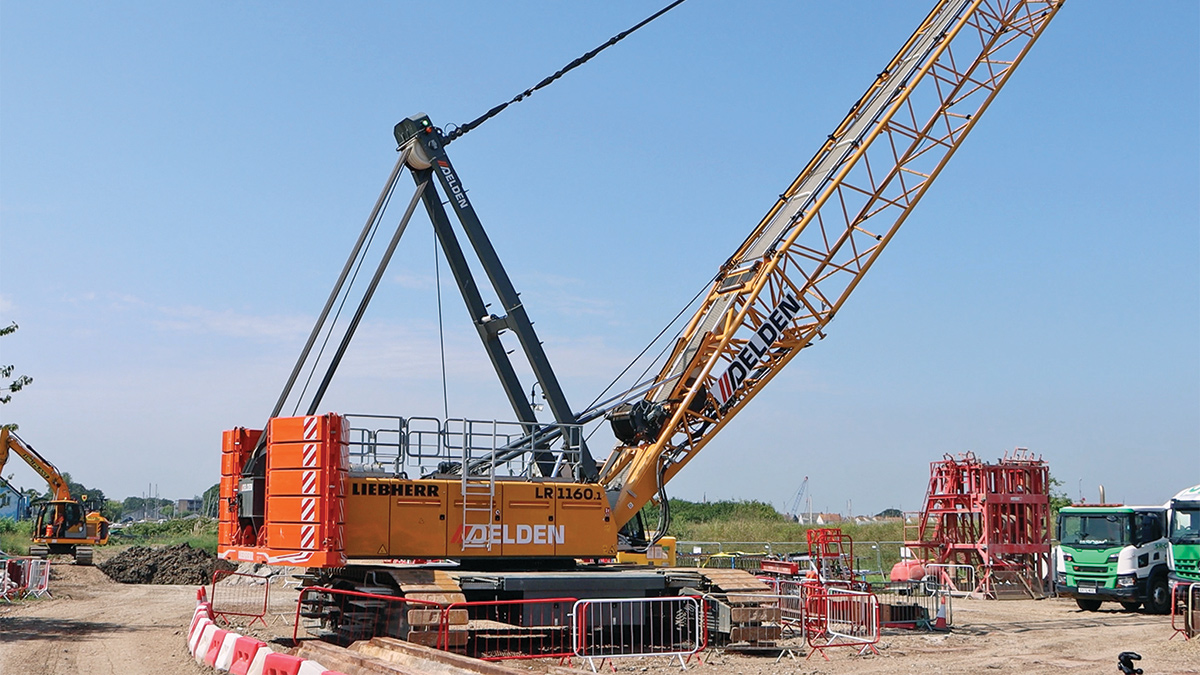
Cadman Cranes supporting the initial works – Courtesy of @one Alliance
The system will operate using an intelligent real time control (RTC) system, dynamically optimising storage and return cycles in response to changing storm conditions. Full integration with the existing MCC and SCADA systems, housed within a new GRP control kiosk, will provide enhanced monitoring, remote operation and improved operational visibility.
To support long-term asset performance, the new storage tank will incorporate a 37kW jetting and mixing system which is capable of delivering a cleaning duty of 300 litres per second, helping to manage sediment accumulation and maintain hydraulic efficiency throughout the asset’s operational life.
Maintaining the existing terminal pumping station in full operation throughout construction is one of the scheme’s greatest engineering challenges. Delivery has therefore been carefully phased to ensure uninterrupted service to customers while the new infrastructure is constructed around the live operational asset.
The below-ground storage tank will be constructed using deep diaphragm wall techniques before excavation and reinforced concrete works are completed within the enclosed structure. Temporary works includes the installation of a limpet dam within the existing storm tank to facilitate safe connection of the new tunnel drive, controlled excavation, staged shaft construction, levelling layers and reinforced concrete base slabs.
The permanent reinforced concrete structure has been specified using C35/45 AC-5 resistant concrete to protect against hydrogen sulphide corrosion, ensuring long-term durability within the aggressive wastewater environment. Permanent works will also include improved access arrangements, a maintenance crane pad, upgraded gated access, and Grasscrete surfacing to support future maintenance activities.
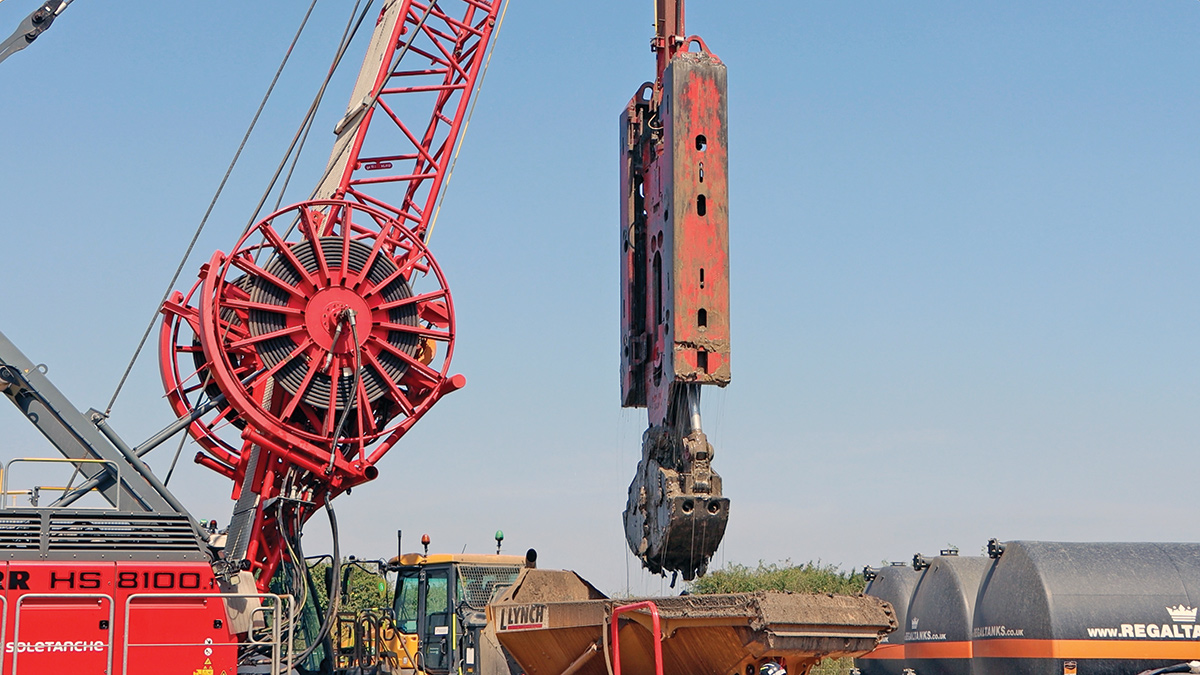
Construction underway with soil removal – Courtesy of @one Alliance
Walton-on-the-Naze Storm Storage Enhancement: Supply chain – key participants
- Client: Anglian Water
- Project delivery: @one Alliance
- Principal contractor & tunnelling: Barhale
- Topographical survey: Randall Surveys LLP
- Flow survey: RPS Environmental
- UXO survey: Zetica Ltd
- Environmental & acoustic consultancy: SWECO
- Ecology survey: SWT Trading Ltd
- WM3 waste classification testing: Eurofins Chemtest Ltd
- Arboricultural works: Ground Control
- Ground investigation: Endeavour Drilling Ltd
- Dewatering: Stuart Wells Ltd
- Ground stabilisation: Geobear Ltd
- Overpumping & specialist pump hire: Selwood
- Tank hire: Regal Tanks
- ECC & PSC piling: Bachy Soletanche
- Civil works: Bell Formwork & Civil Engineering Services Ltd
- In situ concrete works & reinforcement: Kelly Formwork UK Ltd
- Sheet piling: Berryrange Ltd
- Limpet dam ECC & PSC works: High Water™
- MCC & control systems: Paktronic Engineering Co Ltd
- Pipework & valves: Saint Gobain PAM UK
- Bellmouth overflow pipe: Freeflow Pipesystems Ltd
- Pumps & jetting pipework: Xylem Water Solutions
- HV & network modifications: UK Power Networks
- Precast concrete elements: FP McCann Ltd
- Cranage & lifting: Cadman Cranes Ltd
- Temporary works materials: Ischebeck Titan Ltd
- Ready mix concrete supply: Heidelberg Materials
- Aggregates, concrete & waste removal: SRC Group
- Tarmac surfacing works: WN Surfacing Ltd
- Site welfare provision, boards & signage: CMT Group
- Site welfare: Davlav
Environmental considerations
Environmental protection has been embedded throughout both the design and construction methodology. Temporary isolation measures will minimise the risk of uncontrolled discharges during key connection activities, while the bellmouth arrangement will improve solids retention and reduce downstream sedimentation.
The project footprint is contained within existing operational land and previously developed areas, limiting ecological disturbance and avoiding the need for permanent land take.
Construction sequencing has also been carefully planned to minimise disruption to surrounding habitats and coastal drainage pathways, with all temporary working areas reinstated following completion. Where practical, modular and prefabricated construction methods will also be utilised to improve quality, reduce programme risk and minimise disruption throughout delivery.
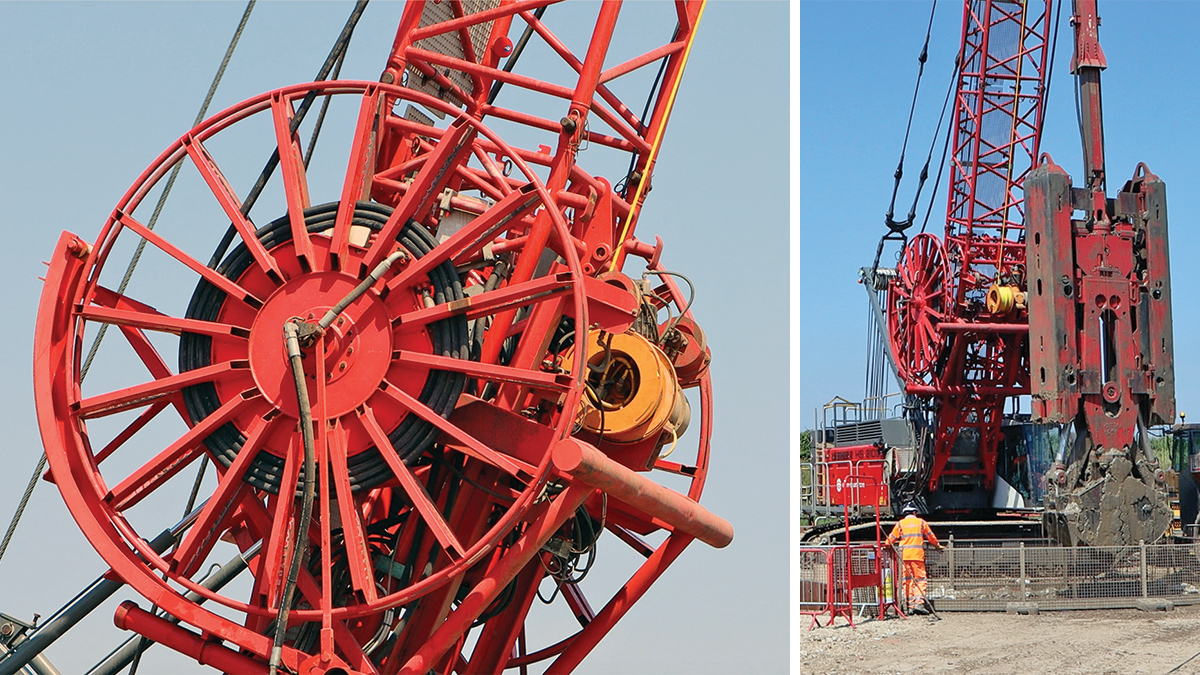
Bachy Soletanche’s machinery at the start of the underground dig – Courtesy of @one Alliance
Benefits
Once complete, the Walton-on-the-Naze Storm Storage Enhancement Scheme will deliver significant environmental, operational and long-term resilience benefits across the catchment, helping to protect the Essex coastline while strengthening the performance of Anglian Water’s wastewater network.
The primary benefit will be a substantial reduction in storm overflow spills, and by significantly increasing storm storage capacity and improving the way flows are managed during periods of heavy rainfall, the scheme will help improve bathing water quality at Walton and Frinton, supporting compliance with bathing water regulations and protecting a valuable environmental and recreational asset.
Operationally, the additional storage capacity and resilient pumping arrangements will provide a much more flexible and robust wastewater network. Integration with the existing SCADA system will also provide operators with enhanced visibility and real-time control of the network, enabling more informed operational decisions and reducing the likelihood of emergency overflow activation during severe weather.
Together, these improvements will enable the system to respond more effectively to peak storm events, reducing pressure on existing infrastructure while improving overall network resilience as rainfall patterns become more intense and unpredictable.
The scheme has also been designed with whole-life performance in mind. The integrated jetting and mixing system will help minimise sediment accumulation within the new storage tank, while the bellmouth arrangement will improve solids retention, reducing downstream maintenance requirements and improving long-term operational efficiency. The use of durable AC-5 resistant reinforced concrete will provide long-term protection against hydrogen sulphide corrosion, extending asset life and reducing future intervention requirements.
Beyond the immediate operational benefits, the project will also contribute towards Anglian Water’s wider environmental and sustainability ambitions. More efficient pumping strategies, reduced reliance on reactive maintenance and fewer tanker movements will help lower operational carbon emissions throughout the asset’s lifetime. The investment also provides additional capacity to accommodate future population growth and climate change, ensuring the wastewater network remains resilient for decades to come.
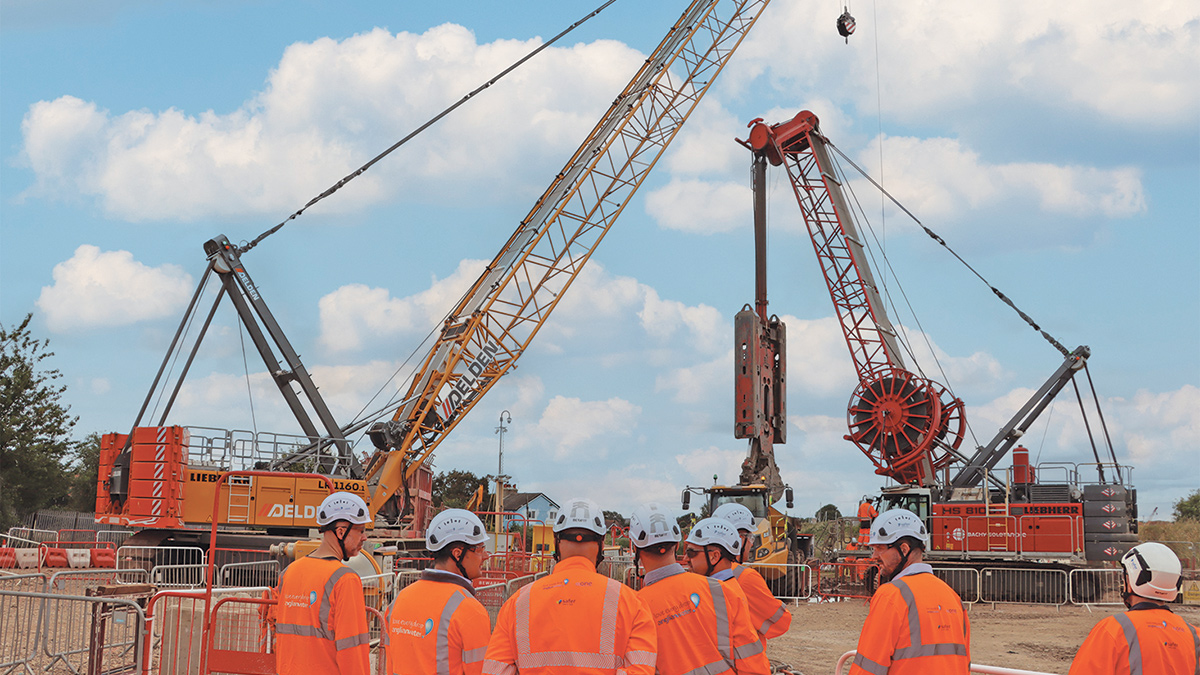
@one Alliance senior leadership team site visit – Courtesy of @one Alliance
Overall, the £18m investment in critical coastal wastewater infrastructure will deliver:
- 4,805m3 of additional underground storm storage capacity.
- Improved bathing water quality at Walton and Frinton.
- Increased resilience to future growth and climate change.
- Enhanced operational control through real time control and SCADA integration.
- Reduced maintenance through improved solids management and integrated jetting systems.
- Lower operational carbon through more efficient asset operation.
- A durable, long-life asset designed to support future network performance.
Conclusion
At the time of writing (August 2026) construction is underway and is due for completion in 2027. The Walton-on-the-Naze Storm Storage Enhancement Scheme marks a significant investment in strengthening one of Anglian Water’s most important coastal wastewater assets.
The project will deliver a long-term solution to the challenges posed by increasing rainfall, climate change and future growth through the construction of substantial new storm storage capacity, resilient pumping infrastructure and intelligent real-time operational control. Once complete, it will significantly reduce storm overflow spills, improve bathing water quality at Walton and Frinton and enhance the resilience of the wider wastewater network.
Just as importantly, the scheme demonstrates the value of collaborative delivery through Anglian Water’s @one Alliance. By bringing together specialist expertise from across the Alliance and its supply chain, the project is being delivered while maintaining continuous operation of a critical live asset, ensuring customers continue to receive an uninterrupted wastewater service throughout construction.
Through innovative engineering, careful environmental stewardship and a focus on long-term operational performance, the Walton-on-the-Naze Storm Storage Enhancement Scheme will create a more resilient wastewater network that protects communities, safeguards the environment and supports sustainable growth across the region for many years to come.