
Belfast Terminal Pumping Station (2026)
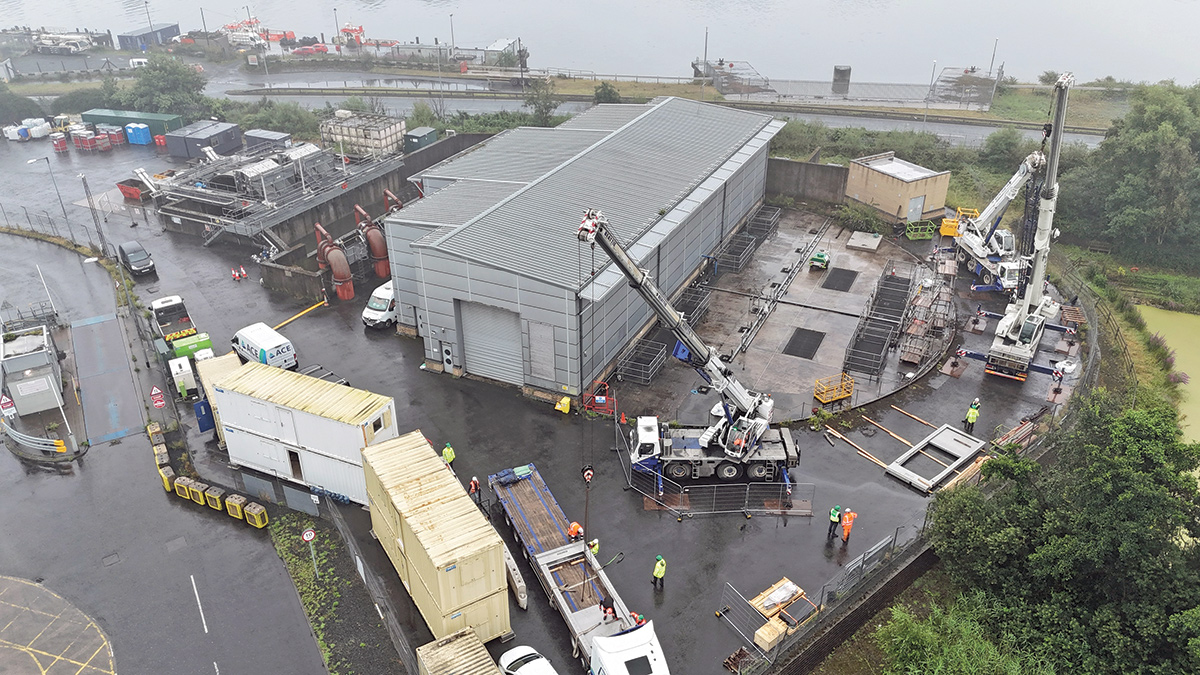
Site overview - Courtesy of GRAHAM
The Belfast Terminal Pumping Station (TPS) is located within Belfast Wastewater Treatment Works (WwTW). It was constructed as part of the Belfast Sewers Project in 2010, which provided the Belfast City catchment with a 1 in 30-year flooding protection standard and substantially reduced the volume of stormwater entering the River Lagan by channelling surface run-off from 11 Storm Overflows (SOs) into a large tunnel. The tunnel runs for six miles and averages a depth of 30m before terminating at the TPS. The Belfast TPS is a stormwater pumping station with a storage capacity of 18 million litres. It has a dual function; (i) during lower flows, the FFT pumps send combined stormwater to Belfast WwTW treatment, and (ii) during higher flows, it is designed to lift unscreened stormwater from a 37m diameter wet well to a screening facility and onward to discharge into the Herdman Channel.
Project need
NI Water operatives raised concerns about two isolation penstocks used to isolate the TPS wet well from the tunnel, reporting that they had been damaged due to failure of a brass knuckle in the mechanism used to operate the penstocks. The penstocks had fallen, and their frames had cracked, meaning they were no longer seated properly and let water through when closed.
Replacement penstocks were required to avoid catastrophic failure of the existing assets.
Project team
NI Water engaged its Base Maintenance Project Team, framework consultants Tetra Tech, and framework main contractor John Graham Construction (GRAHAM) under an ECI (Early Contractor Involvement) contract to assess the condition of the penstocks and develop a solution. The team conducted site visits to investigate possible solutions and produced designs for the supply and installation of two replacement penstocks.
Procurement/ECI
Three options were evaluated during the ECI stage of the construction project; however, two proposals were similar to the failed design and were rejected.
The chosen solution was to provide two stainless steel penstocks with hydraulic cylinders to open and close the penstock doors. The cylinders would be powered by a hydraulic power unit located on the roof slab of the pumping station wet well.
One of the main issues with the original penstock was accessibility and maintenance. The original design meant that scheduled maintenance of rubber seals and operating screw spindles was required.
To remove or replace any component, the entire system had to be dismantled from the top down, which would take approximately one week per penstock and require extensive resources to complete the works.
The new Aquiko penstocks supplied by Aquatic Control Engineering were designed with a cassette frame, meaning that the penstock and primary frame sit within a secondary frame fixed to the concrete head wall. The new penstocks could be completely removed from the wet well by loosening two bolts between the primary penstock frame and secondary cassette frame, detaching the hydraulic hoses and craning the penstock out. Once unbolted, the primary frame, containing the rubber seals, penstock door and hydraulic cylinder can be maintained at ground level, making it safer for operatives to complete their work.
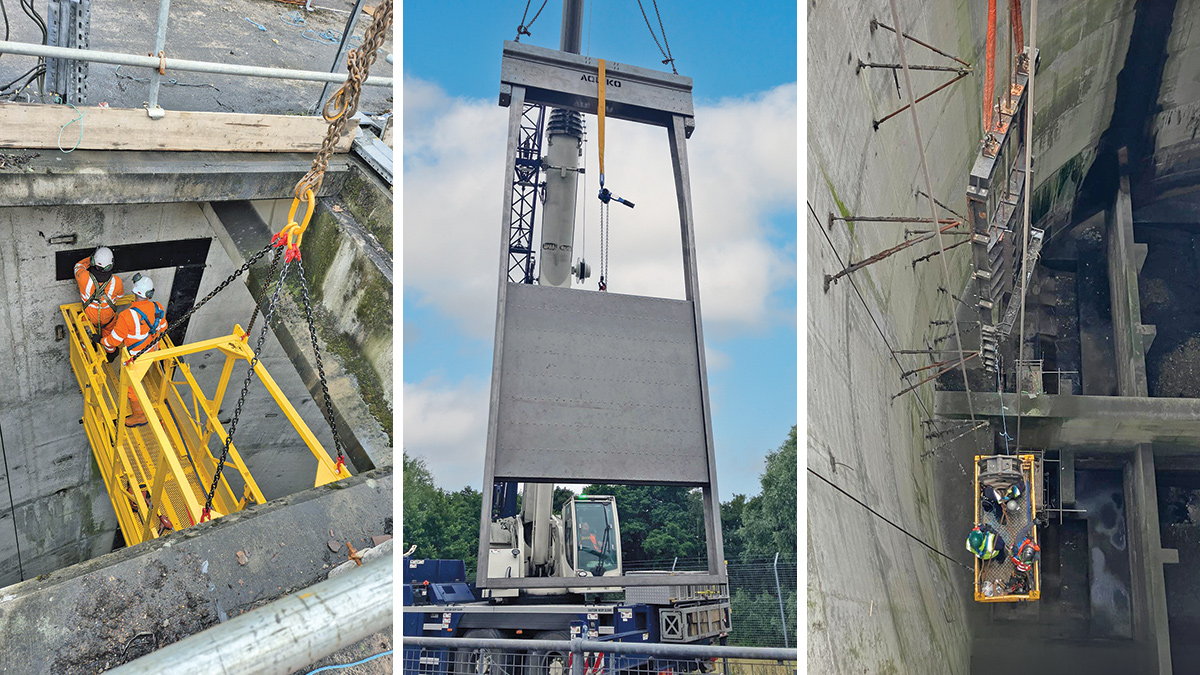
(left) Bespoke expandable man-basket, (middle) crane lift of the new penstock, and (right) new penstock and access basket being lowered into position – Courtesy of Tetra Tech
Overcoming challenges
The penstocks are located 38m below the surface, and the team carefully considered how contractors could access them safely. A one metre overhang at the access point would make reaching the side wall of the well from an access basket difficult, and the penstocks, measuring 6m x 2m and weighing 4 tonnes each, brought further challenges when moving them into position.
The method of moving and installing the penstocks was a major part of the design process. The chosen method used three cranes: one to remove the existing penstocks and lower the new ones into place; a second to hold a bespoke, cantilever access-basket, enabling workers to reach the wet well wall; and a third as an emergency backup.
Due to the wet well cover slab access point overhang, a standard man-basket would not be sufficient, so an extendable man-basket was manufactured. This comprised two sliding elements, one inside the other, and once extended, the operatives could work safely – close to the side walls without having to stretch or lean over the basket’s edge, reducing the risk of injury or incident.
Another significant challenge was the possibility that the tunnel could experience sudden high flow levels as it collects surface water and overflow wastewater from across Belfast. These surges could occur with very little warning, putting anyone inside the tunnel or wet well at risk and leaving little or no time to evacuate.
To address this, an early warning system was developed to monitor conditions across the tunnel network and deliver remote alerts via a web portal and GSM alarms. The system monitored flows at eight locations upstream within the six-mile-long tunnel, providing operatives with real-time data on flow and levels and more time to exit safely if increased flows were detected.
Innovations
The penstocks were designed for easier maintenance, greater durability, and a better seal than the previous penstock. Locating the hydraulic power source on the surface reduced the number of serviceable parts inside the wet well and provided a more robust operating mechanism than the previous mechanical system.
Built-in sensors detect ‘creep’ in the penstocks and automatically raise the doors to the resting position if necessary, and regular exercise cycling ensures the structures remain operational and free.
The replacement penstocks were designed not to fully close off the tunnel, but to act as a means of isolating each side of the well independently for maintenance works within the well. Should flows increase whilst either of the penstocks are closed, the design allows for flow to ‘over-top’ the penstock gates if the level in the tunnel network reaches 2m.
Commissioning/handover
Belfast experienced an unusually long period without significant rainfall during the removal and installation works, and the project was completed on schedule in late summer 2025. On the final day of commissioning, light rainfall perfectly complemented a demonstration of the system, and the penstocks were shown in operation, with watertight isolation of both sides of the wet well from incoming flows.
The system was tested in extreme circumstances the following month when Storm Amy brought heavy rainfall to the city, and the levels in the well rose rapidly, submerging the new equipment entirely. The system operated flawlessly and continues to provide reliable isolation, ensuring safe maintenance of this essential piece of infrastructure.