
Malborough STW (2026)
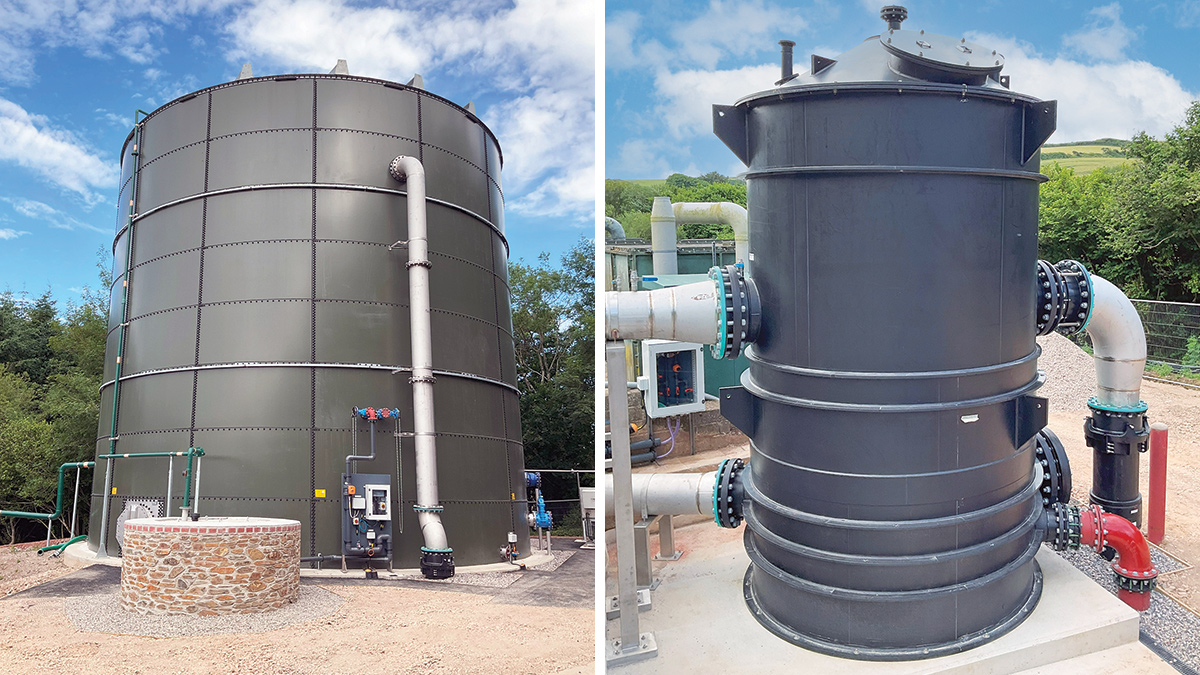
(left) Stortec Engineering's 1150m3 saline smoothing tank (SST) and (right) SST feed pump station reception tank - Courtesy of Galliford Try
Malborough is a village and civil parish in the South Hams region of Devon. The village is located on the A381 between Kingsbridge and Salcombe, and is a popular village for tourists, with many holiday homes located in and around the village. The parish has a population of approximately 1,200 people. Marlborough STW is a medium sized works located near the coast, and the catchment area is subject to saline intrusion at high tides and subsequent fluctuations in salinity in the incoming sewage. The most significant factor being the rapid change of salinity after a high salinity event damaging the secondary treatment biological process.
Existing works
Operated by South West Water, Malborough STW receives pumped flows from North Sands Pumping Station and gravity flows from Marlborough Pumping Station. The treatment process comprises an inlet works, combined lamella/primary settlement tanks, a BAFF plant, and UV treatment. In addition, the works has auxiliary flow balancing tanks, sludge holding tanks, odour control equipment and associated pumping plant.
Project objectives
The primary objectives for the upgrades at Malborough STW are:
- Saline smoothing: To limit the rate of change of salinity of the incoming flows and support continuing use of the existing primary lamellas and BAFF plant.
- Spill reduction: To reduce spills from the existing saline balancing tank emergency overflow (SBTEO) to target average of two spills per bathing season.
These objectives are crucial for safeguarding the site secondary stage site process and reducing spills caused by the existing Saline divert tank ensuring that the water quality at North Sands Beach remains safe for recreational use.
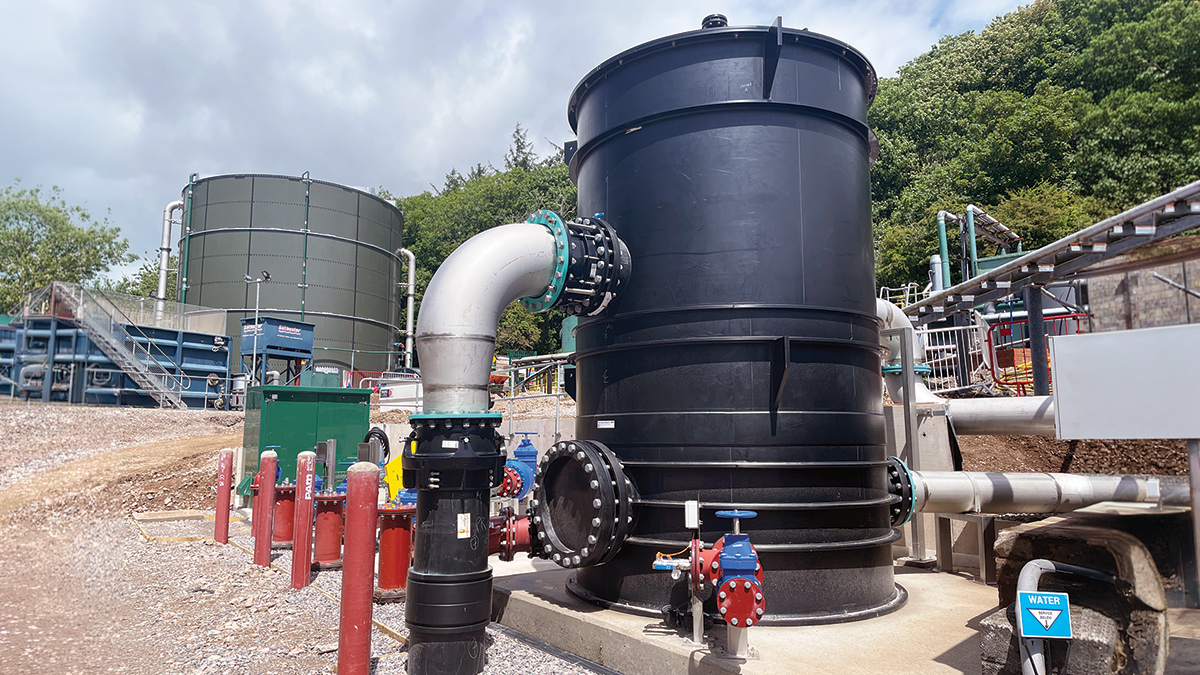
SST feed pump station reception tank – Courtesy of Galliford Try
Project scope
The BAFF plant was required to accommodate a rate of change above industry standards, with a maximum conductivity level in excess of 27,000 millisiemens per centimeter (µS/cm); equivalent to a chloride level of approximately 10,100 mg/l, which equates to 52% sea water. The original BAFF design diverted all flows to the saline overflow originally at a 20,000 µS/cm trigger point (equivalent to a chloride level of approximately 7,400 mg/l).
Analysis of trended salinity data from 2016-2019, indicated that in order to achieve an average of two spills per bathing season, 1,150m3 of smoothing tank capacity would be required.
The works upgrades include a new covered, large volume saline smoothing tank (SST) to smooth out saline intrusion occurring at high tides and protect the downstream treatment processes. Flows will be intercepted between the Inlet channel and primary settlement tanks and diverted to a new Saline Smoothing Tank Feed Pumping Station (SST Feed PS), which then pumps incoming flows to the saline smoothing tank.
Incoming flows will be diluted and mixed to slow down the rate of salinity change to the works. The flow will exit the tank via a high level bell mouth and be returned by gravity to the downstream lamella/primary settlement tank via a baffle chamber to reduce the velocity of the return flow. The contents of the saline smoothing tank will mixed and aerated by an external duty/standby air-mixing plant to prevent the risk of septicity occurring owing to long retention time on low flow periods.
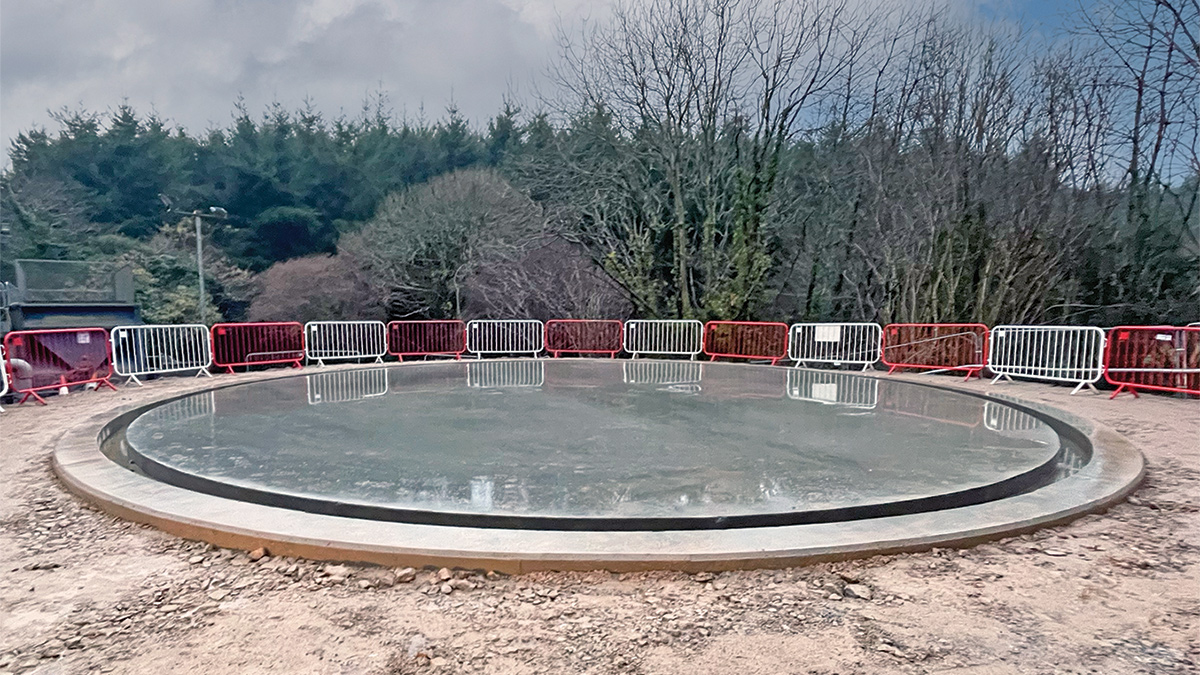
Smoothing tank base construction – Courtesy of Galliford Try
Malborough WwTW: Supply chain – key participants
- Client: South West Water
- Principal designer & contractor: Galliford Try
- Mechanical design: SWECO
- Ecology: Tamar Ecology
- Topo & utility survey: Kemp Chartered Engineering & Surveying Ltd
- PBT & CBR testing: Analytical Construction Services
- Vacuum excavation: Pier (UK) Ltd
- Concrete & rebar: D&P Reinforcements Ltd
- Over pumping: Andrews Sykes
- Temporary works solutions: MGF Ltd
- Piling: Saxton Drilling
- Core drilling: 24-7 Diamond Drilling & Sawing Services
- Smoothing tank supply/install: Stortec Engineering Ltd
- Smoothing tank mixing: The Utile Engineering Company
- OCU system & pipework: Air-Water Treatments Ltd
- Electrical installation: Drew & Co
- Generators: Addicott Electrics Ltd
- MCC & software: Lintott Control Systems
- Pipework fittings: Frazer Utilities
- Trace heating & lagging: Jade Insulation
- IPS tank: NOV – Pipex Flow & Environmental Solutions
- Protective coatings: Technique
- Lightning protection: DEHN
- Plant hire: Plantforce
- Plant hire: Flannery Plant Hire (Oval) Ltd
- Plant hire: GAP Group
- Crane hire: Spence Crane Hire Ltd
- Site accommodation & welfare: Algeco UK Ltd
- Tankering: Clear-Flow
- Haulage: Steve Wills Haulage Contractor
- Scaffolding: RBS Scaffolding Ltd
- Concrete: E & JW Glendinning Ltd
- Tarmac: Devon Tarmasters
- Fencing: Topan Group
- Tree surgery: R&R Services
Design & construction
To address these project objectives, a comprehensive upgrade was implemented at Malborough STW, focusing on both process improvements and infrastructure enhancements.
Manifold
A new manifold was fitted on the existing pipework between the Inlet channel and PST pipework comprising flow, return and bypass valves. The location of the pipe was approximately 2m under the main access road through site. This required a carefully planned shutdown in dry weather conditions and a process risk assessment written and approved by the Galliford Try project team and South West Water.
An earlier PAS128 Ground Investigation Survey indicated the presence of many buried services which were carefully avoided with the use of vacuum excavation. This activity was completed in a single weekend and the road reinstated ready for tanker collections the following Monday.
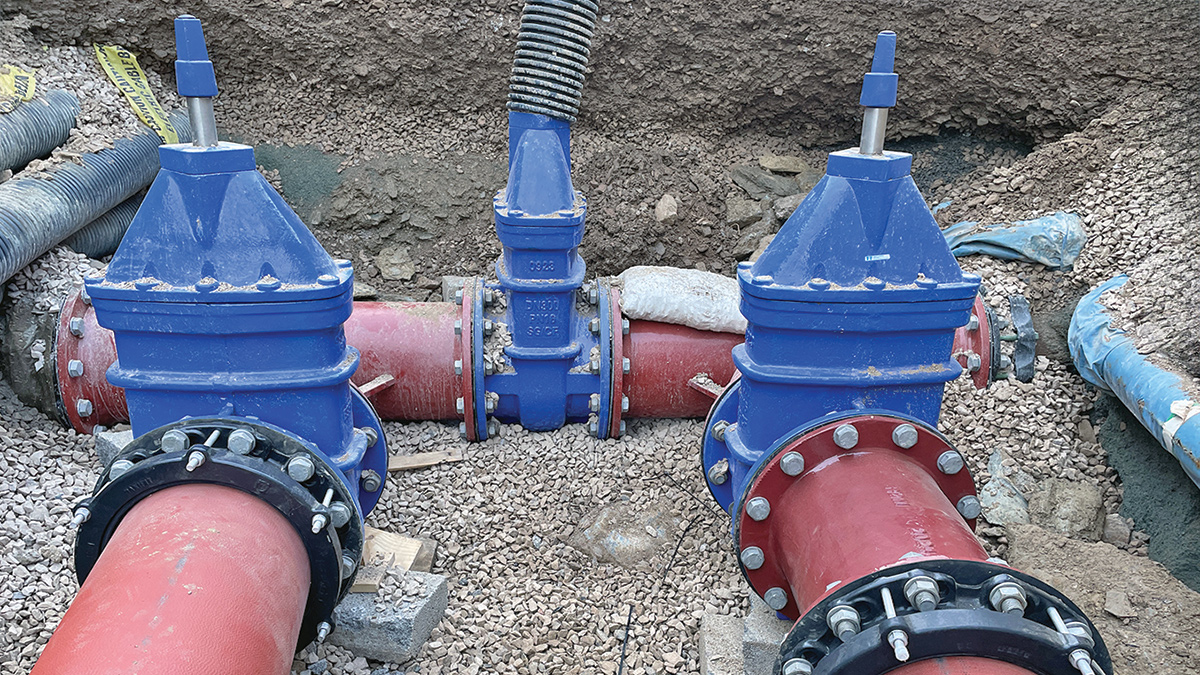
Newly installed manifold – Courtesy of Galliford Try
Saline smoothing tank
Space was very limited on site to accommodate the new above-ground smoothing tank from Stortec Engineering Ltd. The stainless steel tank is approximately 12m high by 12m in diameter, with a 1150m3 capacity. It works on the principle of dilution into a large capacity, effectively ‘slowing down’ the rate of salinity change passing through the works.
The most suitable location for the tank was at the top of site, which required a new pumping station and infrastructure to pump incoming flows through the tank. The reinforced concrete base required 44 ODEX piles ground cored into competent rock.
Mixing
A duty/standby air mixing plant was selected to ensure the smoothing tank contents is constantly mixed and kept in suspension. Air mixing also has the benefit of adding oxygen to the tank reducing further reducing the risk of septicity, especially on low flows.
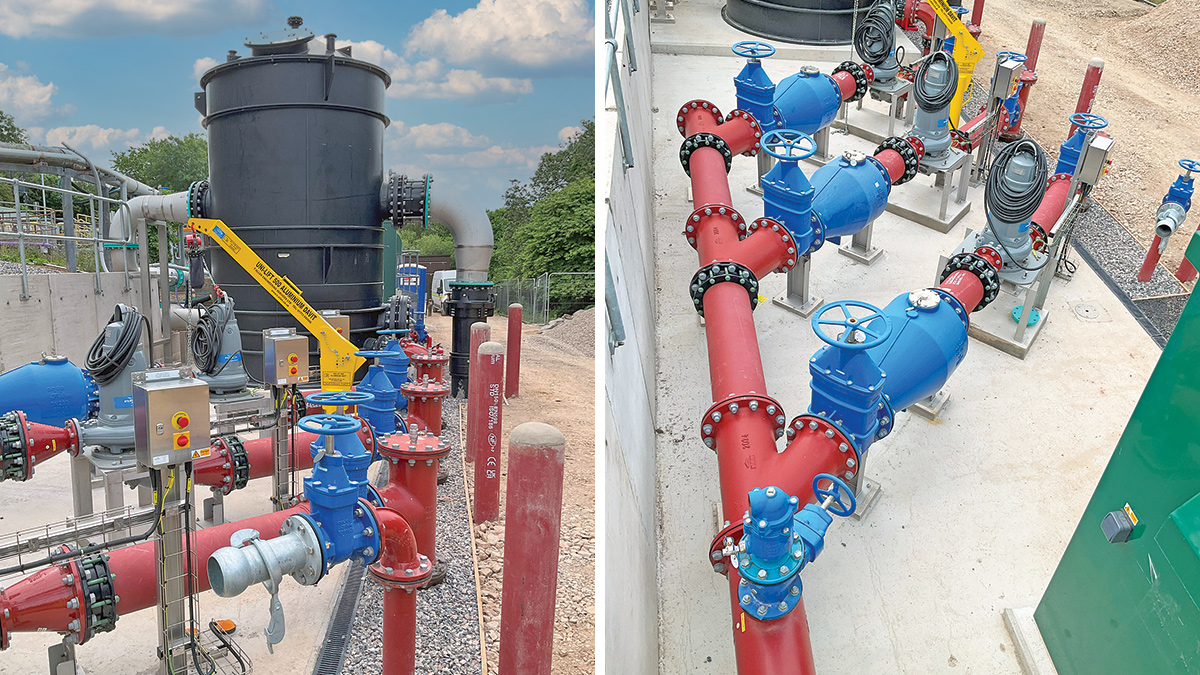
The SST pump station – Courtesy of Galliford Try
SST Feed Pumping Station
The new pumping station was designed and built capable of pumping the maximum works flows of 62.8 l/s via a separate balancing tank to control flow based on tank level.
The pumping station comprises duty/assist/standby pumps, which pump forward flows into the smoothing tank and return via gravity overflow. The tank was designed with an internal overflow weir to bypass the smoothing tank in the event of pump failure.
Instrumentation
New water quality instrumentation was installed and commissioned to monitor dissolved oxygen, flow and tank levels. This information can be accessed remotely by South West Water.
Saline smoothing tank outlet chamber
A new partially buried chamber was constructed with internal stainless steel baffle wall to reduce the pace of return gravity flows from the smoothing tank into the primary settlement tank. As it was located in a prominent position on site, and visible to the public, it was decided by the project team to clad it with some of the left-over stone from Devon Hedge reconstruction elsewhere on site.
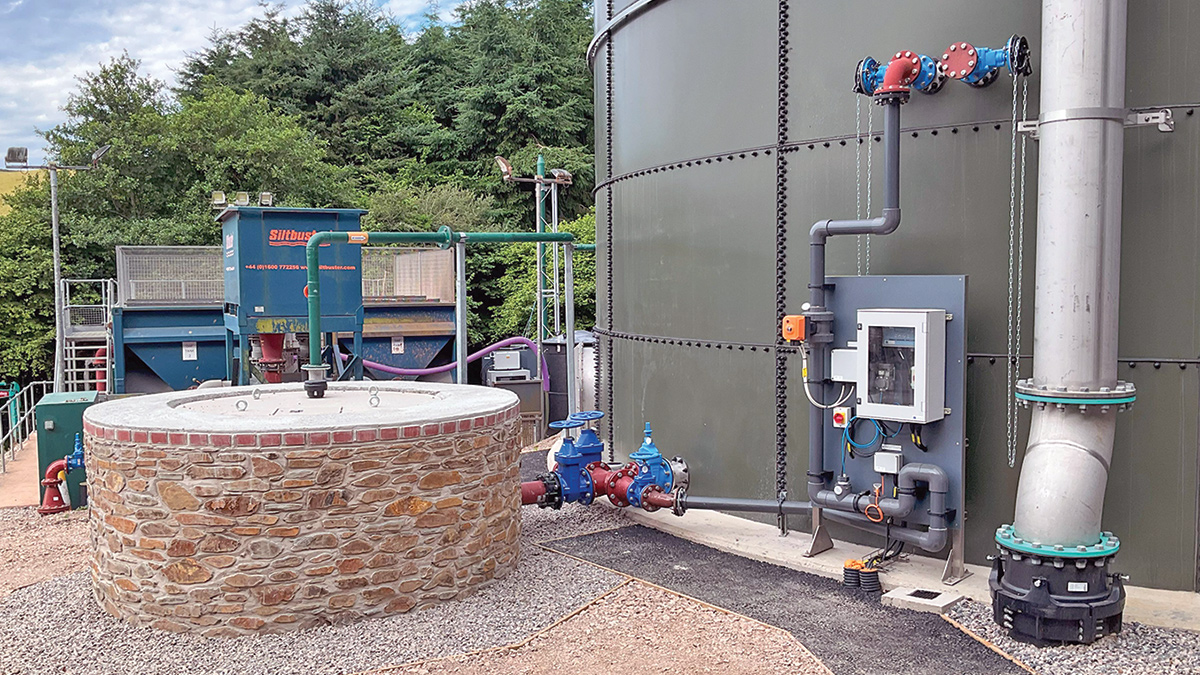
The SST outlet chamber or “wishing well” as it was nicknamed by the site operators – Courtesy of Galliford Try
Innovations, cost savings, & carbon reduction
The project incorporated several innovative approaches aimed at improving operational efficiency, reducing costs, and minimising environmental impact:
- Commissioning: Once the new saline smoothing plant was dry commissioned, the existing feed pipework to the DAFF plant was modified to allow the new process to be filled over a few days, taking an agreed percentage of site final effluent. The manifold arrangement fitted during the shutdown allowed the new plant to be filled and wet commissioned off line in a closed loop, with no risk to the site process. With wet commissioning complete, flows were introduced into the system by simply operating the new flow and return valves and closing the bypass valve.
- MCC room: An existing on-site building storing grounds maintenance equipment was re-purposed as an MCC room. As space was limited on site, the existing building was upgraded with new doors and the wall height raised to house the new MCC.
Conclusion
The upgrades at Malborough Sewage Treatment Works represent a significant investment in environmental protection and public health. Both trend data, and feedback from SWW Senior Operations Management after the new process was operational, have proven the upgrades are working effectively.
The final effluent quality has improved significantly and is much more consistent with improved FE transmissivity which has allowed the UV system to operate at a lower lamp intensity providing a saving in electricity and lamp lifespan for the South West Water.
The facility now operates more efficiently and effectively, helping to ensure that treated effluent meets the new stringent environmental standards. These improvements not only benefit the works process local ecosystem but also enhance the recreational water quality at North Sands Beach; providing long-term value to the community.