
Ovingham Raw Water Pumping Station (2026)
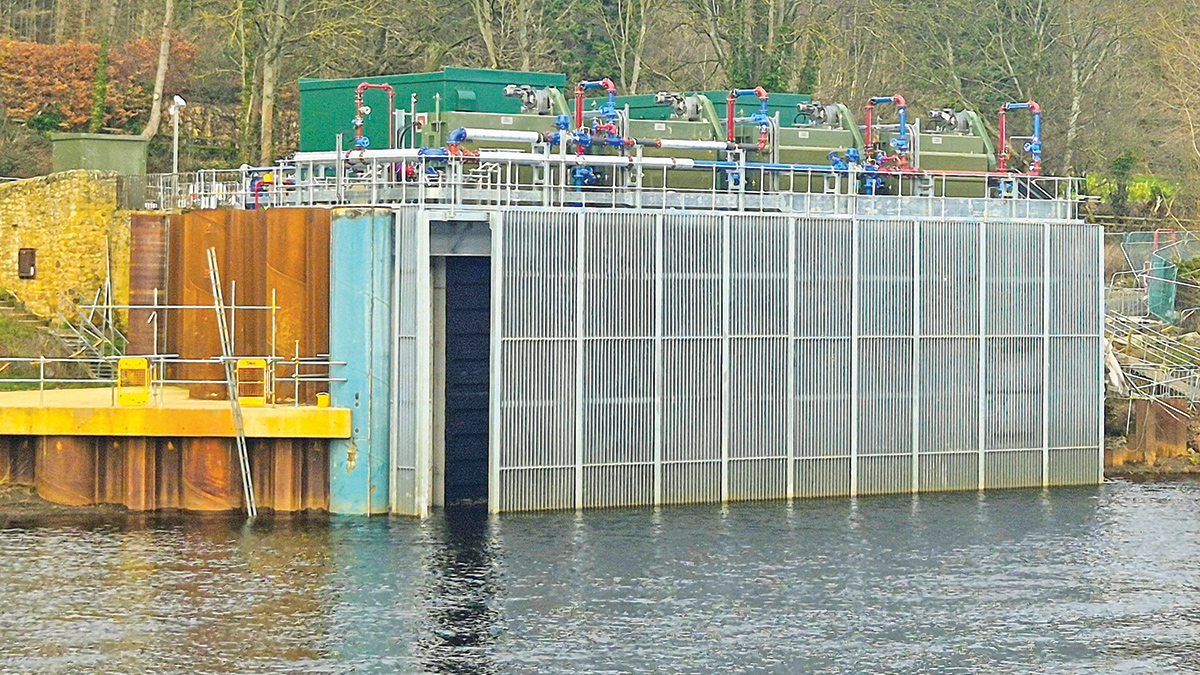
The completed eel screen installation at Ovingham RWPS (February 2026) - Courtesy of Mott MacDonald Bentley
Ovingham Raw Water Pumping Station (RWPS) is an abstraction station located on the north bank of the River Tyne in South Northumberland between the towns of Wylam and Ovingham. The station provides raw water from the River Tyne to Horsley Water Treatment Works (WTW) and the Great Southern Reservoir at Whittle Dene WTW. Treated water is then pumped to Birney Hill Reservoir and supplies the City of Newcastle-upon-Tyne and Tyneside with a population in excess of 800,000. To comply with The Eels (England and Wales) Regulations 2009, in 2016, Northumbrian Water appointed Mott MacDonald Bentley (MMB) to investigate viable options for screen replacement. Subsequently, in January 2023, MMB was awarded the contract to construct the works.
Eel Regulations
European eel stocks are at an all-time low and continue to decline. The European Commission has therefore put in place a recovery plan, which the UK and other member states must implement. The European Commission’s Eel Recovery Plan (Council Regulation No. 1100/2007) aims to return the eel stock to sustainable levels, both in terms of glass eel recruitment and the abundance of adult eels. The Eel Management Plans (EMPs) for England and Wales describe impacts of entrainment on eel and measures to reduce these impacts via appropriate screening.
The Eels (England and Wales) Regulations 2009 Statutory Instrument requires the owners of water undertakings and other abstractions to fit suitable screens or equivalent eel exclusion measures. This is on top of any existing legal requirement to fit fish screens (Screening at Intakes & Outfalls: Measures to Protect Eel. The Eel Manual – GEHO0411BTQD-E-E).
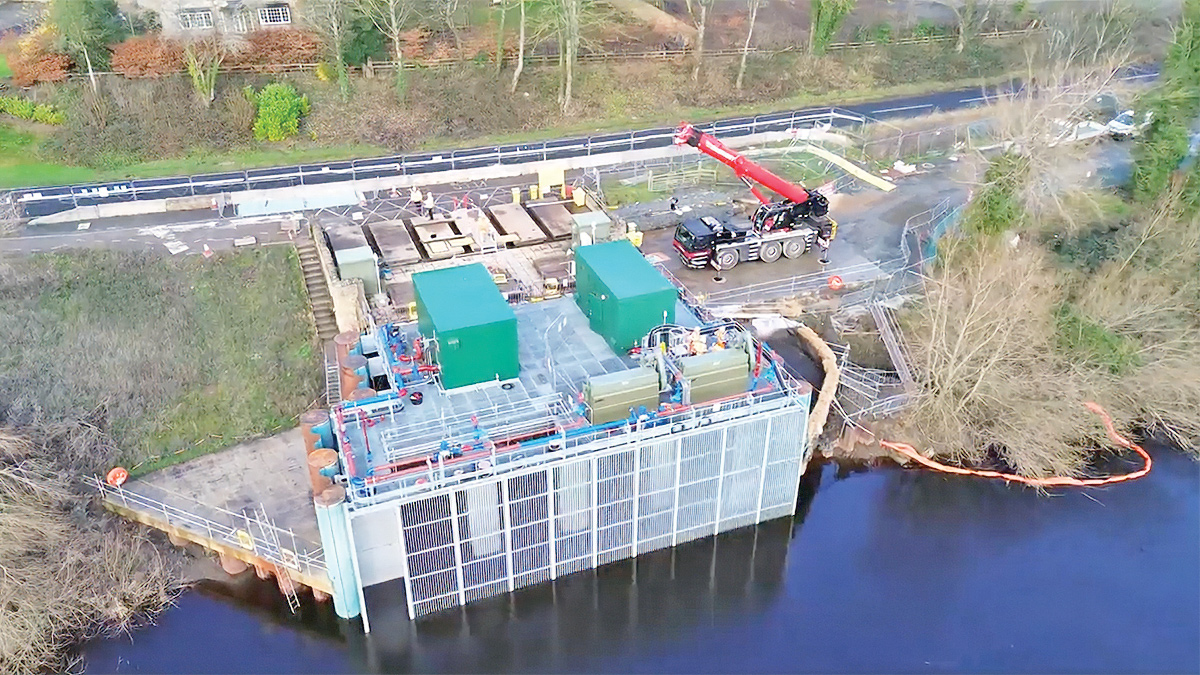
Ovingham RWPS with the first two (of four) Hydrolox eel screens in place – Courtesy of Mott MacDonald Bentley
Scope of works
- The four Environmental Fish Exclusion (EFE) eel compliant screens must allow for a future maximum abstraction rate of 180 ML/D at a water depth of 1.7m (measured from 5.5mAOD) and 130 ML/D at 1.2m depth.
- The screen mesh size must not exceed 1.8mm.
- The acceptable approach velocity is 0.25 m/s (if parallel to the flushing flow) – based upon 10% blinding.
- The screens must be capable of operation in the River Tyne which is one of the siltiest rivers in England.
Detailed design
CFD modelling: Computational fluid dynamics (CFD) modelling was required at the design stage to determine the lateral forces exerted on the structure during a 0.1%AEP (1:1000 year flood event) and also to ensure flows to the pumps were maintained. The new structure has been designed so that the screen motors are positioned above this level. A Flood Risk Assessment was also carried out to ensure the new works didn’t make flooding up and downstream worse.
HES RAS modelling of the River Tyne calculated the Q95 flows (low river level) and ensured the screens were adequately sized and velocities through the screens did not exceed the EA Eel Manual recommendations.
Piled structure: Ground investigation was carried out in 2019 both on the riverbank and within the river channel itself. Rotary boreholes were advanced to a depth of 20m through river silts, mudstones, siltstones. coal measures and sandstone.
Southbay Civil Engineering Ltd (SCEL) was appointed to carry out the piling works, and they in turn appointed Fairhurst to design the piled structure and associated steelwork to the following specifications:
- 19 (No.) 1220mm diameter S355 steel tubular piles with a wall thickness of 25mm and a minimum of 9.5m of embedment to form the main piled structure.
- PU18 sheet piles infilled the gaps between the tubes and were driven to refusal.
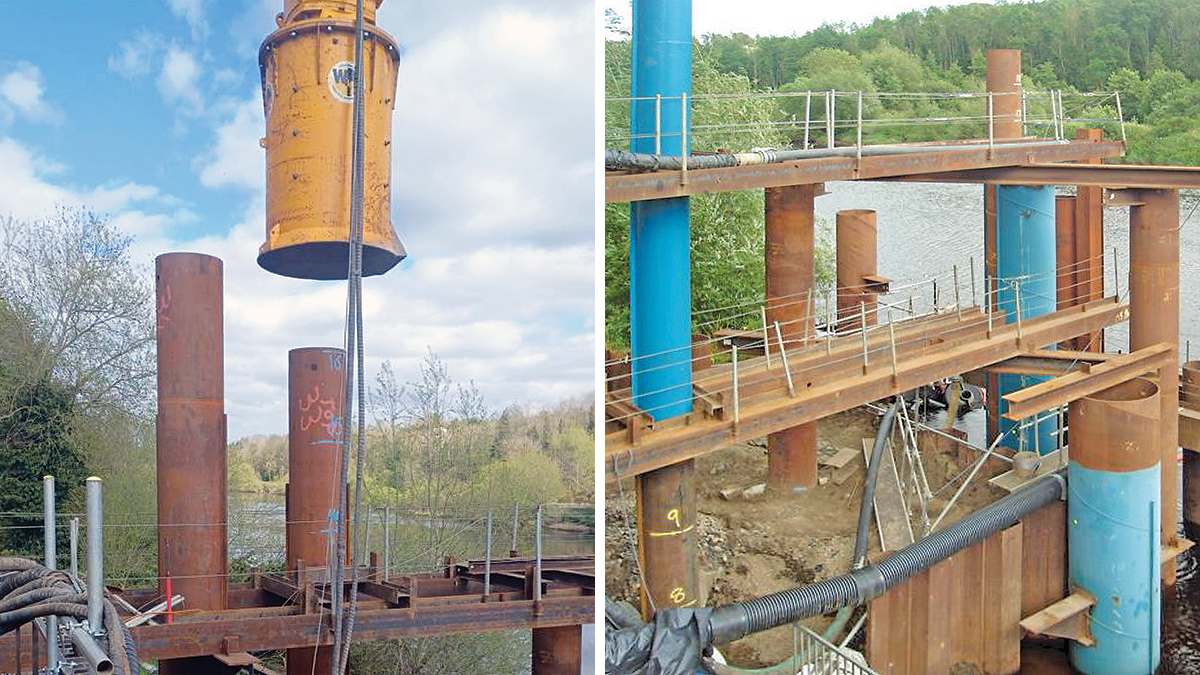
(left) Piles were vibrated to rock level and then hammered in 1m below rock level and (right) view from the west of permanent piles – Courtesy of Mott MacDonald Bentley
Crane pad: Southbay Civil Engineering Ltd confirmed that a 500-tonne crawler crane would be required to enable the piling works to be complete. A 100-tonne mobile crane was required to build the crawler crane; each track weighed 30 tonnes alone!
As the crane would be positioned adjacent to the pumping station and to the river, a number of geotechnical design checks were required, and in total, 274 pages of calculations were generated to demonstrate the crane pad and sub-grade would be adequate.
A 15m x 13m x 500mm thick reinforced concrete pad was cast following the diversion of electrical cables. Sacrificial sheet piles were also driven to allow the removal of an old jetty. Tubular piles were driven within 2m of the crane pad and so deflections on the crane pad were checked every day and vibration levels limited to avoid affecting the sub soil.
Ovingham RWPS: Supply chain – key participants
- Project delivery: Mott MacDonald Bentley Ltd
- Piling design: Fairhurst
- Piling & primary steelwork: Southbay Civil Engineering Ltd
- Noise & vibration monitoring: Paul Horsley Acoustics Ltd
- Hydrolox eel screens: Intralox
- Electrical & instrumentation installation: Intelect (UK) Ltd
- Systems integration: IDEC Group Ltd
- Local control panels: RSE Control Systems (Blackburn Starling)
- Temporary treatment plant: RVT Group Ltd
- Washwater package plant & kiosk: NPS Engineering Group
- Washwater boll filters: Bollfilter UK Ltd
- Penstock refurbishment: Cutlass Technologies Limited
- Primary steel beams for platform: Nationwide
- Secondary steel beams for platform & general metalwork: Steelway
- Additional metalwork: ADL Fabrications
- Scaffolding: SWL Scaffolding Ltd
- CCTV: ACEDA
- Security fencing: Burn Fencing Ltd
Programme of works & engineering challenges
Site works commenced in May 2023 and civil works ran through until October 2025. Being a key operational asset, Northumbrian Water required that the pumping station had to be fully operational throughout the works and so a big challenge was to complete the works whilst providing critical raw water supplies to Horsley WTW.
The pumping station is situated in rural Northumberland which, brought its own logistical challenges. Site staff had to consider that any plant used for lifting operations could be demobilised and moved from site prior to a flood event at short notice.
The new Hydrolox eel screens from Intralox were installed in pairs in January and February 2026 and will be commissioned and operational by April 2026.
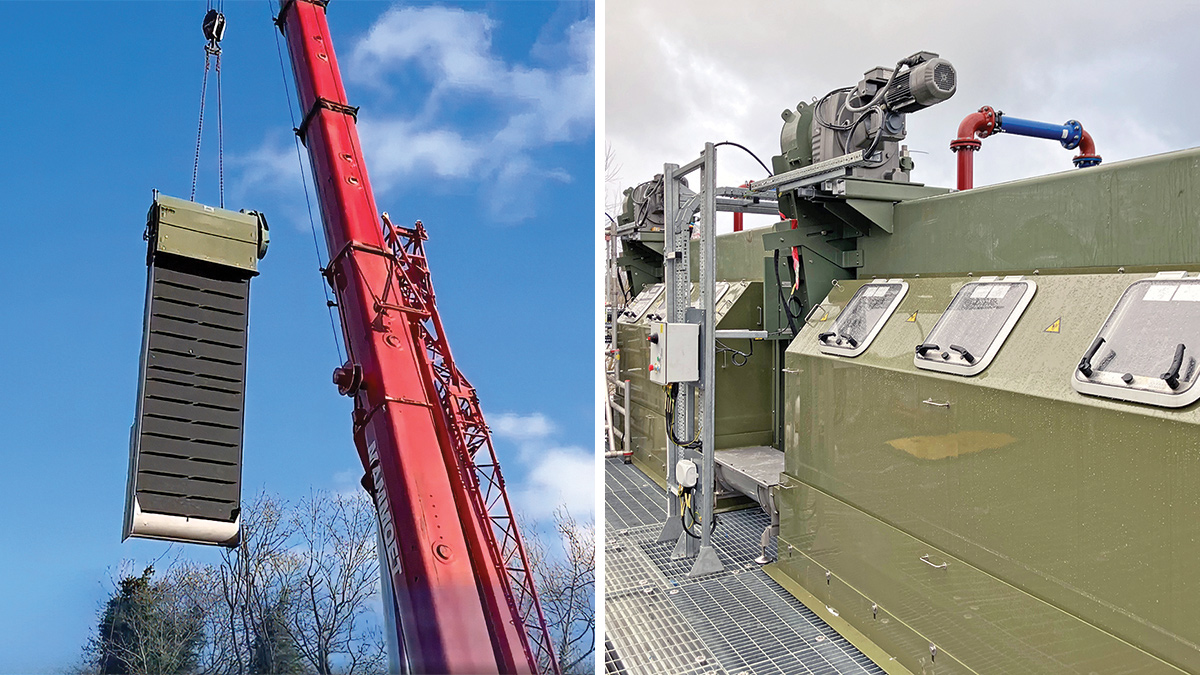
(left) The Hydrolox eel screens being lifted into place and (right) the installed screens – Courtesy of Mott MacDonald Bentley
Cost & programme efficiencies
Removal of Pile 18: The piling design was challenged and one tubular pile on the eastern side was removed from the scope following design checks. It is estimated this saved 3-weeks on the works programme.
Penstocks refurbished not replaced: MMB was contracted to replace eight penstocks, roughly 3m high and 500mm wide. Diver surveys confirmed that the penstocks were in good working order and the guides just required a clean. Cutlass Technologies Ltd was contracted to release and refurbish the penstocks.
Washwater package plant: An adequate and reliable supply of washwater – delivered at the correct pressure, fully screened, and free from debris – is essential for the effective operation of the new eel screens.
Washwater is doubly essential at Ovingham RWPS as it is also required for the cooling of the new VTP pumps that MMB installed in 2022. A package plant containing duty/standby boll filters was designed, fabricated and tested off-site by NPS Engineering Group. It is estimated that this saved 8-weeks on the programme.
Synchro 4D: Synchro 4D allows the clause 32 program and the REVIT model to be linked. The 3D visualization allowed clashes to be spotted and the methodology to be explained to operatives, sub-contractors and visitors.
Challenges
Treatment of arisings: Most works adjacent to or within a main river require a Flood Risk Activity Permit (FRAP) from the Environment Agency. MMB received this permit before the contract had been awarded, but the exact conditions on treatment of drilling arisings (crushed rock/coal/clay drilled, mixed with river water and pumped out the tubular piles) was not specified. Later, post award discussions determined that the level of treatment of flows back into the River Tyne should have “no visible discolouration or solids”.
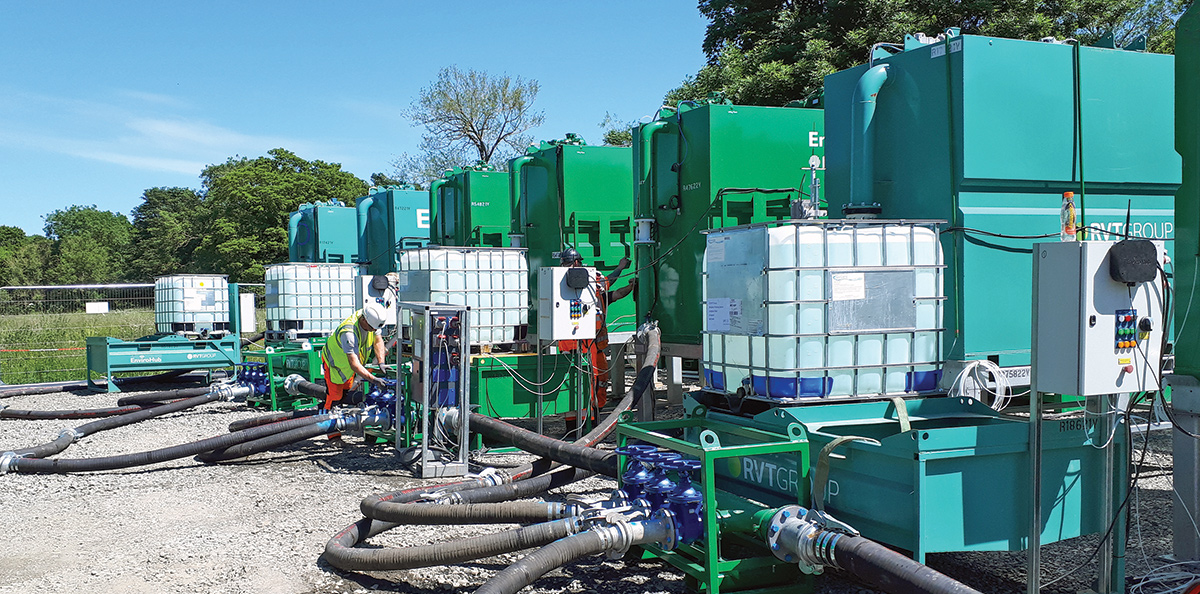
Temporary treatment plant from RVT Group to treat the arisings from the piling operations – Courtesy of Mott MacDonald Bentley
MMB engaged specialist supplier RVT Group to provide the temporary treatment plant to remove the drilling solids from the river water before discharging it back to the Tyne.
The plant treated the flows to a good standard, but the plant experienced early teething problems when the pile top drill passed through different geological strata and had to be regularly flushed and re-filled. The FRAP also put conditions on use of the impact hammer and a limit of two hours per day to avoid stress to migrating fish.
The Environment Agency visited the site to witness the level of treatment and were impressed. They also reported no issues with fish migration at their monitoring point at Riding Mill RWPS Crump weir or anecdotally from anglers.
Delays: The working area for plant and materials was limited and the 1220mm diameter tubular piles could only be brought to site three at a time. The 500-tonne crane was required for all piling operations, gate erection and dismantling and transportation of plant and materials around the site along with transporting the driller onto the drilling platform via a man riding basket. The crane was often “winded off” as it could not transport people when the wind speed exceeded 7m/s or lift plant and materials above 15m/s.
During the piling operation a number of metallic objects were encountered, and the pile locations had to be moved numerous times. The objects are thought to be the cofferdam from when the station was built in the 1970s and steel waste that had contaminated the clay backfill. The pile top drill is designed to cut through rock and so metallic objects damaged the drill head. The existing cofferdam was not located during ground investigation as it was close to rock head. Frequent river flood events also delayed the piling operation.
Problems with the existing pumps meant piling operations were often halted so a pump could be removed for refurbishment.
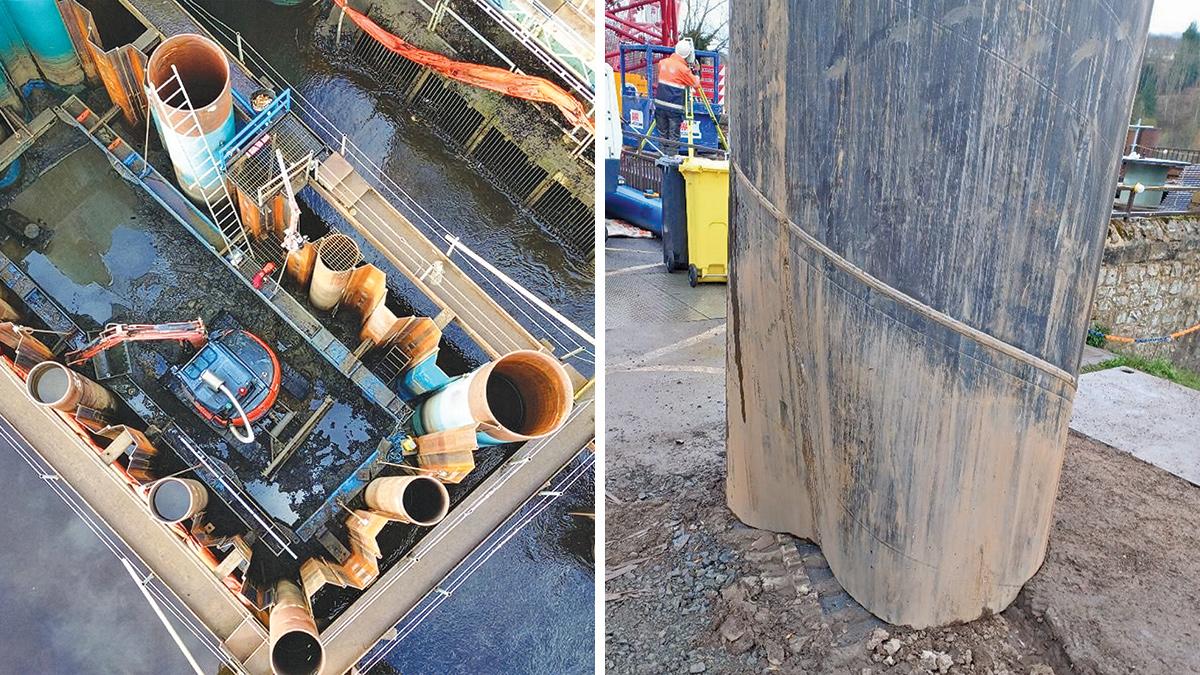
(left) Piling operation and (right) damage to a 1220mm diameter tubular pile after encountering the existing cofferdam from when the pumping station was originally constructed – Courtesy of Mott MacDonald Bentley
River silt & leaf removal: The River Tyne delivers large quantities of silt and leaves to the pumping station intake; especially after a flood event. Silt was removed from the intake apron at least once a year. MMB removed a large quantity of leaves from the intake during the leaf fall season every September and October. It is hoped that moving the intake further out into the river will remove this silt and leaf problem.
Coating of the piles: Northumbrian Water requested that the surface of all piles beyond the intake screens be coated with a Regulation 31 coating. This was costly and time consuming for the piling contractor who had difficulty finding a sub-contractor who could handle 20m long sheets and tubular piles in an environment where the temperature and humidity could be controlled and logged and ensure the correct curing. As the coated sheets and tubes are driven through the piling gate the coating is often damaged.
Community relations
Northumbrian Water are very keen on community projects and leaving a legacy. As a thank you to the local community for any disruption during the works, Mott MacDonald Bentley refurbished park benches at Wylam Village and refurbished the sports pavilion at Ovingham.
Meetings were held with angling organisations and parish councils on site and legacy works such as a new play park slide were installed. Access to the riverbank was maintained where possible for anglers and the NWG Customer Portal regularly updated to keep nearby residents and interested parties up to date
Looking ahead
Following the successful completion of the Ovingham Raw Water Pumping Station Eel Screen Installation Project, Northumbrian Water has asked Mott MacDonald Bentley to look at the options for new eel compliant screens at both the Barrasford and Low Worsall Raw Water Pumping Stations. These works are expected to commence in 2026/2027.
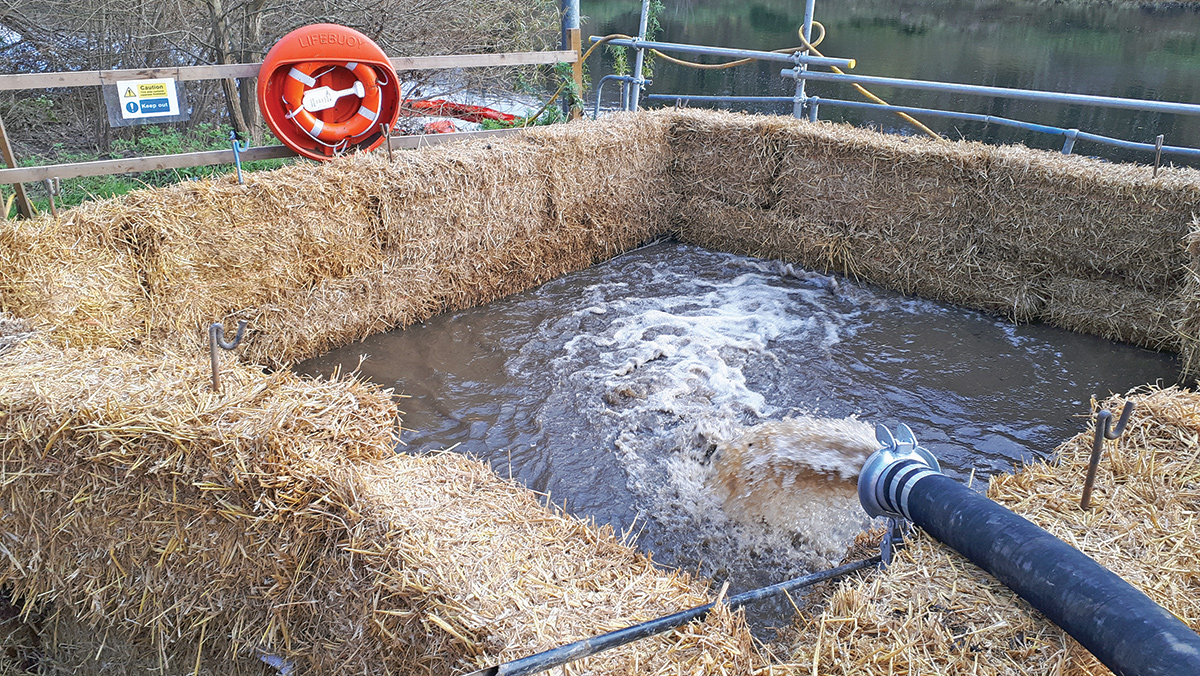
Silt is transferred from the wet wells or intake bay into a stilling pond. The material is held for at least 24 hours, giving eels time to migrate back to the river prior removal and disposal of the silt - Courtesy of MMB