
Hoylandswaine STW (2026)
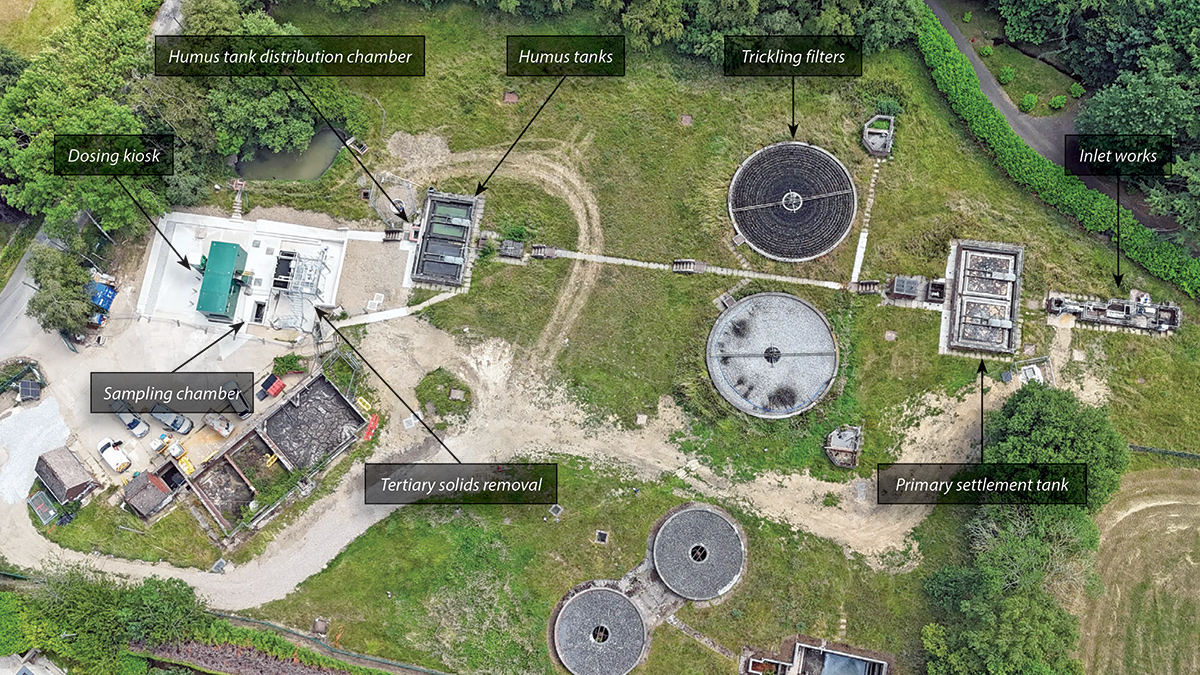
Hoylandswaine STW site layout - Courtesy of Enpure Ltd
Hoylandswaine is a picturesque rural village located near Barnsley in South Yorkshire, with a population of approximately 1,000 residents. Yorkshire Water has completed a comprehensive £7m environmental upgrade at the Hoylandswaine Sewage Treatment Works (STW) to substantially improve local river water quality. The WINEP scheme was required to reduce phosphorus concentrations in the final effluent to 0.4 mg/l (annual average) without exceeding a total iron concentration of 4 mg/l (95%ile) or 8 mg/l (upper tier). This driver originates from the new Water Framework Directive (WFD) consents being applied to the site by the Environment Agency.
Existing works
The existing works comprises of a screened inlet process along with an inlet flume with flows conveyed by gravity into dual primary settlement tanks. From there, flows pass into two trickling filters and subsequently into dual humus tanks, before continuing to a lagoon. The final effluent then passes through a sampling chamber prior to discharge to the watercourse.
The consented flow to full treatment (FFT) for Hoylandswaine STW remains unchanged at 8 l/s (691 m³/d). Flows in excess of three times dry weather flow (3 x DWF), overflow to the storm tanks via existing overflow weirs on the inlet channel.
One of the key challenges was the extremely constrained footprint. Space limitations were so significant that the welfare facilities had to located off-site during the construction phase. This constraint also drove the increased use of off-site manufacture and Design for Manufacture and Assembly (DfMA), which in turn reduced on-site construction time and lowered health and safety risks.
Tightened permits
The purpose of this project was to reduce the phosphorus concentrations in the final effluent without exceeding a total iron concentration.
The new requirements were as follows:
| Parameter | Current Value | Future Value |
| BOD (95%ile) | 45 mg/l | 45 mg/l |
| Suspended solids (95%ile) | 65 mg/l | 65 mg/l |
| Total P (annual average) | N/A | 0.4 mg/l |
| Iron (95%ile) | N/A | 4 mg/l |
| Iron (upper tier) | N/A | 8 mg/l |
Hoylandswaine WwTW: Supply chain – key participants
The successful delivery of the project required strong collaboration between BE JV and their supply chain:
- Main designer & contractor: BE JV
- Civils: Barhale
- Process & M&E: Enpure Ltd
- Electrical installation: Circle Control & Design Systems Ltd
- Mechanical installation: Enpure Ltd
- MCC & switchgear: RSE Saftronics
- Screenings handling: Haigh Engineering
- MCERTS: SIRIS Environmental
- Chemical dosing: Chemdose
- Safety showers & eyebaths: Aqua Safety Showers International Ltd
- Hose reels: Arco Ltd
- Tertiary solids removal: Eliquo Hydrok Ltd
- Valves: Cotswold Valves Ltd
- Trace heating & lagging: Jade Insulation
- Static mixers: Statiflo International
- Turbidity monitors: Badger Meter Limited
- Level transmitters: Siemens
Scope of works
To meet the tightened permits, the following scope of work was necessary:
Inlet works
At the existing inlet works, a fine screen and duty-only screenings handling unit were installed. The screenings handling system was upgraded to a Series 591 ACE Screener® from Haigh Engineering.
SIRIS Environmental Ltd was engaged to verify the design of the inlet flow measurement. The existing inlet flume was assessed and confirmed to be MCERTS‑compliant. A new ultrasonic level monitor was installed to meet the UMON4 driver so as to achieve compliant measurement of flow to full treatment
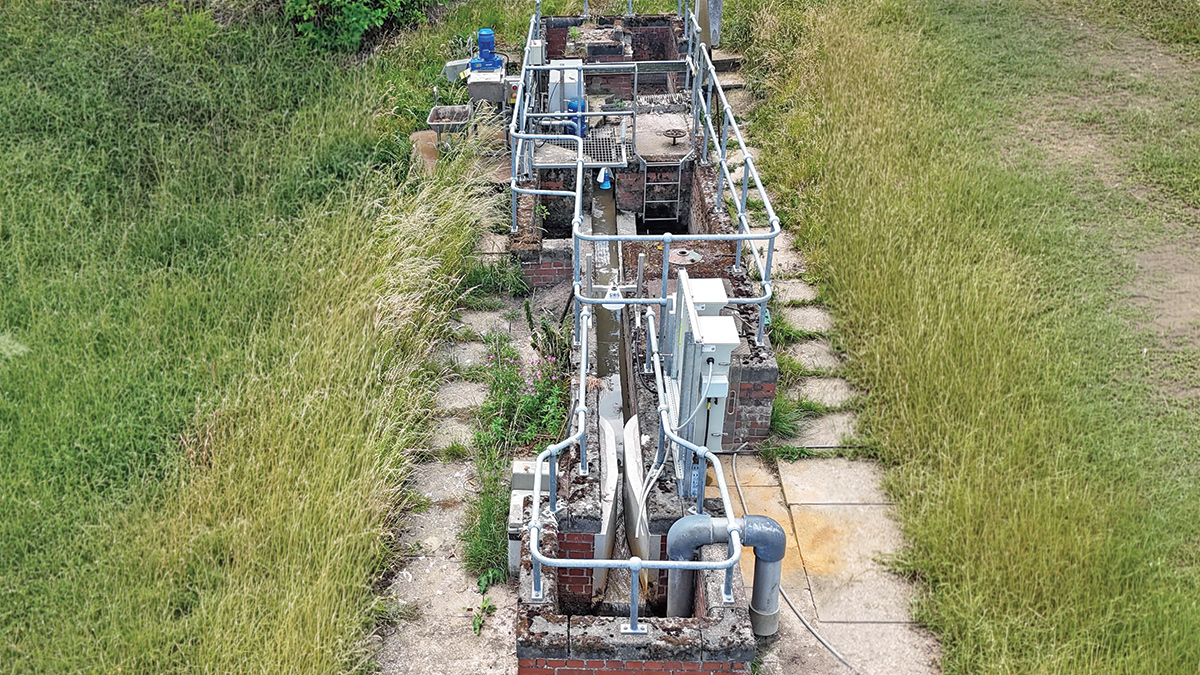
Inlet works – Courtesy of Enpure Ltd
Dosing
To comply with the new phosphorus discharge permit, primary and secondary stage coagulant dosing was required. This was provided in the form of a poly aluminium chloride (PACl) dosing kiosk, complete with internal storage and a service water booster pump.
Due to the nature of the chemical dosing system, a dedicated off-loading area was also required. This comprised a bunded delivery apron, an interlocked delivery chamber, and an emergency drench shower from Aqua Safety Showers International Ltd.
The new primary and secondary stage coagulant (PACl) storage and dosing system was initially designed for ferric sulphate dosing; however, on-site trials identified PACl as a more suitable solution to achieve the phosphorus discharge consent.
The site layout and chemical delivery bund area were designed to accommodate the future addition of a primary stage sodium hydroxide (caustic) storage and dosing system, allowing for future site growth. The chemical dosing and storage system from Chemdose Ltd, was manufactured and tested off-site and includes 14 days of chemical storage capacity.
The primary stage dosing system was designed to deliver coagulant directly into the first compartment of the inlet works outlet chamber downstream of the inlet flume via a dosing tray. It was noted that no stable standing wave exists at low flows downstream of the flume, resulting in insufficient natural mixing.
While the original design proposed air mixing to provide the required mixing energy, site observations confirmed that the turbulence generated by raw water entering the distribution chamber provided adequate mixing. This allowed the air mixing system to be designed out, removing the need to modify the inlet works final chamber and delivering both CAPEX and OPEX savings for the client.
The second stage chemical dosing location was trialled and optimised, with the most suitable position identified as the inlets to each of the existing humus tanks.
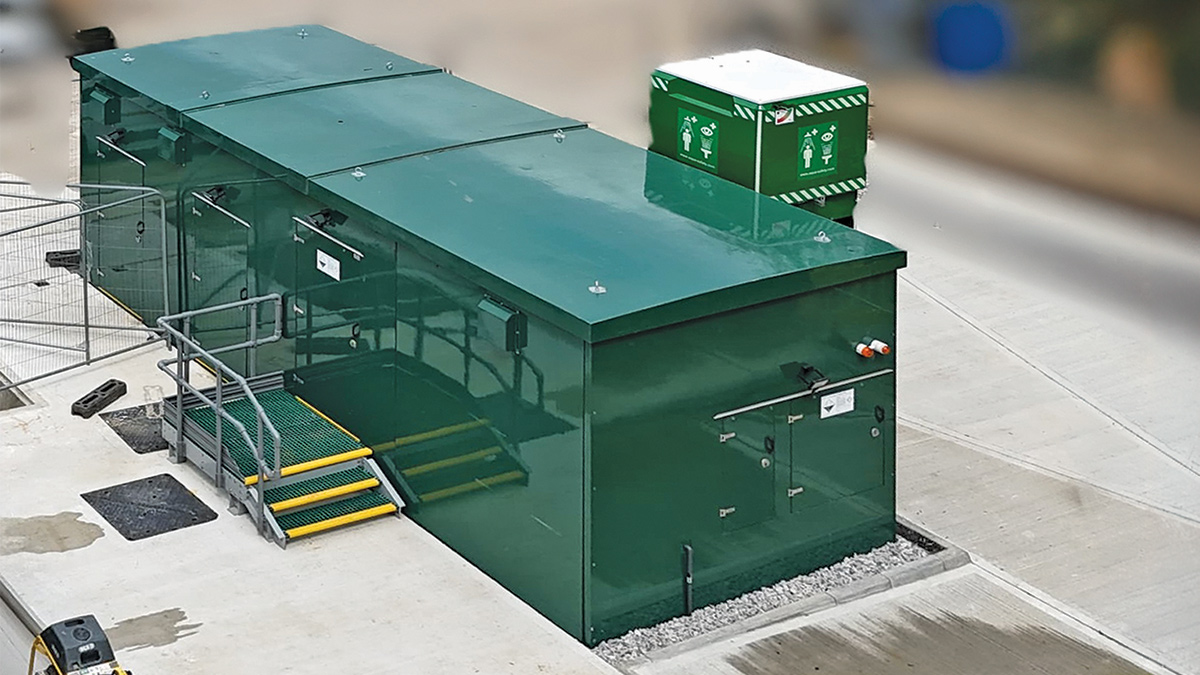
Ferric dosing kiosk – Courtesy of Enpure Ltd
Tertiary solids removal (TSR)
Tertiary solids removal represents the final, advanced stage of wastewater treatment, designed to remove any remaining suspended solids, nutrients, and microorganisms following secondary treatment. This process typically utilises physical filtration, such as cloth membrane technology, to achieve the high-quality effluent required for compliance with discharge standards.
At Hoylandswaine, a new tertiary solids removal disc filter was installed downstream of the existing humus tank distribution chamber, providing the final treatment stage for removing solids prior to discharge in line with the new phosphorus permit. A bypass pipe has been incorporated to allow for planned maintenance of the TSR unit.
BE JV engaged Eliquo Hydrok Ltd to supply a pile cloth filter tertiary solids removal unit, complete with an upstream coagulant flocculation tank. Eliquo Hydrok provided their SF6/30 unit, which comprises six rotating disc filters that are periodically cleaned, triggered by an increase in differential head, using filtered effluent.
Suction pumps draw filtered final effluent back through the rotating cloths, removing the build-up of solids on the influent side of the media. This process reduces head loss and allows filtration to continue efficiently. The resulting washwater is returned to the existing liquors return pumping station, from where it is conveyed back to the primary tanks for co-settlement and subsequent manual draw-off to the existing on-site sludge storage tanks.
Due to the site topography at Hoylandswaine, ground levels were reduced and retaining walls constructed to enable gravity flow to the TSR, eliminating the need for interstage pumping.
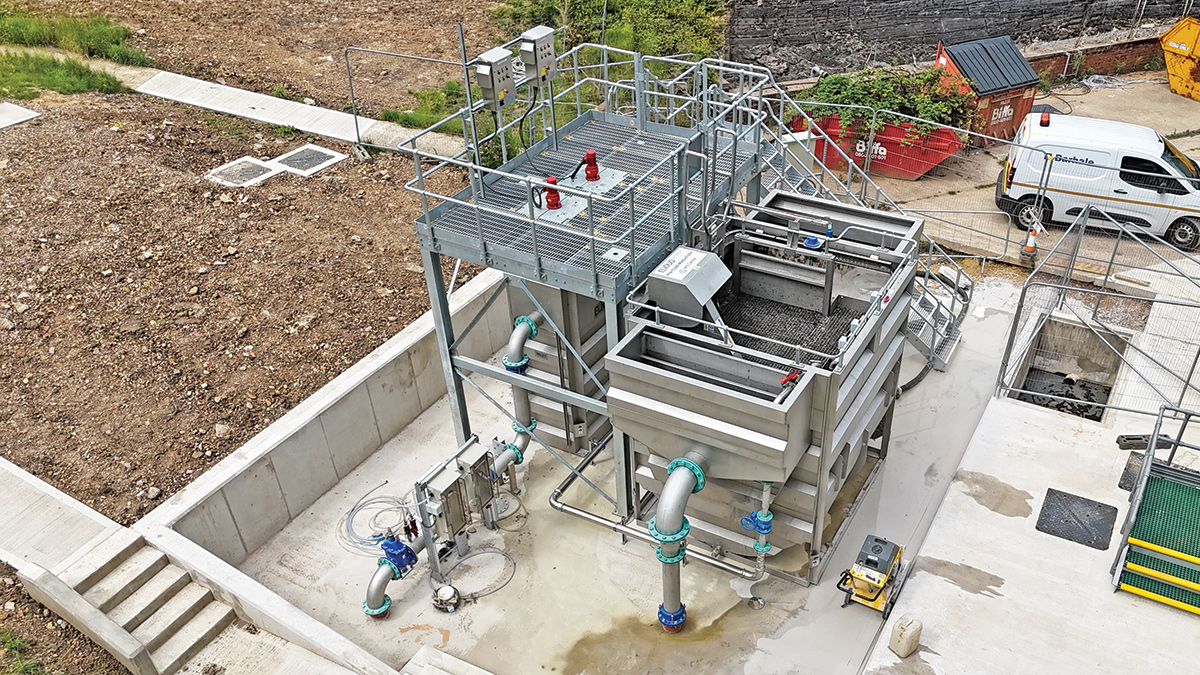
Eliquo Hydrok tertiary solids removal disc filter – Courtesy of Enpure Ltd
Final effluent dosing chamber
Flow from the TSR discharges by gravity into a new in situ reinforced concrete, below-ground final effluent sampling chamber. This chamber incorporates a steel baffle to create a stilling zone, enabling accurate measurement by the new outlet turbidity probe.
Power supply
Power availability at the site was limited and, following feasibility assessments for a supply upgrade, it was necessary to design a system that could operate within the constraints of the existing 400V / 60A supply.
A new Miniform-type switchboard was installed within a GRP kiosk, back-feeding the existing switchboard located in the control building. This arrangement distributes power to the new site assets while maintaining the existing works on the original switchboard, supplied from the existing LV board.
The new LV switchboard kiosk facilitates connection to a mobile generator, providing resilience in the event of a mains power failure.
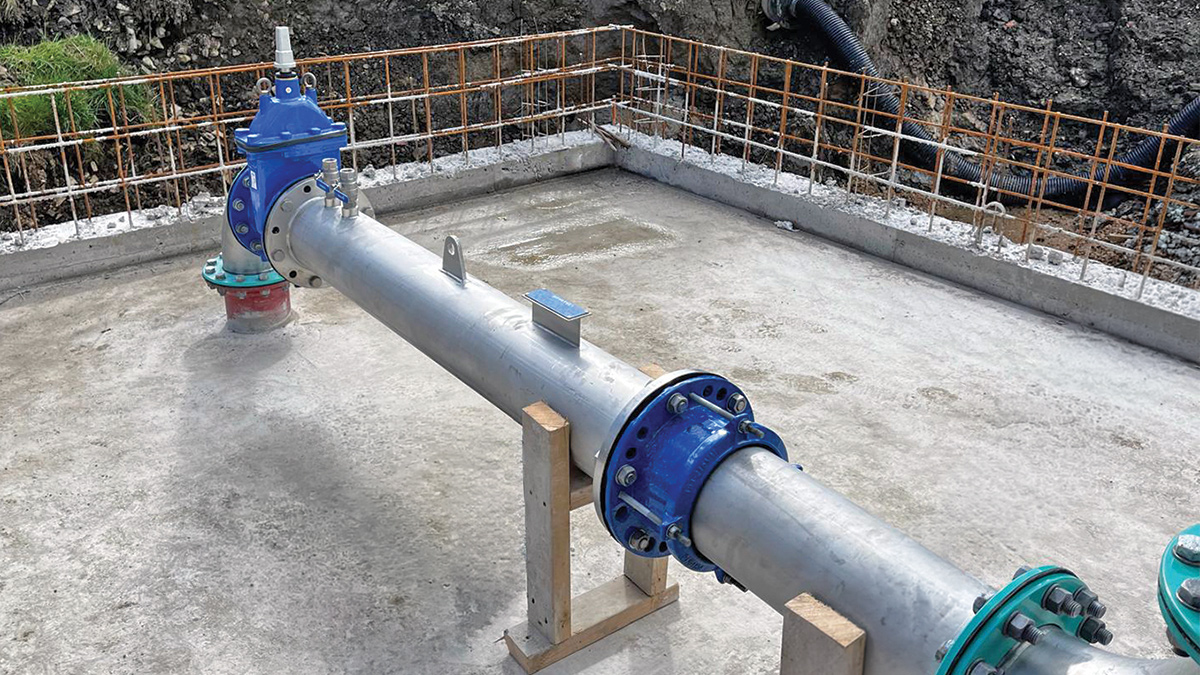
Statiflo static mixer and retaining walls – Courtesy of Enpure Ltd
Status
The upgraded works successfully met the compliance deadline, with all process-critical improvements completed by 31 March 2025. The full project is scheduled for completion in mid-2026.
The Hoylandswaine WwTW upgrade scheme has enhanced the site’s ability to treat incoming flows while stabilising throughput, significantly improving operational resilience within the local Yorkshire Water network for the benefit of future generations.