
Grand Union Canal Transfer (2026)
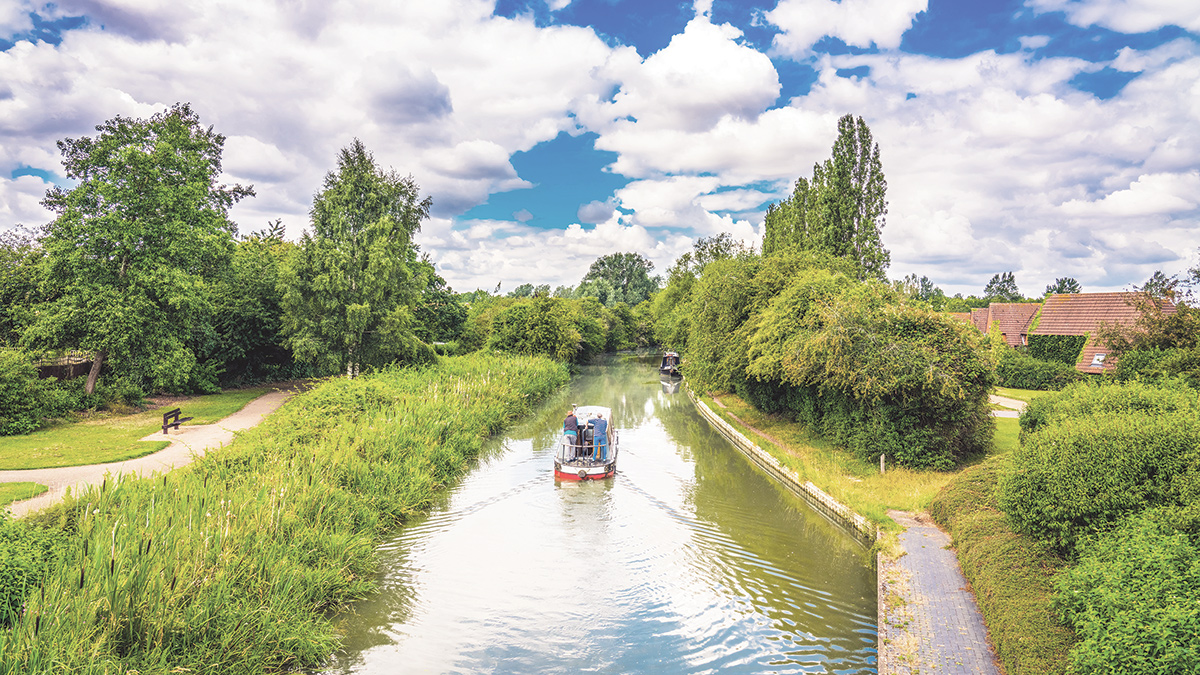
Grand Union Canal at Milton Keynes - Courtesy of the Grand Union Canal Transfer scheme library
Water resources across England are under increasing pressure from population growth, climate change and the need to protect environmentally sensitive watercourses. Current levels of abstraction are placing increasing pressure on rivers and internationally important chalk streams, particularly in the South East of England, where future water deficits are forecast to become more acute. The Grand Union Canal Transfer has been developed to address this challenge by providing a strategic, resilient and environmentally sustainable transfer of water from the Midlands to areas of forecast deficit within Affinity Water’s supply area.
Project background
UK water companies have committed to reaching a 1 in 500-year drought resilience standard by 2050. This means that the chance of severe water restrictions being needed should be less than 0.2% in any given year. For this to be achieved, additional sources of supply are needed, and numerous schemes have been identified in the water companies’ Water Resources Management Plans (WRMPs) to meet the demand. These include Strategic Resource Options (SRO) schemes – nationally significant water resource projects including new reservoirs, desalination, water recycling schemes and water transfer schemes which are identified as essential to securing long-term water supply.
The Grand Union Canal Transfer forms part of the national response to long-term water security challenges and is a Strategic Resource Option within the RAPID gated process and the Regional Water Resources Plans.
A key innovation of the scheme is the use of existing canal infrastructure rather than constructing a wholly new transfer corridor, significantly reducing environmental impacts while making productive use of a historic water asset.
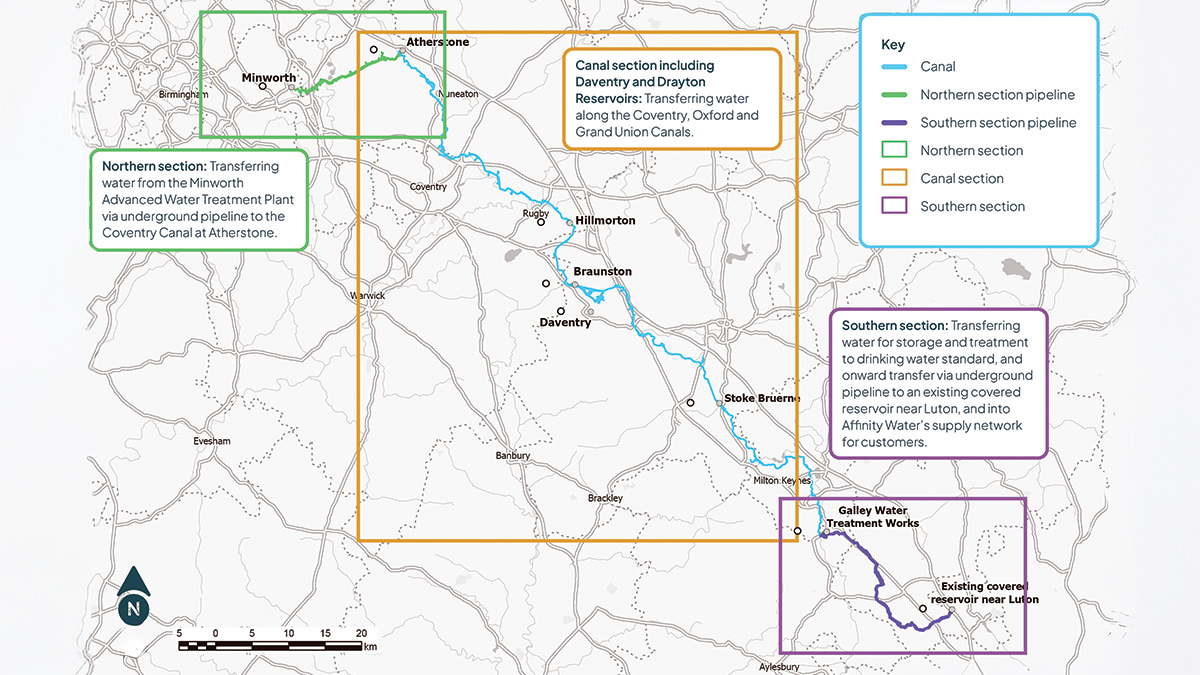
A map of the Grand Union Canal Transfer scheme split into three key sections – Courtesy of the Grand Union Canal Transfer scheme library
Overview
The Grand Union Canal Transfer is a nationally significant water resilience scheme being jointly developed by Affinity Water, Severn Trent, and Canal & River Trust (The Trust). The scheme will transfer up to 115 MLD of highly treated recycled water from the Midlands to the South East of England through a combination of new infrastructure and approximately 130km of existing canal network.
The proposed transfer begins at Severn Trent’s Minworth site near Birmingham, with water being conveyed by new pipelines to the Coventry Canal near Atherstone before travelling through the Coventry Canal, Oxford Canal and Grand Union Canal. Water will then be abstracted south of Milton Keynes, undergo final treatment and be transferred into Affinity Water’s supply network.
In total, the scheme will extend approximately 161km across multiple counties and ten local authority areas, making it one of the most complex water resource transfer schemes in the UK.
Northern section infrastructure
The northern section of the scheme centres on Severn Trent’s Minworth Wastewater Recycling Centre (WwRC), where the new Advanced Water Treatment Plant (AWTP) will be constructed to produce highly treated recycled water suitable for transfer. The treatment process will provide a robust multi-barrier approach to water quality, ensuring that transferred water meets the stringent standards required for environmental protection and subsequent potable water use.
Following treatment, new transfer infrastructure will convey water from Minworth to the Coventry Canal near Atherstone. This section of the scheme will involve new pipeline infrastructure, pumping facilities and associated operational assets, connecting the AWTP with the canal transfer system. The Minworth facilities represent the operational starting point of the strategic inter-regional transfer.
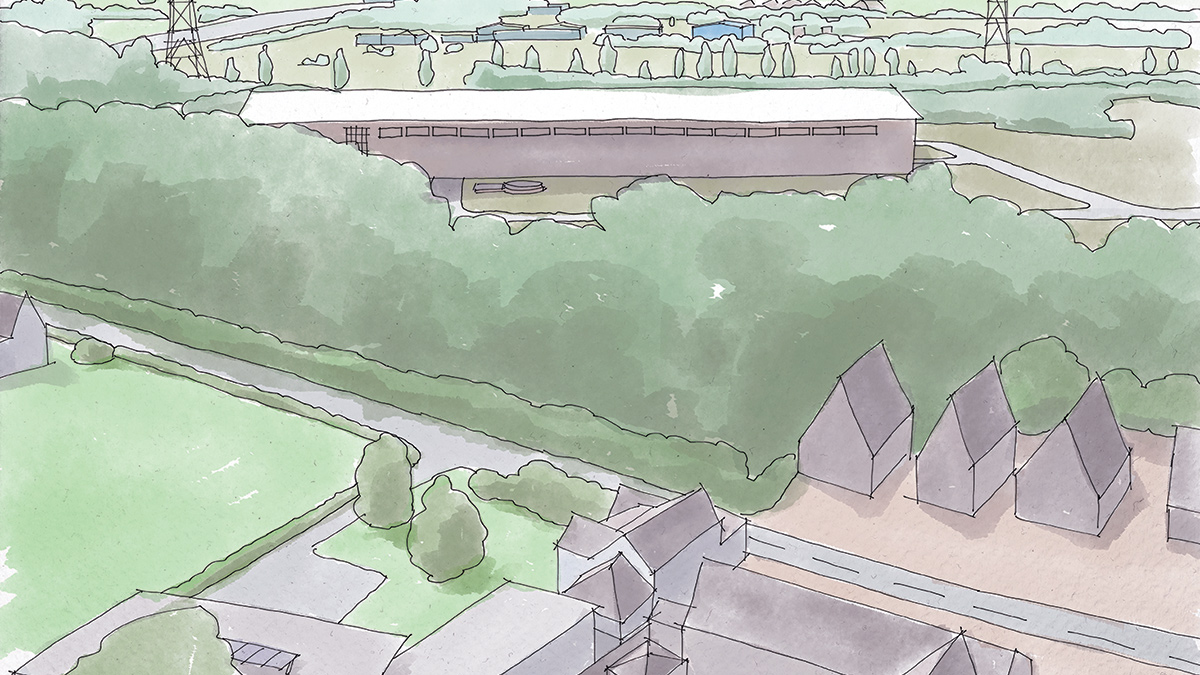
An aerial visualisation of the Minworth Advanced Water Treatment Plant – Courtesy of the Grand Union Canal Transfer scheme library
Canal corridor design & engineering
The defining characteristic of the scheme is the innovative use of the existing canal network as the primary transfer mechanism. Rather than constructing a continuous new pipeline, the scheme will use approximately 130km of the Coventry, Oxford and Grand Union Canals to move water between regions. This approach reduces the extent of new infrastructure required while maintaining the operational function of the canal network. Key engineering elements include:
- Controlled discharge infrastructure to introduce highly treated recycled water into the canal network.
- Canal management measures to maintain navigation and operational requirements.
- New pumping stations, weirs and transfer pipelines associated with canal operations.
- Infrastructure for water quality management/monitoring.
- Reservoir augmentation infrastructure linked to the Daventry and Drayton Reservoir system.
- Monitoring and management measures relating to invasive non-native species.
The scheme proposes the continued use of Daventry and Drayton Reservoirs to support canal operations and water transfer requirements. New pumping infrastructure north of Braunston Tunnel will maintain a semi-continuous transfer between the canal and the reservoirs, ensuring operational resilience during periods of increased demand.
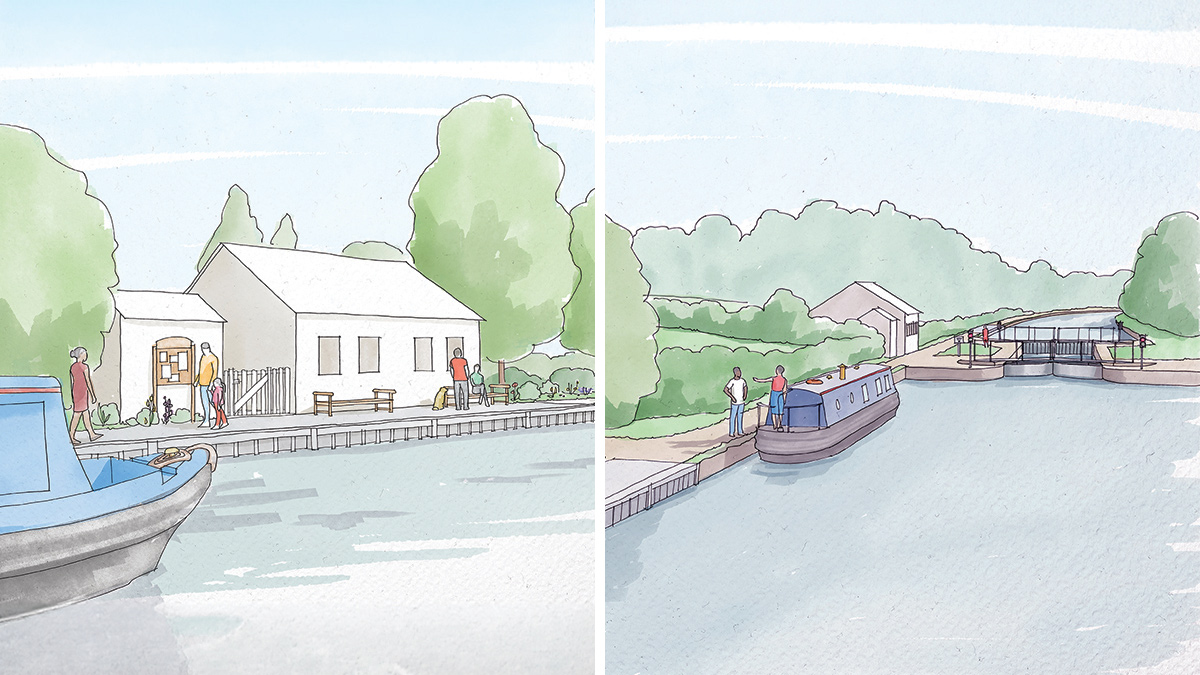
(left) A visualisation of a pumping station from the public consultation in Spring 2026 and (right) a visualisation of a transfer lock from the public consultation in Spring 2026 – Courtesy of the Grand Union Canal Transfer scheme library
Given the scheme’s length and complexity, digital design has been fundamental to its development. Mott MacDonald deployed its Moata Geospatial digital solution as a single source of truth for design, planning, environmental, and land/stakeholder information, enabling integrated decision-making across the scheme partners and multiple disciplines. This facilitated auditable design development and governance to secure two critical design milestones in 2025 and a further design freeze in 2026.
This innovative use of Moata Geospatial ensured that every design decision is informed, defensible and recorded. The approach positioned digital consenting at the heart of scheme delivery, advancing optioneering, design development and consultation through integrated geospatial mapping that balanced site and route selection with planning, land, environmental and constructability requirements.
Southern section infrastructure
At the canal section of the scheme, a new intake structure will enable controlled abstraction of water from the canal. The abstracted water will then be treated at Galley Water Treatment Works, a new treatment works at the southern end of the scheme, supported by associated storage infrastructure, before being conveyed via a new transfer pipeline into Affinity Water’s existing distribution network. This infrastructure forms the final stage of the transfer system, converting the strategic resource transfer into a secure potable water supply capable of supporting long-term regional demand.
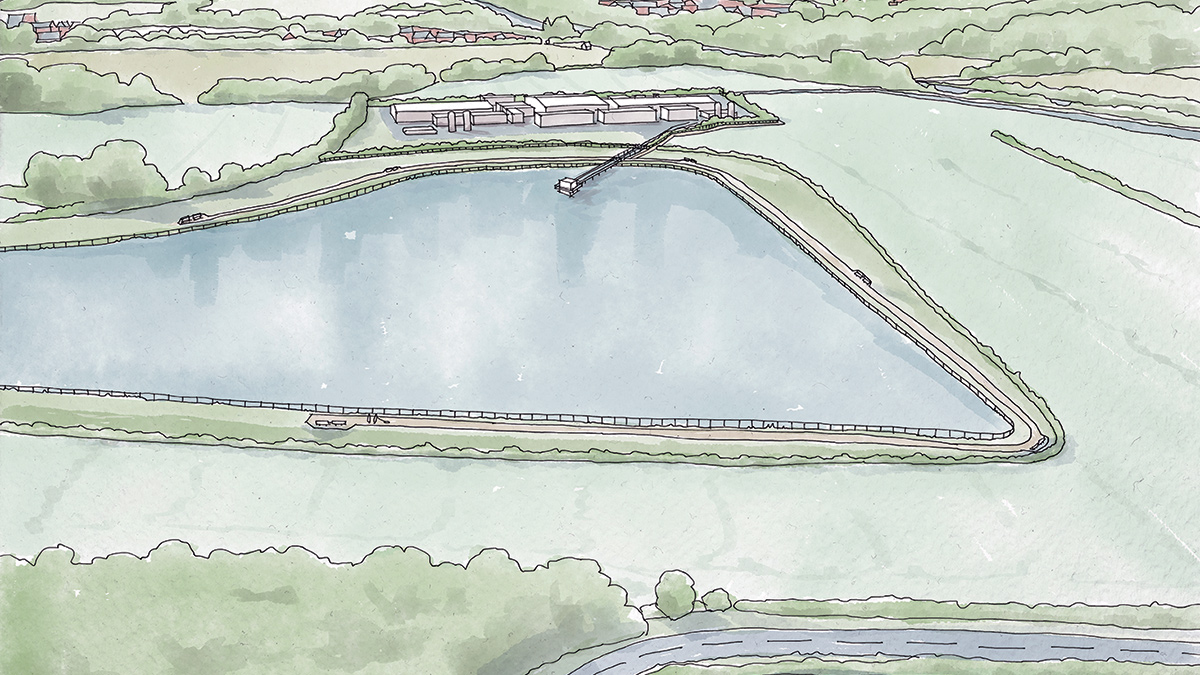
A visualisation of Galley WTW water storage site from the Spring 2026 public consultation – Courtesy of the Grand Union Canal Transfer scheme library
Scheme partners
The Grand Union Canal Transfer is a joint water scheme between two water companies, Severn Trent and Affinity Water and the Canal & River Trust (the Trust). The partnership is crucial to securing this sustainable and reliable water supply.
Severn Trent is one of the largest regulated water and sewerage companies in the UK, providing water and wastewater services to more than 4.5 million homes and businesses in the Midlands, from the outskirts of Bristol to the southern suburbs of Sheffield.
Affinity Water is the UK’s largest water-only supply company supplying 950 million litres per day to more than 3.8 million people in parts of Bedfordshire, Berkshire, Buckinghamshire, Essex, Hertfordshire, Surrey, the London Boroughs of Harrow and Hillingdon, and parts of the London Boroughs of Barnet, Brent, Ealing, and Enfield.
The Trust is the UK’s largest canal charity and the owner and navigation authority of canals in England and Wales responsible for a 2,000-mile network of historic canals and navigable rivers, attracting 800 million visits to the network and supporting 80,000+ waterway dependent jobs. Its canal network is largely used by boats and connects many of the UK’s urban and rural areas, providing essential spaces for wildlife and people. The Trust manages several existing water transfer schemes in the UK.

Planning & consenting
Development work began in 2019 to understand how the scheme would work and the infrastructure required to facilitate it. In 2024, the Secretary of State for the Environment, Food and Rural Affairs determined that the scheme is of national significance and directed it into the Development Consent Order (DCO) regime.
The process puts an emphasis on early engagement with communities and stakeholders, to allow for the opportunity to influence a scheme before a DCO application is submitted to the Planning Inspectorate. Affinity Water Ltd and Severn Trent Ltd must apply to the Secretary of State, through the Planning Inspectorate, for a DCO before the scheme can be built, operated and maintained. It is anticipated that the application for DCO consent will be submitted in Summer 2027.
Specialist consultancies involved with the planning and initial design include:
- Engineering design: Jacobs
- Engineering design: WSP
- DCO planning: Mott MacDonald/Adams Hendry
- Environmental Impact Assessment (EIA) & stakeholder engagement: AECOM
- Land advisory: Fisher German
Engineering & technical delivery
The scheme is being delivered through a fully integrated, multi-disciplinary engineering and consenting model that brings together water resource planning, process engineering, environmental assessment, land, stakeholder engagement and digital delivery.
Given the scale of the scheme, spanning approximately 161km and involving three partners, the engineering team has adopted a systems-based approach to develop the scheme as a single connected water transfer network rather than a series of individual assets. This approach enables the new Advanced Water Treatment Plant at Minworth WwRC, the canal transfer corridor, reservoir augmentation infrastructure, abstraction facilities and the new Galley WTW to be designed as interdependent components of one strategic water resource solution.
Engineering development has been supported through extensive optioneering, route and site assessment work, ensuring that environmental, planning, land, stakeholder and technical and operational considerations are integrated into decision making from an early stage.
The use of Mott MacDonald digital tools to coordinate the geographically dispersed project team and maintain a single source of truth across all disciplines enabled Affinity Water, Severn Trent, Canal & River Trust and the wider consultant team of over 70 specialists to access and interrogate planning, engineering, environmental, land and stakeholder information within a common digital environment.
This digital-first approach supports real-time collaboration, design development, risk management and programme coordination across the scheme’s ten local authority areas and multiple workstreams. The result is a more efficient and transparent engineering process that helps maintain alignment between the scheme’s technical, environmental and consenting objectives as it progresses towards Development Consent Order submission.
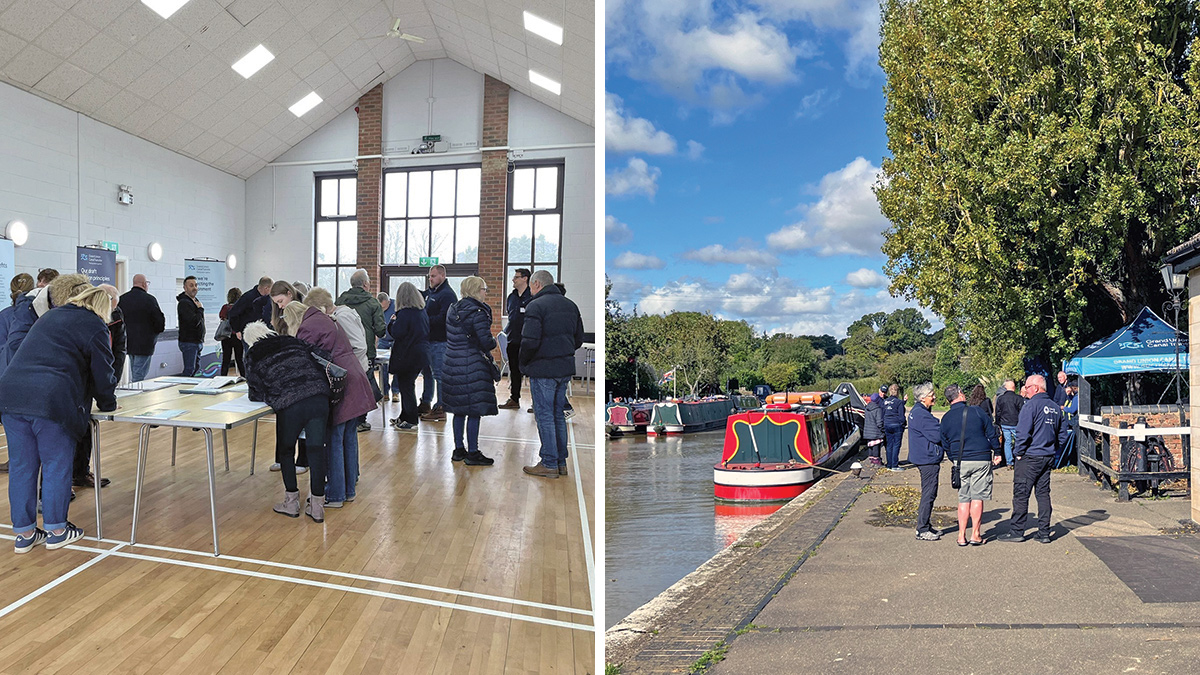
Public consultation events: (left) at Great Brickhill, March 2026 and (right) at Stoke Bruerne, Autumn 2024 – Courtesy of the Grand Union Canal Transfer scheme library
Lessons for future water infrastructure
A scheme of this scale cannot be developed through engineering design alone. It needs to bring together the practical, environmental, land, operational and community issues from the start.
For the Grand Union Canal Transfer, that meant creating a delivery model that gave the three partner organisations and the wider consultant team a shared view of the scheme as it developed. Route choices, facility locations, environmental constraints, land requirements and stakeholder feedback could be considered together, rather than passed between separate teams or reviewed too late to influence the design.
That matters on a DCO scheme, where early engagement is not just a requirement of the process it is one of the main ways a scheme becomes stronger, more deliverable and easier to explain. The public consultations in Autumn 2024 and Spring 2026 helped test the scheme with the people and places most likely to be affected. The issues raised were practical and important: visible benefits, environmental management, visual and operational impacts, access, construction effects and the level of detail needed to understand how the scheme would be built, operated and maintained.
This is where the digital consenting approach became most valuable. By holding design, environmental, planning, land and stakeholder information in one geospatial environment, the team could see how decisions connected across the full length of the scheme. A change in one location could be understood in relation to constraints, consultation feedback, constructability and the wider system. That helped create a clearer audit trail, supported more consistent decision-making, and gave the project team a stronger basis for explaining how the scheme has evolved.
The lesson for future water infrastructure schemes is simple. Digital consenting is not about just adding technology to a traditional planning process. It is about using evidence earlier, making trade-offs more visible and helping large teams make decisions they can stand behind.
As the water sector responds to climate change, population growth and increasing pressure on existing resources, schemes like the Grand Union Canal Transfer will become more important and they will become more complex.
Those projects that make progress will be the ones that treat consenting, design, environment, land and stakeholder engagement as connected parts of the same challenge, not separate stages to be managed in sequence.
That is the real value of the approach. It gives major infrastructure teams a better way to move from complexity to clarity, and from consultation to consent, while keeping the purpose of the scheme in view – a more resilient water future.
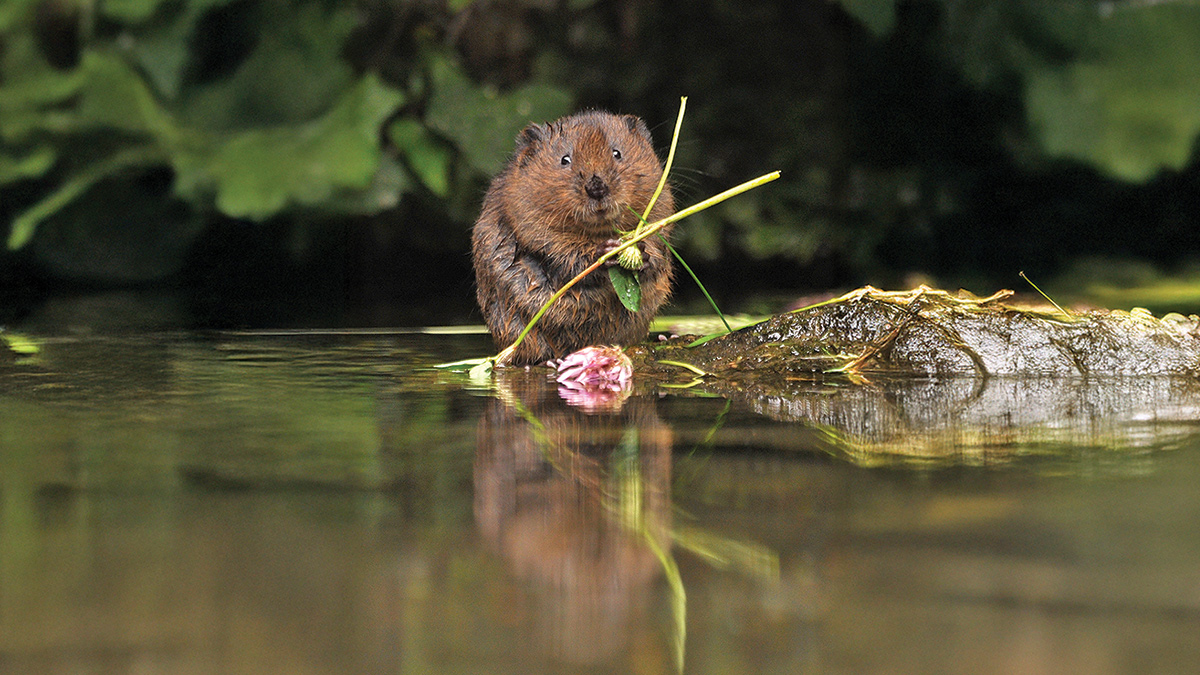
A water vole – Courtesy of the Grand Union Canal Transfer scheme library
Status
At the time of writing (August 2026) design is ongoing, and the scheme is in the pre-application stage of the Planning Act 2008 which governs the consent of nationally significant infrastructure projects.
A public consultation was held in Autumn 2024, and in March 2025, an Environmental Impact Assessment (EIA) Scoping Opinion was provided by the Planning Inspectorate. A second public consultation was held in Spring 2026 with the Development Consent Order application expected to be made to the government in Summer 2027.
Construction is anticipated to commence in 2029/2030 with the scheme being operational by 2033.