
Outstrays to Skeffling Managed Realignment Scheme (2026)
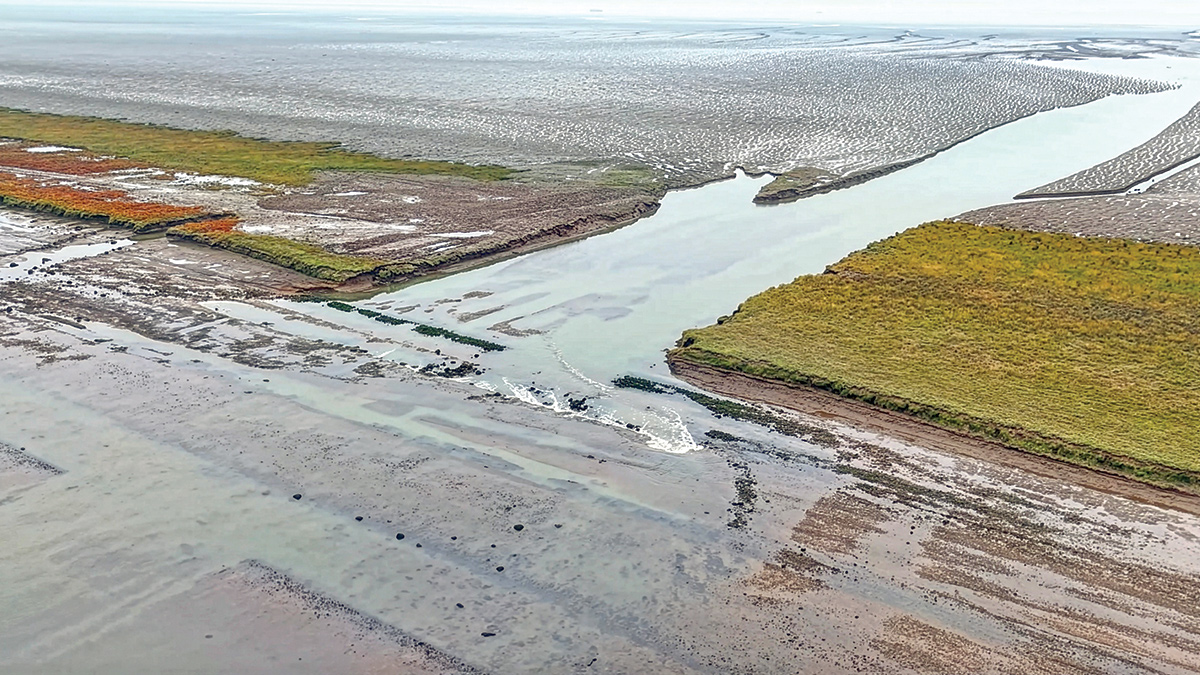
Breaching the existing embankment to enable controlled tidal ingress facing the Humber Estuary - Courtesy of JBA Bentley
The Outstrays to Skeffling Managed Realignment Scheme (OtSMRS) is a major coastal flood risk management and habitat creation project located on the north bank of the Humber Estuary, East Riding of Yorkshire. Developed by a joint initiative of the Environment Agency (EA) and Associated British Ports (ABP), the project is being delivered by JBA Bentley, and it forms part of the wider Humber Flood Risk Management Strategy. The project was developed to address several needs including compensating for intertidal habitat losses from coastal squeeze, new flood defences and future port developments, reducing the risk of flooding for properties and land around the villages of Patrington, Welwick, Weeton and Skeffling, and creating a more resilient land drainage system capable of responding to long-term climate change pressures.
Project background
As the managed realignment altered the lower catchment drainage regime, a planning condition stipulated that the total pumping capacity of the fluvial pumping station needed to be increased to maintain effective drainage performance. Hydraulic modelling showed that the existing asset could not provide the required standard of protection during a 1-in-100-year fluvial event with climate change allowances.
The scheme includes the construction of a new managed realigned coastal flood embankment, controlled breaching of existing defences, habitat creation and replacement of the existing Skeffling Pumping Station.
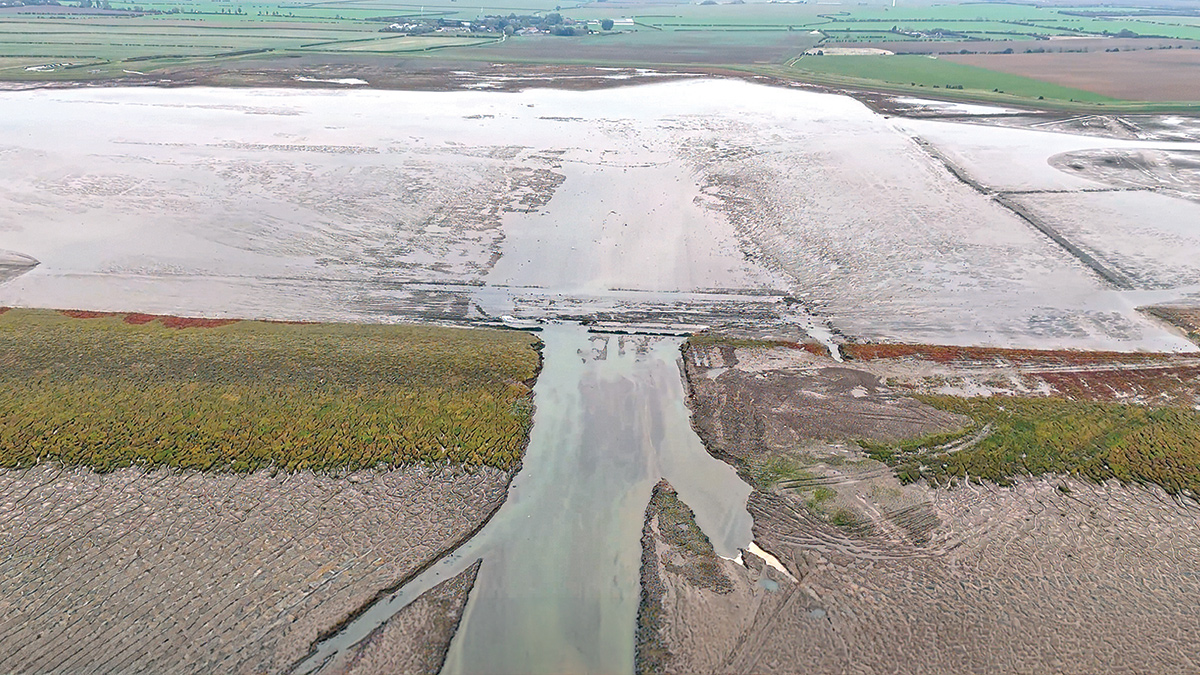
Breach facing the intertidal habitat and set back embankment – Courtesy of JBA Bentley
Client & stakeholders
The project is being delivered for the Environment Agency, working in partnership with Associated British Ports as the funding partner. Key stakeholders included the South Holderness Internal Drainage Board (IDB), East Riding of Yorkshire Council in its role as Lead Local Flood Authority, and Yorkshire Wildlife Trust, the Wildfowling Association, Natural England, the RSBP, Wildfowl and Wetlands Trust, and local naturalists for input on access and environmental considerations.
Climate-resilient flood defence & intertidal habitat creation
The Outstrays to Skeffling Managed Realignment Scheme fundamentally restructures the coastal defence line by constructing set-back embankments and allowing tidal inundation of previously defended agricultural land.
The intent of the design was to create 169 hectares of new intertidal habitat and 75 hectares of complementary freshwater habitat (wet grassland) on the north bank of the Humber Estuary.
The new flood defence comprises approximately 5.5km of earth embankment designed to provide improved protection against tidal flooding, incorporating allowances for climate change. This required over 2 million tonnes of site-won material to be excavated, transported and placed to form embankments, habitat features and drainage infrastructure. The use of indigenous materials eliminated the need for imported fill, reducing both cost and embodied carbon.
The embankment design incorporated climate change allowances, providing protection against a high fluvial 1-in-200-year storm event including 2080 climate change projections.
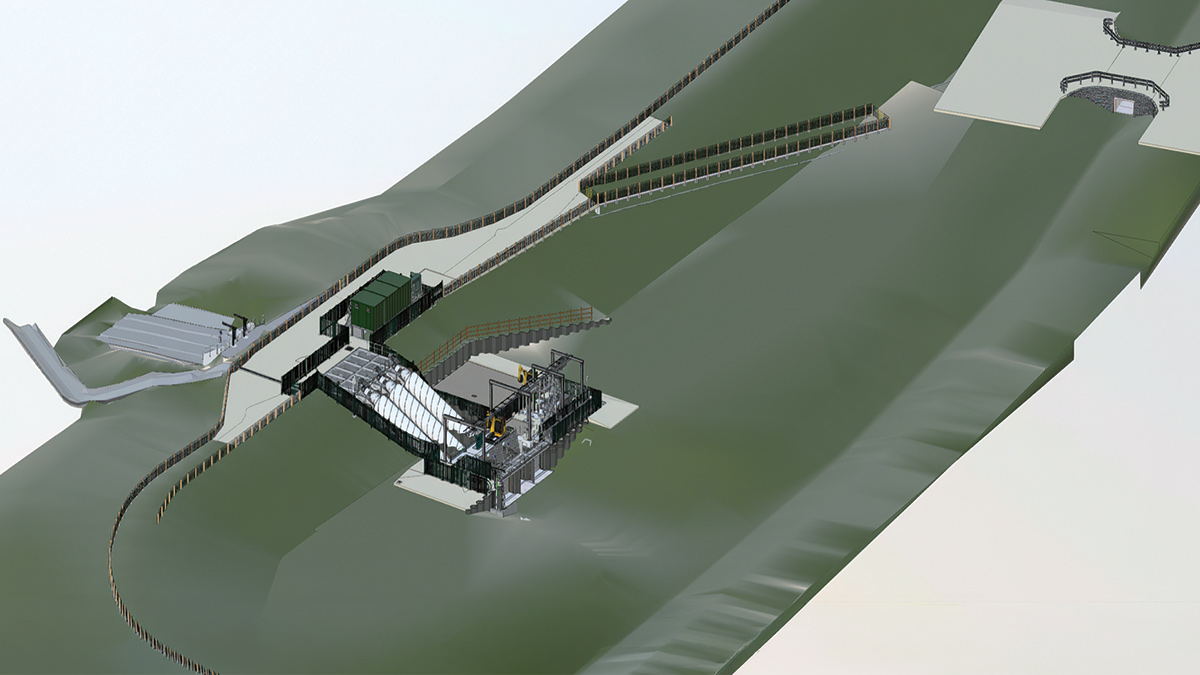
3D model used for design and communication throughout the project displaying access arrangement, the new Skeffling Pump Station, the eel pass and realigned embankment – Courtesy of JBA Bentley
Drainage & hydraulic infrastructure
The OtSMRS required a complete reconfiguration of the drainage and hydraulic network to accommodate both river flows and tidal influences following the creation of intertidal habitat. Approximately 4.1 km of open drainage channels were constructed to convey inland flows around the realigned landscape and maintain effective catchment drainage.
As a result of the revised drainage strategy, flows reach Skeffling Pumping Station (SPS) more rapidly than under the previous arrangement. Hydraulic modelling showed that the existing pumping capacity of 2.40m3/s would be insufficient to maintain flood protection standards under future climate change scenarios, requiring an increase to 2.85m3/s.
To address this, a new pumping station was constructed 250m west of the existing facility, where modelling demonstrated improved hydraulic performance and operational resilience. Located behind the new eastern embankment, the station is protected from tidal flooding and provides a robust long-term solution for managing catchment drainage and reducing flood risk.
Supply chain – key participants
- Principal designer & contractor: JBA-Bentley JV
- Designer: JBA Consulting
- Contractor: JN Bentley
- Hydrodynamic modelling: ABPmer
- Steel sheet piling & CHS bearing piles: Ivor King the Piling People
- Pumps & weedscreen (subcontractor): Aquatic Control Engineering (ACE)
- Weedscreen, cleaner & gantries (supplier): Landustrie
- Stoplogs & flap valve: Waterfront Fluid Controls
- Metalwork: APT Engineering
- MCC: RSE Control Systems (TCS)
- MCC kiosk & wiring: Southern & Redfern
- Systems integration: Actemium Automation
- Electrical subcontractor: Bradshaw’s Electrical Ltd
- OSA subcontractor: Hesselberg Erosion Protection
- Geotechnical testing & validation: Professional Soils Laboratories
- Ground investigation: Central Alliance Pre-Construction Services Ltd
- Ground investigation: Lankelma Ltd
- Archaeology: York Archaeology Trust
- Fencing: Burn Fencing Ltd
- Bird hides: Gilleards Brothers
- Landscaping: Lowthers Forestry Group
- Road surfacing: Til-Ex
Pumping station design & replacement
The installed solution comprises three Archimedes screw pumps, selected for their suitability in low-head, high-flow land drainage applications and their inherent compatibility with eel passage requirements. The pumping station discharges into the newly created intertidal habitat area, representing a significant change from conventional outfall configurations and requiring careful hydraulic integration with tidal conditions.
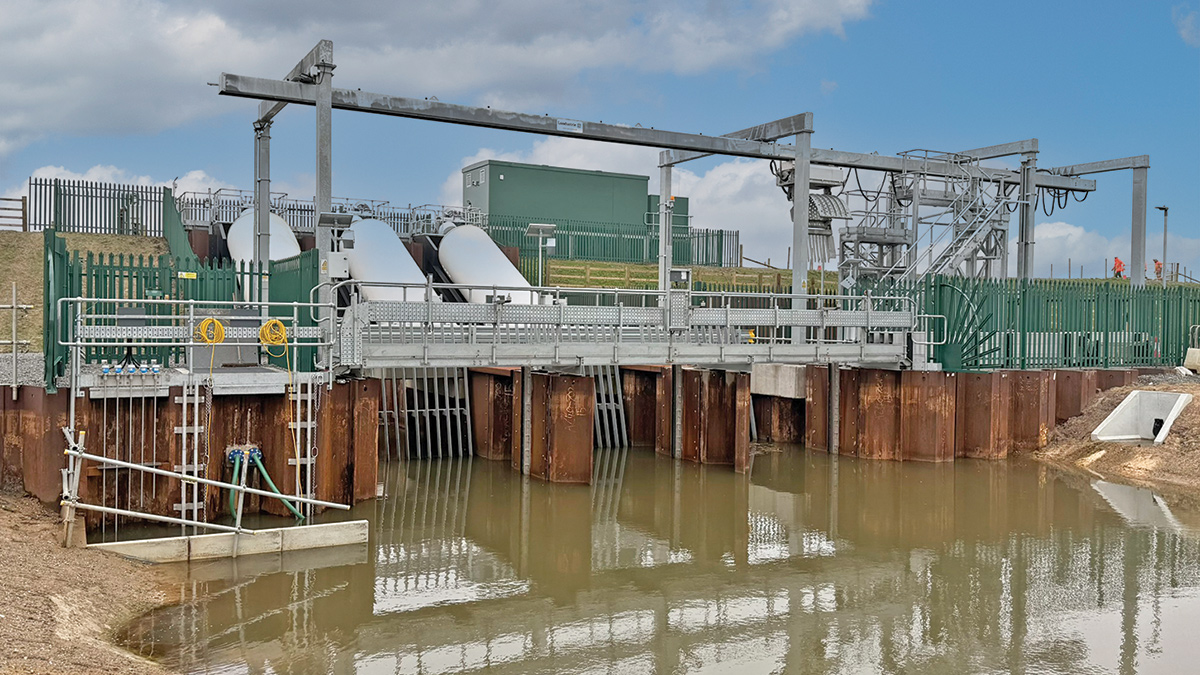
Skeffling Pumping Station view from inlet channel – Courtesy of JBA Bentley
Innovations, cost savings & carbon reduction
The scheme incorporates several practical innovations through eel-friendly Archimedes screw pumps, an open stone asphalt (OSA) eel pass, a site-won wave bund, virtual reality (VR) stakeholder engagement, and GPS-enabled digital earthworks.
Results included improved buildability, reduced carbon, supported ecological compliance and created repeatable solutions for future EA schemes.
Material reuse and carbon reduction
- The extensive use of site-won material for embankment construction reduced the need for imported fill.
- Sacrificial wave bund constructed from site-won material which avoided approximately 40,000t of rock armour saving approximately 23,000 tCO2e (90% less carbon than rock armour).
- Haul road materials were re-purposed through site-won materials with carbon saving of approximately 116.5 tCO2e.
Eel pass innovation
Suitable for erosion protection in tidal and river environments, with the capability to withstand flow velocities of up to 8.5m/s, the scheme incorporates a purpose-built eel pass integrated within the new embankment.
Constructed using open stone asphalt (OSA), the eel pass was selected for its permeability, flexibility and rough surface texture, which provide favourable conditions for eel migration while accommodating ground settlement and reducing hydrostatic uplift forces.
The design was developed to comply with the Eels (England and Wales) Regulations 2009, ensuring the safe upstream passage of eels between the Humber Estuary and inland watercourses while maintaining the resilience and performance of the wider flood defence infrastructure. The use of OSA for eel passage is the first of its kind in the UK, and possibly globally.
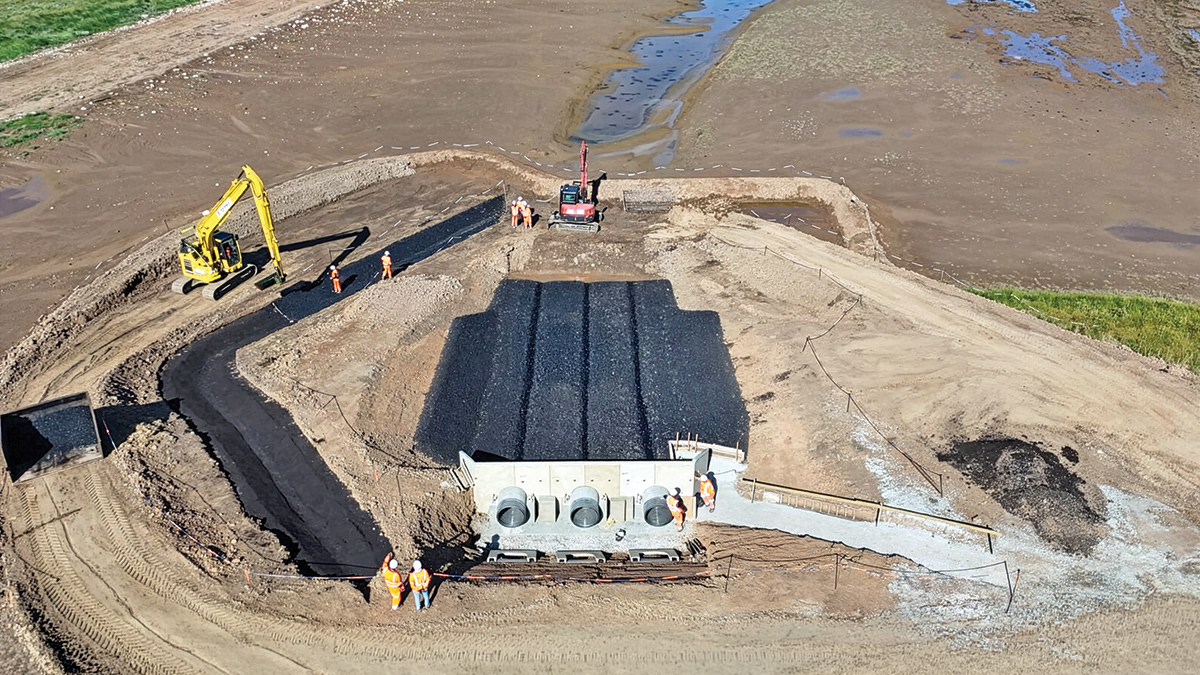
OSA formed eel pass integrated within the new embankment on the left – Courtesy of Hesselberg Erosion Protection
Digital delivery
Digital engineering played a significant role in scheme delivery. The collaborative 3D modelling platforms such as VR, 360° imagery, drone footage and coordinated 3D models to walk through the design, enabled the coordinated and multidisciplinary design team to resolve clashes and support construction sequencing and stakeholder engagement.
This digital approach improved quality control and provided a clear audit trail, particularly important for a scheme involving multiple interfaces between civils, geotechnical, hydraulic, structural and environmental disciplines.
Programme & cost performance
Integrated delivery, digital tools, early stakeholder engagement and material reuse improved buildability, reduced change and strengthened cost certainty. Re-purposed materials and alternative haul road methods saved approximately two weeks.
Early option appraisal and collaborative workshops with the Environment Agency, Natural England, the Internal Drainage Board and other stakeholders helped reduce risk, streamline approvals and manage ecological, seasonal and weather constraints.
Careful phasing, concurrent work fronts and close collaboration enabled the project to be delivered on time and below budget.
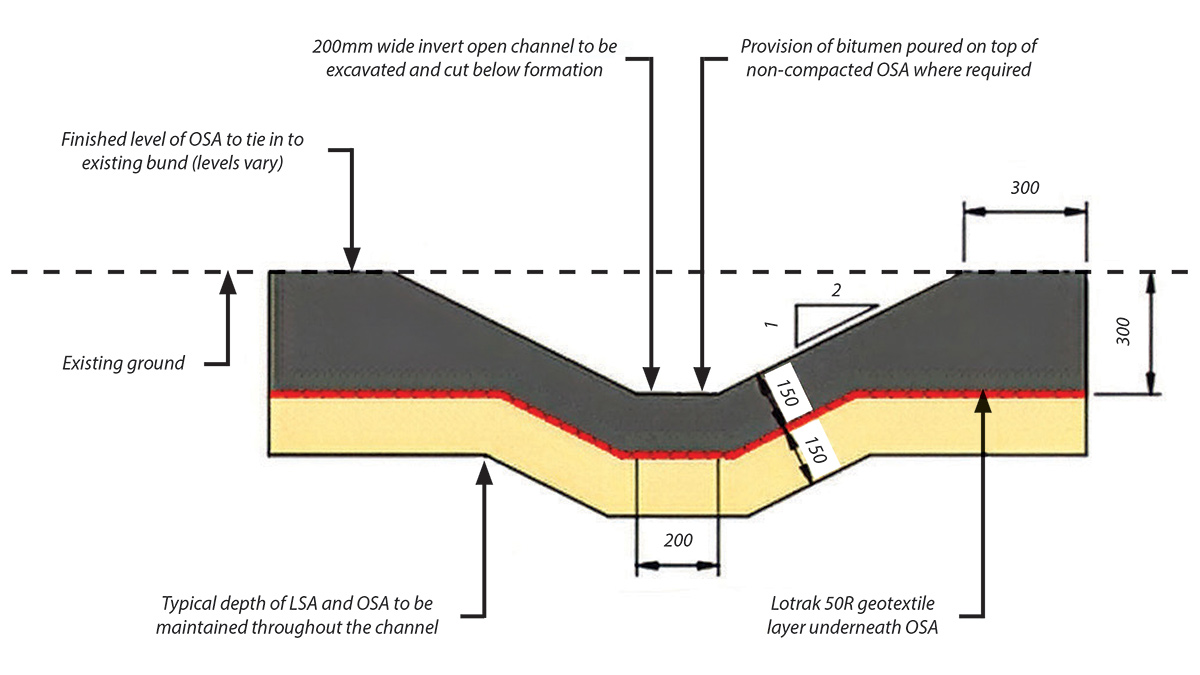
Typical OSA section for eel pass open channel – Courtesy of JBA Bentley
Social value
Social value is the wider value generated above and beyond the scope or requirements of a project. At Skeffling, there were no social value targets set at the beginning of the project. However, as the project evolved, the team ‘went the extra mile’ to ensure that social value was still delivered throughout the works.
This was achieved through close collaboration with landowners, farmers, statutory bodies and community stakeholders, helping to reduce disruption, use local knowledge and create a more resilient landscape for communities around the Humber Estuary.
Supporting local businesses
Prioritising local suppliers enabled investment in the local economy, with local farmers efficiently flailing 250ha of land and seeding 20ha of new embankment using their specialist knowledge of the area.
Supporting the environment
Collaboration with local environmental groups helped deliver biodiversity enhancements beyond the project’s original scope.
By trebling its original planting commitment of 4,901 replacement trees and shrubs (five new trees/shrubs for every one removed), the project delivered more than 14,200 trees and shrubs and 700m of new hedgerows. These measures have created a network of interconnected green corridors for wildlife and enhanced the ecological value of the site.
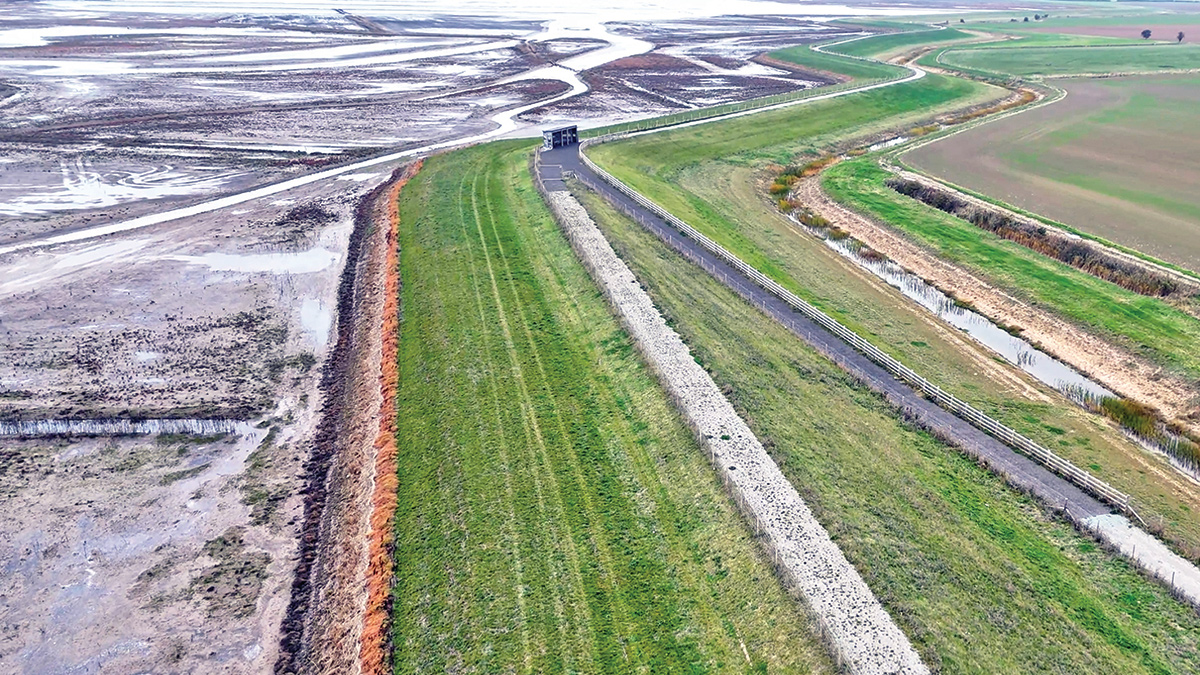
New set back tidal defence embankment and the intertidal habit area on the left – Courtesy of JBA Bentley
Promoting sustainability, educational outreach & supporting early careers
The scheme delivered lasting environmental and community benefits that aligned with long term sustainability goals where more efficient pumping stations have been installed and new embankments created, improving flood resilience, increasing drainage capacity and reducing operational carbon.
The project team supported Blue Carbon research through site sampling conducted by a PhD student. Alongside this, the EA and JBA Bentley dedicated over 100 hours to educational activities with local schools and college students, covering topics such as archaeology, coastal erosion and flooding. Students also helped design new bird hides, with features including sustainable oak sleepers and a cockleshell roof incorporated into the final design.
The project supported a range of apprenticeships and work placements, from engineers to quantity surveyors and general construction operatives. This generated over 15,000 hours of earn-and-learn opportunities.
Community engagement
Community engagement was vital throughout the scheme, from concept to delivery. Regular newsletters kept stakeholders informed on design and construction progress, while local drop-ins and surgeries provided opportunities to ask questions, share feedback and raise concerns. Stakeholder input helped shape the design wherever possible.
During construction, site visits for parish councillors, environmental groups and students, together with drone footage showcased at drop-ins, maintained engagement despite restricted site access.
Local-led design
During the design phase, feedback from residents and local organisations led to the main path being relocated to the embankment crest, improving estuary views. In response to requests from horse riders, the route was also designated as a bridleway. Continued engagement helped shape accessibility improvements, including horse rider-friendly gates, Access for All features and locally informed signage.
Archaeology as an engagement tool
As the project progressed, a strong interest from the local community was noticed in the archaeological investigations. As a result, the project team displayed finds at several drop-ins, allowing people to see and handle them. At the request of community members, the project team created a public exhibition at a local museum, telling the story of settlement in South Holderness and produced a booklet on the history of the area for visitors to take away.
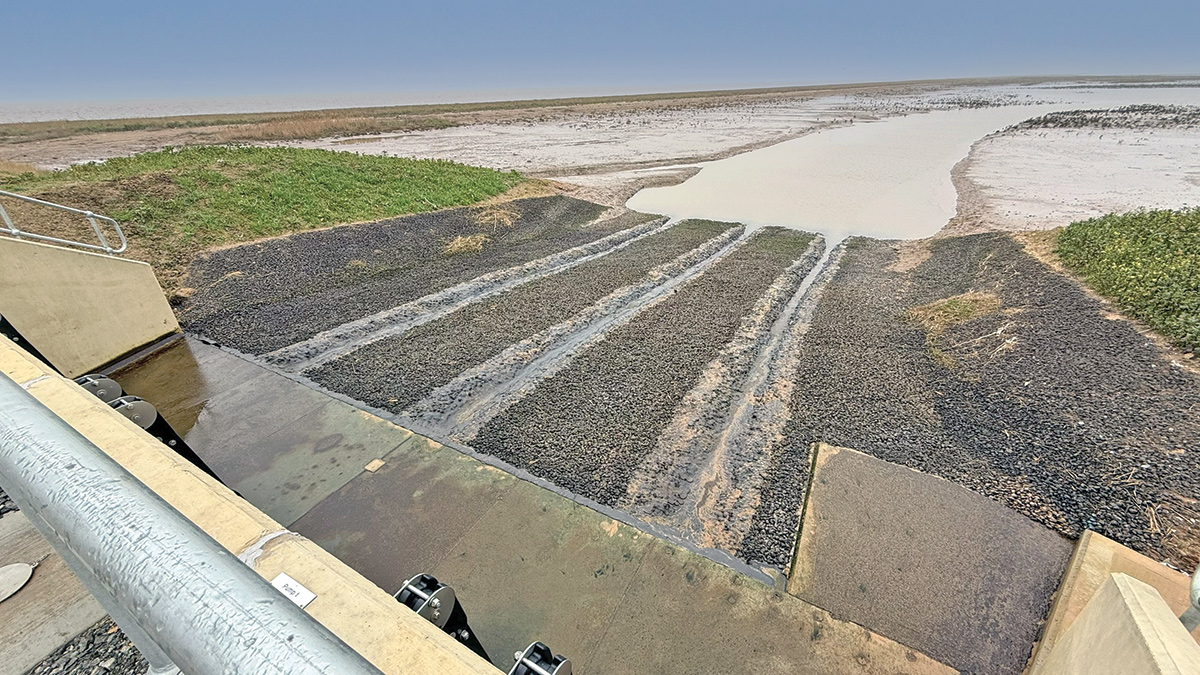
Open stone asphalt (OSA) implemented on discharge channel replacing conventional hard-engineered materials – Courtesy of JBA Bentley
Conclusion
The Outstrays to Skeffling Managed Realignment Scheme is a major piece of coastal infrastructure, delivering flood risk reduction, enhanced land drainage, habitat creation and wider community benefits. The scheme demonstrates how traditional engineering can be adapted to meet modern sustainability and environmental objectives, while providing long-term public value through improved climate resilience, new intertidal habitat and lessons that can be applied to future coastal and water infrastructure projects.
Key achievements include:
- Large-scale habitat creation exceeding original targets.
- Delivery of resilient flood defences incorporating climate change allowances.
- Innovative solutions such as the Open Stone Asphalt (OSA) eel pass and site-won sacrificial wave bund.
- Measurable reductions in cost, carbon and imported materials through the extensive reuse of site-won resources.
- Transformation of formal social value targets into a wide-ranging legacy of community, environmental and economic benefits across the Humber Estuary.
Construction has been completed in phases, with pumping station works completed in 2025 and final scheme completion expected in 2026. Despite significant ecological constraints, seasonal working restrictions and challenging weather conditions, the project was delivered on time and below budget through collaborative planning, digital delivery and efficient construction methods.