Preston & Chaul End Reservoirs (2026...
Affinity Water’s ‘Water Resources Management Plan’ identified a potential supply shortfall of up to 449 million litres per day by 2050 without intervention. Increasing storage capacity and enhancing interconnectivity between supply zones are therefore critical to maintaining a reliable and sustainable water supply. OCU Group is leading the design and delivery of a programme of potable water storage infrastructure across Bedfordshire and Hertfordshire through Affinity Water’s Water Retaining Structures (WRS) Framework. The programme forms part of Affinity Water’s strategic supply initiative, Connect 2050, which aims to address long-term supply-demand challenges and improve operational resilience across the network.
Design & delivery approach
Under the Water Retaining Structures Framework, OCU Group is delivering multiple service reservoirs, including schemes at Preston and Chaul End in Luton. These projects are designed to increase storage capacity, improve operational flexibility and support future strategic water transfers.
The WRS Framework is being delivered through an integrated design and build model, combining in-house engineering capability with specialist design partners and a coordinated supply chain.
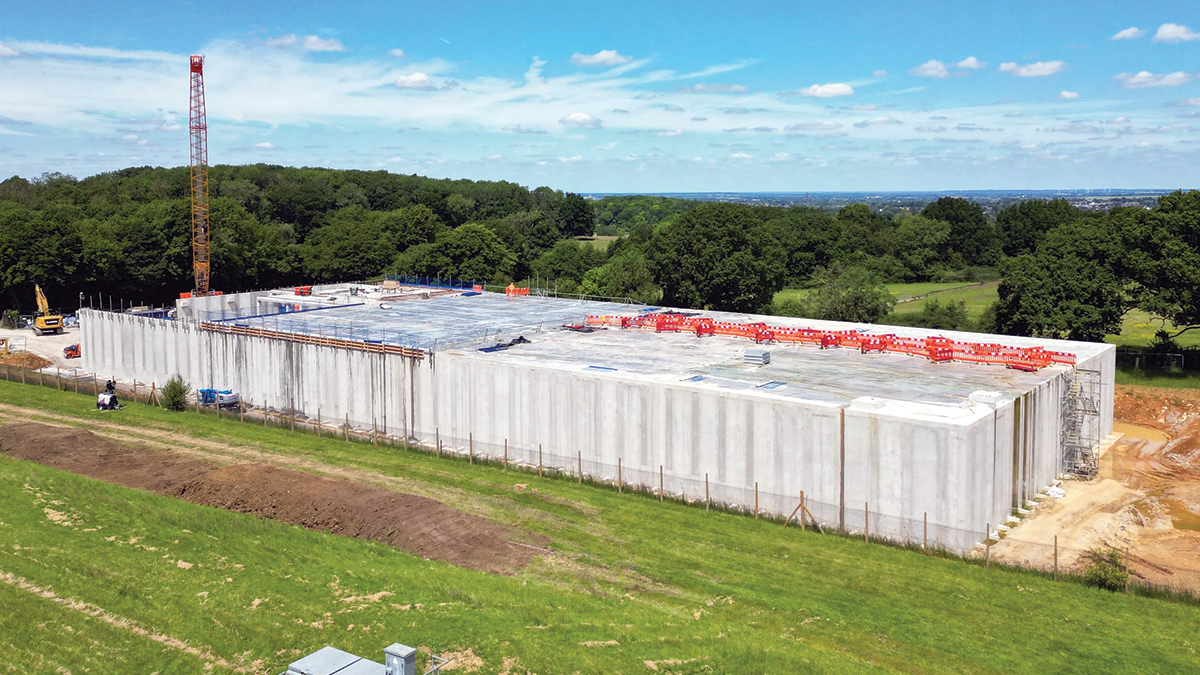
[caption id="attachment_29998" align="alignnone" width="1200"] Chaul End Reservoir under construction - Courtesy of OCU Group[/caption]
Optioneering across the programme considered traditional in situ reinforced concrete construction and off-site manufacturing approaches. A semi-precast solution was selected to improve programme certainty, reduce on-site risk within constrained sites and deliver significant reductions in embodied carbon.
An early contractor and supplier engagement approach was implemented to align structural design with off-site manufacturing capabilities. This enabled key decisions regarding construction methodology, sequencing and material selection to be made at an early stage.
Early engagement with FLI Precast Solutions enabled OCU Group to align structural design with off-site manufacturing principles. This ensured reservoir structures were optimised for precast construction, improving constructability and reducing interface risks between structural and mechanical elements. OCU provided overall design coordination, construction delivery, and mechanical and electrical integration across the schemes.
This approach has enabled OCU Group to standardise key elements of design and delivery across multiple sites, improving efficiency, reducing risk and enabling a repeatable delivery model for future schemes.
[caption id="attachment_30180" align="alignnone" width="1200"] Chaul End Reservoir concrete pour - Courtesy of OCU Group[/caption]
Preston Service Reservoir: Structural solution & construction
The focus of this case study is Preston Service Reservoir which is a representative example of the design and construction approach adopted across the framework.
The Preston Service Reservoir comprises a single cell potable water storage structure with a total capacity of 20 megalitres (ML), constructed adjacent to the existing reservoir. Once operational, the combined assets provide approximately 38 ML of storage capacity.
The structure was formed using a reinforced concrete raft foundation combined with a semi-precast superstructure. Precast wall panels, columns and roof planks were manufactured off site and installed sequentially.
OCU Group selected precast construction in response to site constraints and programme requirements. Compared with traditional in situ construction, the approach reduced on-site activities including formwork, reinforcement installation and concrete pours, improving safety and reducing construction duration. It also enables concrete quality control to be carried out within a factory quality-controlled environment where the weather is not an issue.
Precast elements were delivered and installed sequentially upon arrival, minimising on-site storage requirements and improving efficiency within the constrained site footprint.
Off-site manufacturing also enhanced quality control, with structural components produced in a controlled environment, improving consistency and long-term performance.
[caption id="attachment_29999" align="alignnone" width="1200"] Chaul End Reservoir concrete pour - Courtesy of OCU Group[/caption]
Digital engineering & coordination
OCU Group applied Building Information Modelling (BIM) across the framework to support design coordination and construction delivery.
At Preston, a detailed 3D model integrated structural, mechanical and process elements, enabling accurate coordination of pipework, valves and interfaces. This reduced delivery clashes during construction and improved installation efficiency.
The model also enabled assessment of operational requirements, including access, maintenance and asset management considerations. Stakeholders were able to visualise the completed facility and make informed decisions during the design stage.
The completed BIM model provides a comprehensive digital record of the asset, including manufacturing and installation data, supporting long-term maintenance and future upgrades.
Water Retaining Structures Framework: Supply chain: key participants
Client: Affinity Water
Project delivery: OCU Group
Design: GHD
Precast structures: FLI Precast Solutions
Formwork & Reinforced Concrete: Bell Formwork & Civil Engineering Services Ltd
MEICA: LJR Engineering Project Services Ltd
[caption id="attachment_30000" align="alignnone" width="1200"] Preston Reservoir concrete pour - Courtesy of OCU Group[/caption]
Construction & earthworks
The reservoir was constructed on a reinforced concrete raft foundation designed to distribute loads across underlying clay and chalk strata. Geotechnical investigations confirmed consistent ground conditions, allowing for a uniform foundation design. Any localised weak material encountered during construction was excavated and replaced with compacted structural fill to ensure stability.
A key feature of the construction approach was the retention and reuse of excavated materials. Topsoil and subsoil were stored and reused on site for backfilling and landscaping, maintaining a zero net cut-and-fill balance.
OCU Group’s approach reduced vehicle movements, minimised environmental impact and improved site safety. It also enhanced programme resilience by reducing reliance on imported materials and maintaining continuity during adverse weather conditions.
Topographic surveys were undertaken throughout construction to verify earthworks volumes and confirm compliance with design requirements.
Carbon reduction and sustainability
At Preston, a carbon assessment undertaken in accordance with ISO 14064 standards identified total construction emissions of approximately 1,062 tonnes of CO2 equivalent.
A primary reduction measure was the use of precast concrete incorporating ground granulated blast furnace slag (GGBS) as a partial replacement for Portland cement. Approximately 50% of the cement content was replaced, with higher substitution levels achieved under favourable conditions.
[caption id="attachment_29995" align="alignnone" width="1200"] Courtesy of OCU Group[/caption]
This resulted in an estimated saving of 138 tonnes of CO2 compared with conventional concrete mixes. Additional reductions were achieved through the use of recycled aggregates, reducing reliance on virgin materials and supporting circular economy principles.
The semi-precast approach also reduced the volume of reinforced concrete required and limited on-site activities, contributing to an estimated 50% reduction in embodied carbon compared with in situ construction.
Application across the framework: Chaul End Reservoir
The Chaul End Service Reservoir in Luton has been delivered using the same design and construction principles established at Preston.
The scheme provides additional potable water storage and adopts a semi-precast structural solution, incorporating off-site manufactured components, a reinforced concrete base and integrated valve arrangements.
The same coordinated, off-site-led approach was applied, enabling efficient delivery within site constraints and maintaining programme certainty.
The application of a standardised delivery approach across both Preston and Chaul End has enabled OCU Group to refine its methodology, improving efficiency, reducing risk and enhancing sustainability performance across the framework.
[caption id="attachment_29997" align="alignnone" width="1200"] Inside the new Preston Reservoir - Courtesy of OCU Group[/caption]
Outcomes & performance
Through the delivery of the Water Retaining Structures Framework (Bedfordshire and Hertfordshire), OCU Group has enabled significant new potable water storage capacity across multiple sites. The strong collaborative working relationship established between Affinity Water and OCU has been essential to this.
At Preston, 20 ML of additional storage capacity has been delivered, increasing total site capacity to approximately 38 ML and improving supply resilience for the surrounding network.
Across the framework, the adoption of a standardised precast construction methodology has delivered improved programme certainty, reduced embodied carbon and enhanced safety.
The repeatable delivery model established through schemes such as the Preston and Chaul End Reservoirs provides a scalable approach for future reservoir projects, supporting ongoing investment in water infrastructure and strengthening long-term resilience across Affinity Water’s network.